
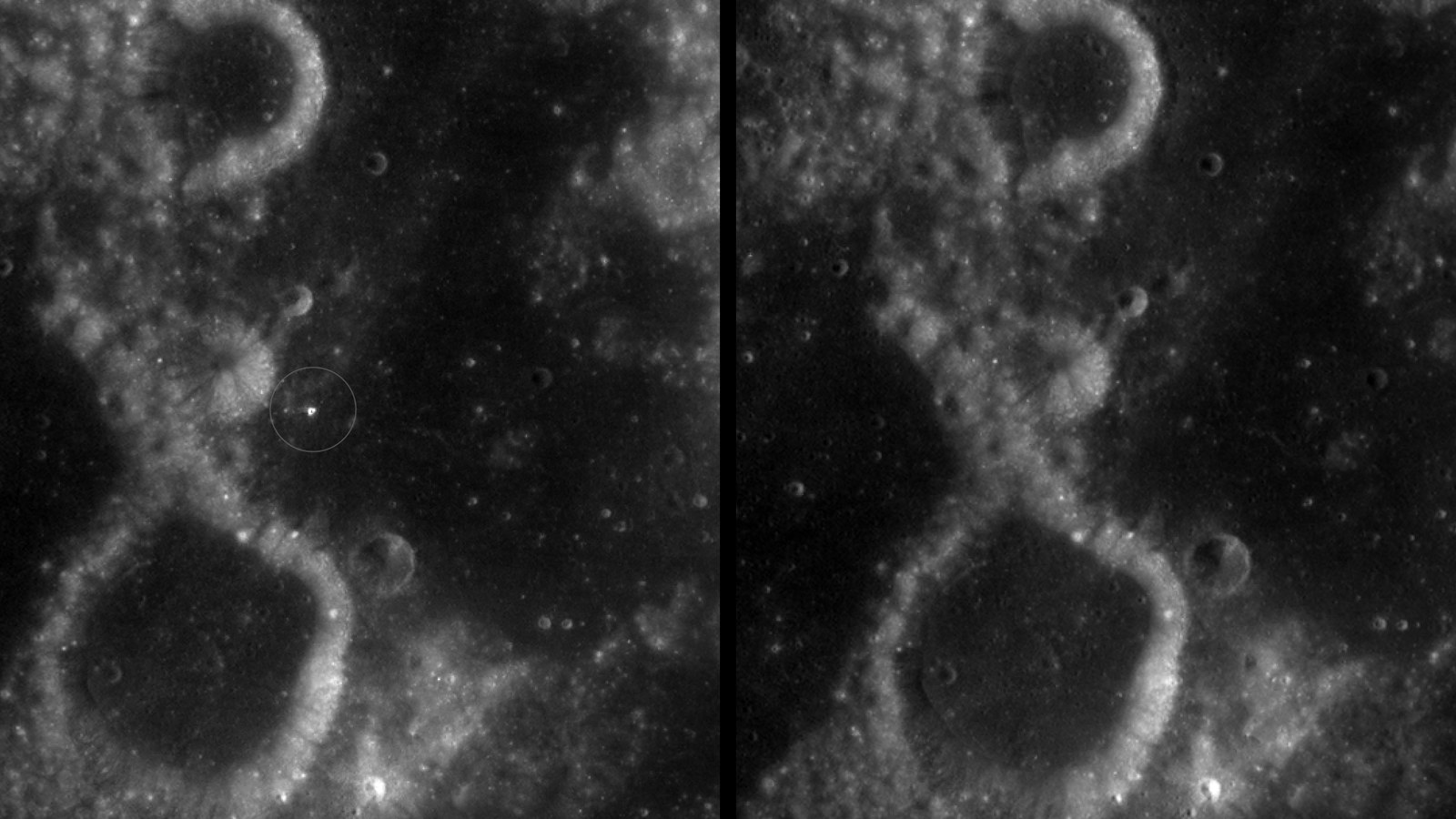
NASA’s Lunar Reconnaissance Orbiter, which has studied the Moon since 2009, has identified a recently formed impact crater about 222 metres across and about 43 metres deep. NASA places the collision between 11 April and 22 May 2024. Neither Earth-based telescopes nor space observatories recorded the impact in real time; the crater appeared later when Wide Angle Camera images were compared, then measured with the Narrow Angle Camera.
The crater is named McGetchin, after lunar geologist Thomas McGetchin. Debris thrown out by the collision forms a bright patch visible for tens of kilometres; other analyses report material flung more than 120 kilometres. NASA describes an impact of this size as roughly a once-in-a-century event. A pair of papers in Science Advances, dated 15 September 2026, published the interpretation.
The observations allow tests of crater-formation models: rim height, depth-to-diameter ratio, ejecta extent and block size. They also help estimate how often impacts occur. For future crewed missions or lunar depots, cosmic debris remains a design constraint rather than an archival curiosity.
The find does not mean the Moon has “woken up”. It shows that a surface that looks inert is still being reshaped. Before-and-after comparison remains the basic method: without the LRO archive, the crater could have been mistaken for an older one.
Photo: LRO comparison of the McGetchin crater area, with ejecta visible on the left. Credit NASA/GSFC/Arizona State University, via NASA Science.
Source consulted: NASA Science — Moon orbiter spots new, once-in-century crater; Associated Press.










0 Comments
No comments on this article yet. Be the first!