


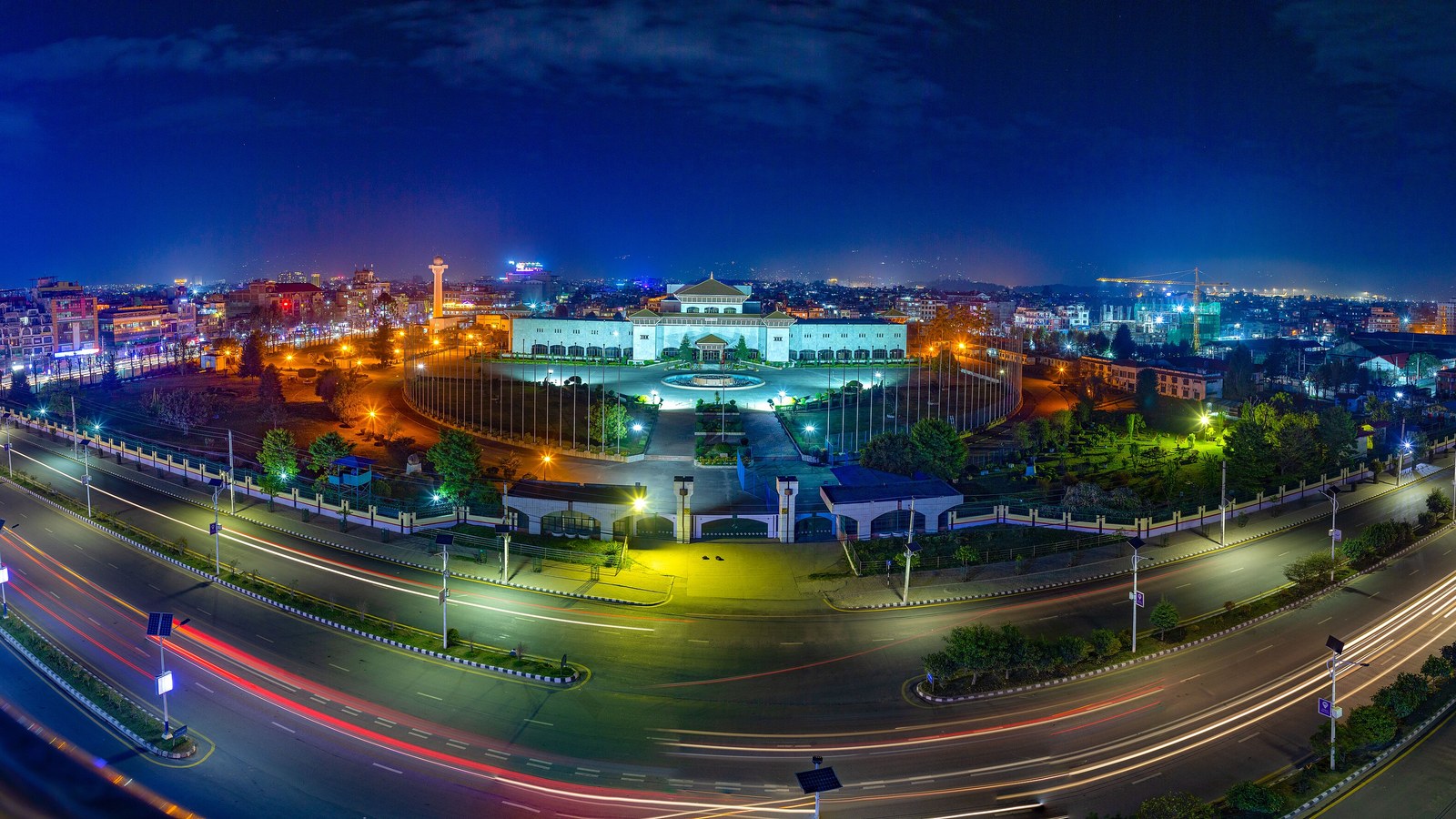
On 21 November 2006, in Kathmandu, at the Birendra International Convention Centre, Prime Minister Girija Prasad Koirala and Prachanda (Pushpa Kamal Dahal), Chairman of the Communist Party of Nepal (Maoist), signed the Comprehensive Peace Accord. It is not the twelve-point understanding of 2005 and not the eight-point understanding of June 2006. The accord has ten sections. Clause 1.2: it shall come into effect today after a public declaration by the government and Maoist parties.
Section 3: an interim legislature-parliament on the basis of the interim constitution, and free elections to the constituent assembly by the month of Jestha 2064. None of the authorities related to the country's rule shall remain with the King. The properties of late King Birendra, late Queen Aishwarya and their family shall be brought under the Government of Nepal and placed in a trust; all properties obtained by King Gyanendra in his capacity as the King shall be nationalized. The first meeting of the constituent assembly shall decide by simple majority whether or not to retain the monarchy. The state is to be restructured in an inclusive, democratic and progressive manner by ending the centralized and unitary form.
Section 4: Maoist Army combatants shall remain in seven main temporary cantonments — Kailali, Surkhet, Rolpa, Nawalparasi, Chitwan, Sindhuli and Ilam — with three sub-cantonments around each; the United Nations shall verify and monitor them. Arms other than those required for camp security shall be stored under a single lock, the key remaining with the party concerned, with UN monitoring. The Nepali Army shall be confined to barracks and shall store an equal number of arms under a single lock. The Interim Council of Ministers shall form a special committee to supervise, integrate and rehabilitate the Maoist combatants.
Section 5 terminates military action and armed mobilization: no attacks, kidnapping, disappearance, mining, bombardment, additional recruitment or transport of weapons. Within 15 days the status of people in custody shall be made public; within 60 days, the names of those disappeared or killed. A National Peace and Rehabilitation Commission and a High-level Truth and Reconciliation Commission shall be set up. Section 6 declares that the armed war going on since 2052 BS has ended.
Section 7 restates commitments under the Universal Declaration of Human Rights: no law shall be formulated to award the death penalty; children of 18 years and below shall not be included in the armed force. Section 9: the United Nations Office of the High Commissioner for Human Rights, Nepal, shall monitor the human-rights provisions; the United Nations Mission in Nepal shall monitor the management of arms and armies; the United Nations shall supervise the constituent assembly elections. Section 10: neither party shall operate parallel mechanisms of the state; the accord may be revised with the consent of both parties; after the Interim Legislature-Parliament is constituted, the concept of the two parties shall cease, and the Interim Council of Ministers shall carry the obligations.
It is not the 8 November 2006 decision of the seven parties, not the 28 November agreement on monitoring the management of arms and armies and not the Interim Constitution.
Image: Birendra International Convention Centre, Kathmandu, place of the signing; Mithunkunwar9, 24 September 2020; CC BY-SA 4.0, Wikimedia Commons. Cropped to 16:9.
Source consulted: Comprehensive Peace Accord. Treaty text: Comprehensive Peace Accord between the Government of Nepal and the Communist Party of Nepal (Maoist), Kathmandu, 21 November 2006.










0 Comments
No comments on this article yet. Be the first!