


At Washington, on 6 February 1922, the United States of America, Belgium, the British Empire, China, France, Italy, Japan, the Netherlands and Portugal sign the Nine-Power Treaty concerning China. The plenipotentiaries, after communicating their full powers, agree upon the text; the English and French texts are both authentic. The Treaty remains deposited in the archives of the Government of the United States, which transmits duly certified copies to the other Contracting Powers.
The preamble records the desire to adopt a policy designed to stabilize conditions in the Far East, to safeguard the rights and interests of China, and to promote intercourse between China and the other Powers upon the basis of equality of opportunity. For the United States, among others, Charles Evans Hughes, Henry Cabot Lodge, Oscar W. Underwood and Elihu Root sign; for China, Sao-Ke Alfred Sze, V. K. Wellington Koo and Chung-Hui Wang; for Japan, Baron Tomosaburo Kato, Baron Kijuro Shidehara and Masanao Hanihara.
Article I requires the Contracting Powers other than China to respect the sovereignty, the independence, and the territorial and administrative integrity of China; to provide the fullest and most unembarrassed opportunity to China to develop and maintain for herself an effective and stable government; to use their influence for the purpose of effectually establishing and maintaining the principle of equal opportunity for the commerce and industry of all nations throughout the territory of China; and to refrain from taking advantage of conditions in China in order to seek special rights or privileges which would abridge the rights of subjects or citizens of friendly States, and from countenancing action inimical to the security of such States.
Article II forbids any treaty, agreement, arrangement or understanding — with one another or with any Power or Powers — which would infringe or impair the principles stated in Article I. Article III applies the Open Door: the Powers other than China will not seek, nor support their nationals in seeking, any arrangement purporting to establish general superiority of rights with respect to commercial or economic development in any designated region of China, or any monopoly or preference that would deprive nationals of any other Power of the right of undertaking legitimate trade or industry in China or of participating in any category of public enterprise; China undertakes to be guided by the same principles in dealing with applications from Governments and nationals of all foreign countries. Article IV forbids support for agreements by nationals designed to create Spheres of Influence or mutually exclusive opportunities in designated parts of Chinese territory.
Article V requires China not to exercise or permit unfair discrimination of any kind throughout the railways in China — in particular no discrimination in charges or facilities on the ground of the nationality of passengers, the origin or ownership of goods, or the nationality or ownership of the ship — and the other Powers assume a corresponding obligation for railways over which they or their nationals exercise control by concession or otherwise. Article VI requires the Powers other than China fully to respect China’s rights as a neutral in time of war to which China is not a party, and China declares that when she is a neutral she will observe the obligations of neutrality.
Article VII provides for full and frank communication between the Contracting Powers concerned whenever a situation arises which in the opinion of any one of them involves the application of the stipulations of the Treaty. Article VIII invites non-signatory Powers which have Governments recognized by the Signatory Powers and which have treaty relations with China to adhere; the Government of the United States makes the necessary communications, and adherence becomes effective on receipt of notice by that Government.
Article IX requires ratification in accordance with the respective constitutional methods of the Contracting Powers; the Treaty takes effect on the date of the deposit of all the ratifications, which shall take place at Washington as soon as possible. The Government of the United States transmits to the other Contracting Powers a certified copy of the procès-verbal of the deposit of ratifications. The text is not the Washington Naval Treaty (Five-Power Treaty) signed the same day.
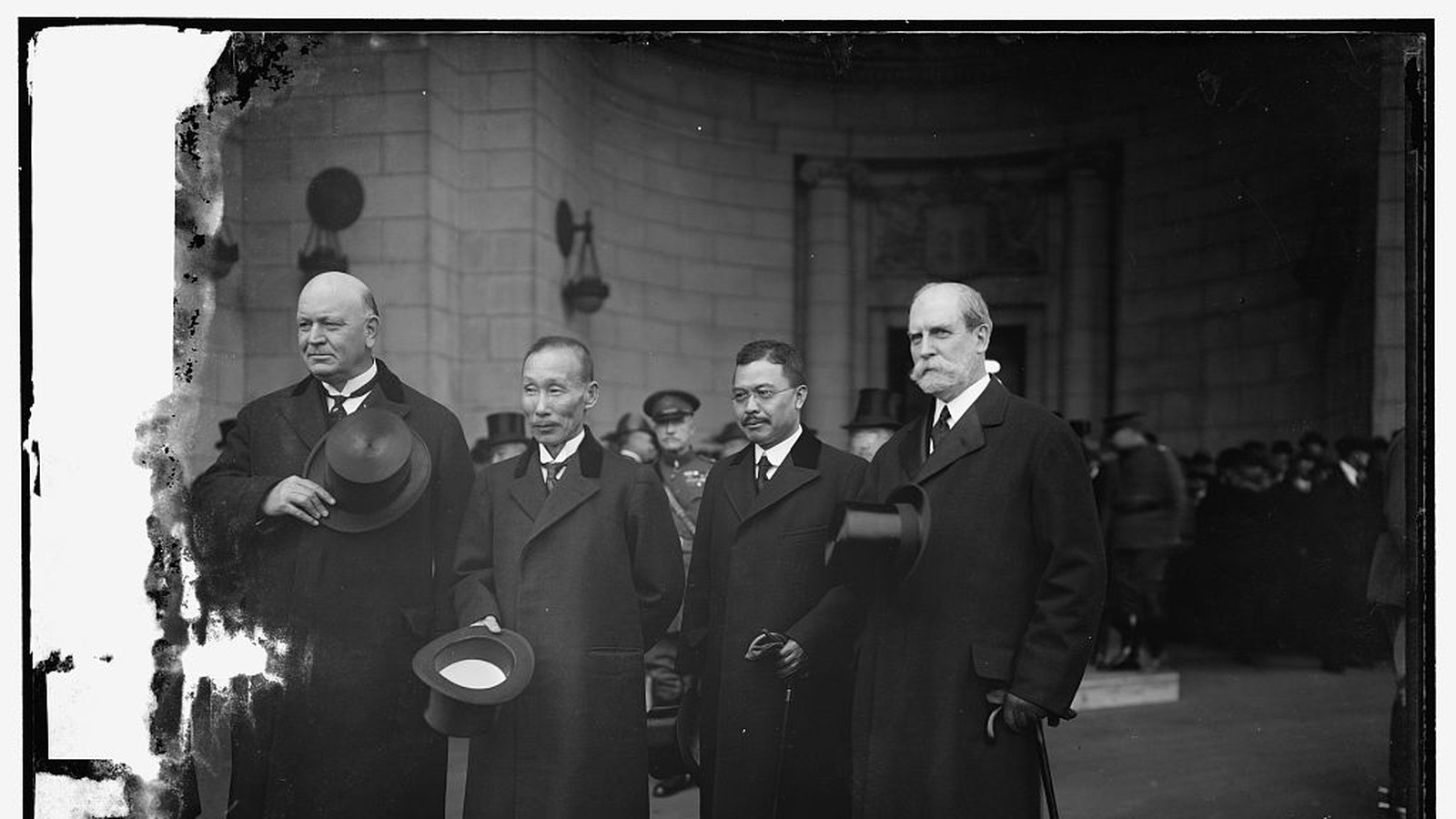
Image: Japanese delegates and Charles Evans Hughes at the Conference on the Limitation of Armament, Washington; public domain, Wikimedia Commons. Cropped to 16:9.
Source consulted: Nine-Power Treaty. Treaty text: Treaty Between the United States of America, Belgium, the British Empire, China, France, Italy, Japan, the Netherlands, and Portugal, Washington, 6 February 1922, Avalon Project.








0 Comments
No comments on this article yet. Be the first!