


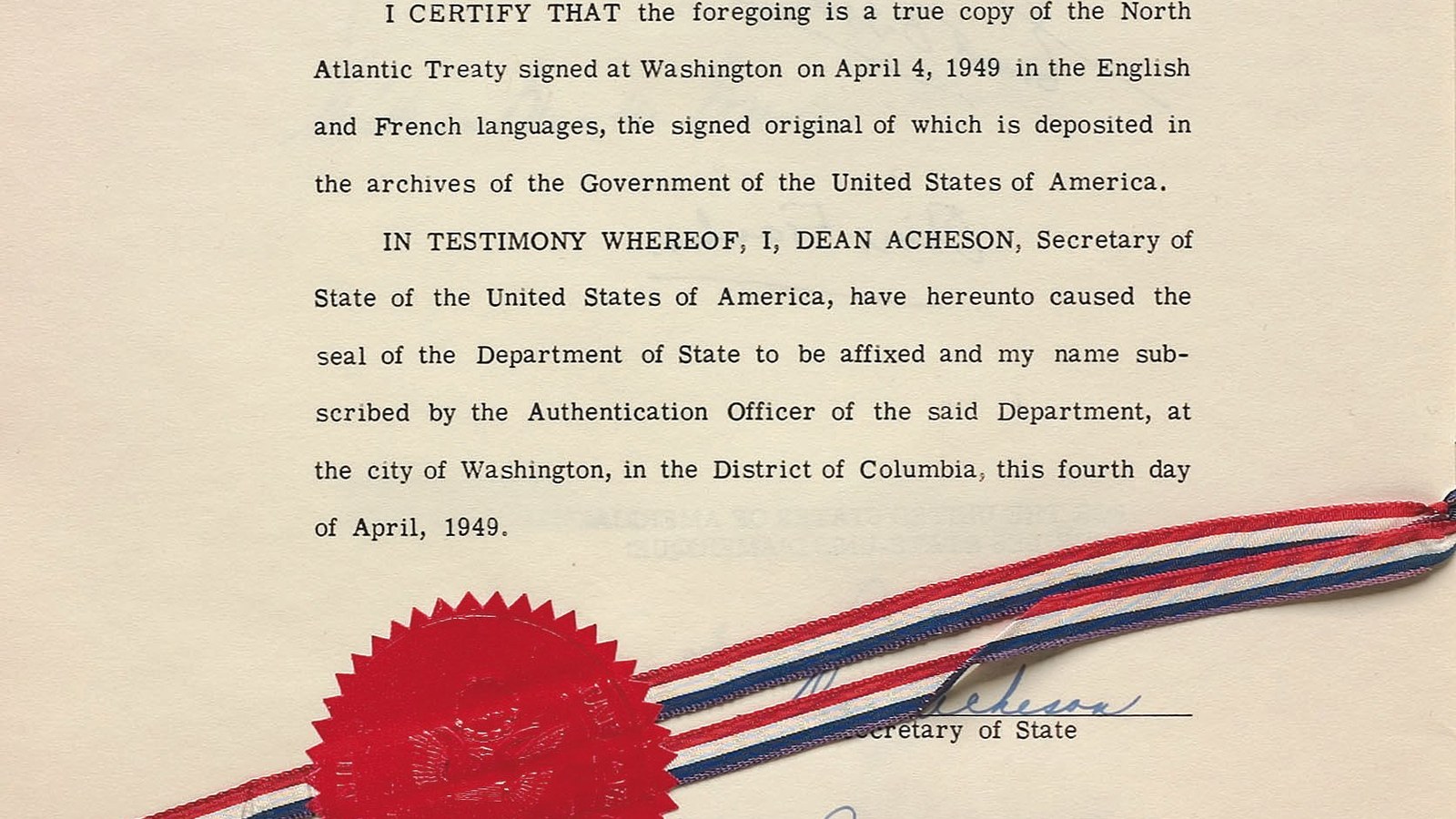
The North Atlantic Treaty, also called the Washington Treaty, is the legal basis of NATO. The official text published by the Alliance reaffirms the Charter of the United Nations and the determination to safeguard “the freedom, common heritage and civilisation of their peoples, founded on the principles of democracy, individual liberty and the rule of law”. It was framed after the Czechoslovak coup and the Berlin blockade. Early drafts, drawing on the Rio Treaty and the Brussels Treaty, came from the American diplomats John D. Hickerson and Theodore Achilles.
The Five of the Brussels Pact — France, Belgium, the Netherlands, Luxembourg and the United Kingdom — accepted the American draft in London on 14–15 March 1949, without changes. The same day, with the United States and Canada, they invited Norway, Denmark, Iceland, Portugal and Italy. Twelve founding signatories remained.
On 4 April 1949, in Washington, the signatories included Dean Acheson for the United States, Ernest Bevin for the United Kingdom, Robert Schuman for France, Lester B. Pearson for Canada, Paul-Henri Spaak for Belgium, Carlo Sforza for Italy and Dirk Stikker for the Netherlands. The depositary is the United States Government. The English and French texts are equally authentic. The treaty entered into force on 24 August 1949, after ratification by a majority including Belgium, Canada, France, Luxembourg, the Netherlands, the United Kingdom and the United States.
Article 5, the heart of the pact, provides that an armed attack against one or more of them in Europe or North America “shall be considered an attack against them all”. Each party, invoking Article 51 of the UN Charter, will assist “by taking forthwith, individually and in concert with the other Parties, such action as it deems necessary, including the use of armed force”. Measures are reported to the Security Council. The article has been invoked only once, after the 11 September 2001 attacks on the United States.
Article 4 requires consultation whenever the territorial integrity, political independence or security of any party is threatened. Article 6 sets the zone: territories in Europe and North America, Turkey, islands in the North Atlantic north of the Tropic of Cancer, and forces, vessels and aircraft in that area; the clause on the Algerian Departments of France became inapplicable from 3 July 1962. Article 9 establishes the North Atlantic Council and a defence committee.
Article 10 allows, by unanimous agreement, the invitation of any other European state able to contribute to the security of the area. Greece and Turkey joined in 1952, the Federal Republic of Germany in 1955, Spain in 1982. After 1999 came, among others, Poland, Hungary, Romania (2004), then Finland (2023) and Sweden (2024). Article 13 allows denunciation after twenty years, with one year’s notice.
The alliance was designed as a collective answer to a Soviet attack on Western Europe. The mutual-defence clause was not invoked in the Cold War. Acheson certified, the same day, the authentic copy of the instrument deposited in the archives of the Department of State.
Sources: North Atlantic Treaty; NATO, The North Atlantic Treaty.











0 Comments
No comments on this article yet. Be the first!