


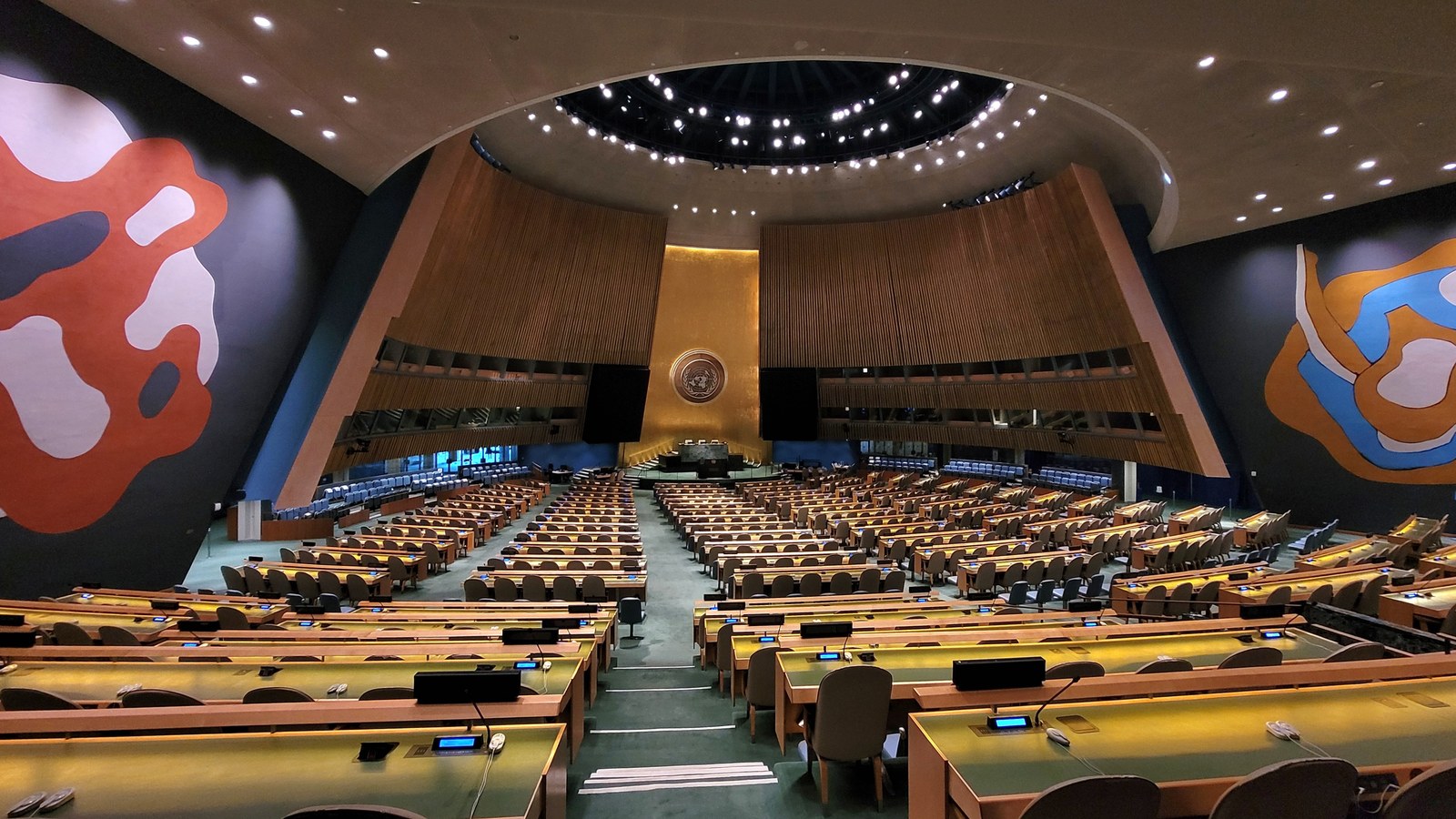
On 13 December 2006, in New York, the United Nations General Assembly adopts, by resolution 61/106, the Optional Protocol to the Convention on the Rights of Persons with Disabilities. It has 18 articles. The authentic texts are Arabic, Chinese, English, French, Russian and Spanish. The depositary is the Secretary-General. It is not the Convention itself, adopted the same day as Annex I to the same resolution; the Protocol is Annex II. Signature opens later, at United Nations Headquarters, on 30 March 2007.
Article 1 recognizes the competence of the Committee on the Rights of Persons with Disabilities to receive and consider communications from or on behalf of individuals or groups of individuals subject to the jurisdiction of a State Party who claim to be victims of a violation of the Convention. No communication shall be received if it concerns a State Party to the Convention that is not a party to the Protocol.
Article 2 treats as inadmissible a communication that is anonymous, an abuse of the right of submission or incompatible with the Convention, that concerns a matter already examined by the Committee or under another international procedure, that has not exhausted domestic remedies, that is manifestly ill-founded or not sufficiently substantiated, or that relates to facts prior to the Protocol's entry into force for the State concerned, unless those facts continued after that date. Exhaustion of domestic remedies is not required where their application is unreasonably prolonged or unlikely to bring effective relief.
Article 3 requires the State, within six months, to submit written explanations and any remedy that may have been taken. Article 4 allows the Committee to request interim measures to avoid possible irreparable damage; such a request does not imply a determination on admissibility or merits. Article 5 provides for closed meetings; after examining a communication, the Committee forwards its suggestions and recommendations to the State Party and to the petitioner.
Article 6 opens a confidential inquiry if the Committee receives reliable information indicating grave or systematic violations of rights set forth in the Convention. The Committee may designate one or more of its members to conduct the inquiry; a visit to the territory requires the State's consent. The State submits observations within six months. Article 7 allows the Committee to invite details in the report under article 35 of the Convention. Article 8 lets each State, at signature, ratification or accession, declare that it does not recognize the competence in articles 6 and 7.
Article 13 provides that, subject to the entry into force of the Convention, the Protocol shall enter into force on the thirtieth day after the deposit of the tenth instrument of ratification or accession. Those conditions were later met; the Protocol entered into force together with the Convention on 3 May 2008. Article 14 does not permit reservations incompatible with the object and purpose of the Protocol. Article 16 provides for denunciation by written notification; the denunciation becomes effective one year after receipt by the Secretary-General. Article 17 requires the text to be made available in accessible formats.
It is not the Convention on the Rights of Persons with Disabilities as the substantive instrument, although that was adopted the same day. It is not the Optional Protocol to the International Covenant on Civil and Political Rights, and not the Optional Protocol to the Convention on the Elimination of All Forms of Discrimination against Women.
Image: United Nations General Assembly Hall, New York; Mojnsen, 20 February 2024; CC BY-SA 4.0, Wikimedia Commons. Cropped to 16:9.
Source consulted: Optional Protocol to the Convention on the Rights of Persons with Disabilities. Treaty text: Optional Protocol to the Convention on the Rights of Persons with Disabilities, New York, 13 December 2006.











0 Comments
No comments on this article yet. Be the first!