


Sputnik, in October 1957, and intercontinental missiles took space out of air law. Dwight Eisenhower proposed to the General Assembly, on 22 September 1960, a treaty on the Antarctic model. Moscow linked the offer to American overseas missile bases, then unlinked it after the Partial Nuclear Test Ban Treaty, in 1963. On 17 October, resolution 1884 (XVIII) asked states not to put weapons of mass destruction in orbit. On 13 December, resolution 1962 (XVIII) set the legal principles, unanimously.
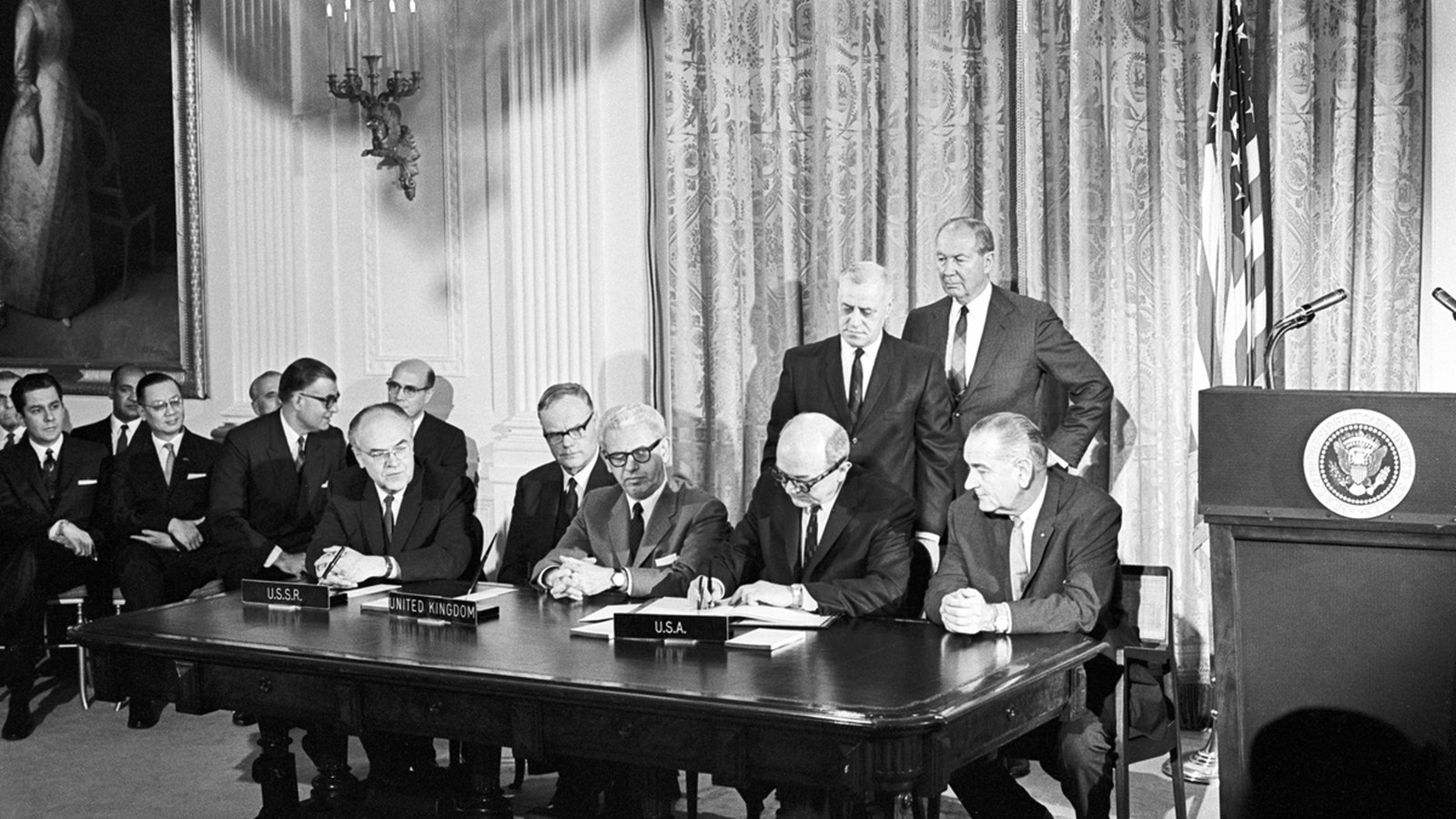
The UN Committee on the Peaceful Uses of Outer Space worked the text in 1966, in Geneva and New York. The General Assembly commended it by resolution 2222 (XXI), on 19 December. The Treaty on Principles Governing the Activities of States in the Exploration and Use of Outer Space, including the Moon and Other Celestial Bodies, was opened for signature on 27 January 1967, in triplicate, in London, Moscow and Washington. Depositaries: the United Kingdom, the Soviet Union and the United States. In the East Room, Dean Rusk signed; at the table, Lyndon Johnson, Arthur Goldberg, Sir Patrick Dean and Anatoly Dobrynin. The English, Russian, French, Spanish and Chinese texts are equally authentic.
Article I: exploration is “the province of all mankind”, free, without discrimination, with access to all areas of celestial bodies. Article II forbids national appropriation by claim of sovereignty, by use, occupation or any other means. Article IV bars nuclear weapons and other weapons of mass destruction in orbit, on the Moon or stationed in space. The Moon and other celestial bodies are exclusively peaceful: no military bases, weapons tests or manoeuvres. Military personnel are allowed for peaceful research. The treaty does not ban conventional weapons in orbit.
Astronauts are “envoys of mankind”; after an emergency landing they must be returned to the state of registry. States bear international responsibility also for private activities, which they must authorise and supervise. The launching state is liable for damage. The object remains under the jurisdiction of the state of registry. Harmful contamination and interference require consultations, a clause born after Project West Ford. Stations on the Moon are open, with notice, on a basis of reciprocity.
The treaty entered into force on 10 October 1967, after five ratifications, including the three depositaries. There followed the Rescue Agreement (1968), the Liability Convention (1972), the Registration Convention (1976) and the Moon Treaty (1979), the last with few parties. The Bogota Declaration, in 1976, by which eight equatorial states claimed sovereignty over the geostationary orbit, did not hold; slots stayed with the International Telecommunication Union.
The ITU photograph, CC BY 2.0, is the White House ceremony. The text is silent on lunar mining. The United States legalised, in 2015, the extraction of resources; the Artemis Accords try to clarify use. More than a hundred states are parties, including all major spacefaring powers.
The act set space law on the ban of sovereignty and of weapons of mass destruction, not on a total demilitarisation of orbit.
Sources: Outer Space Treaty; UNOOSA, Treaty on Principles Governing the Activities of States in the Exploration and Use of Outer Space, including the Moon and Other Celestial Bodies.











0 Comments
No comments on this article yet. Be the first!