


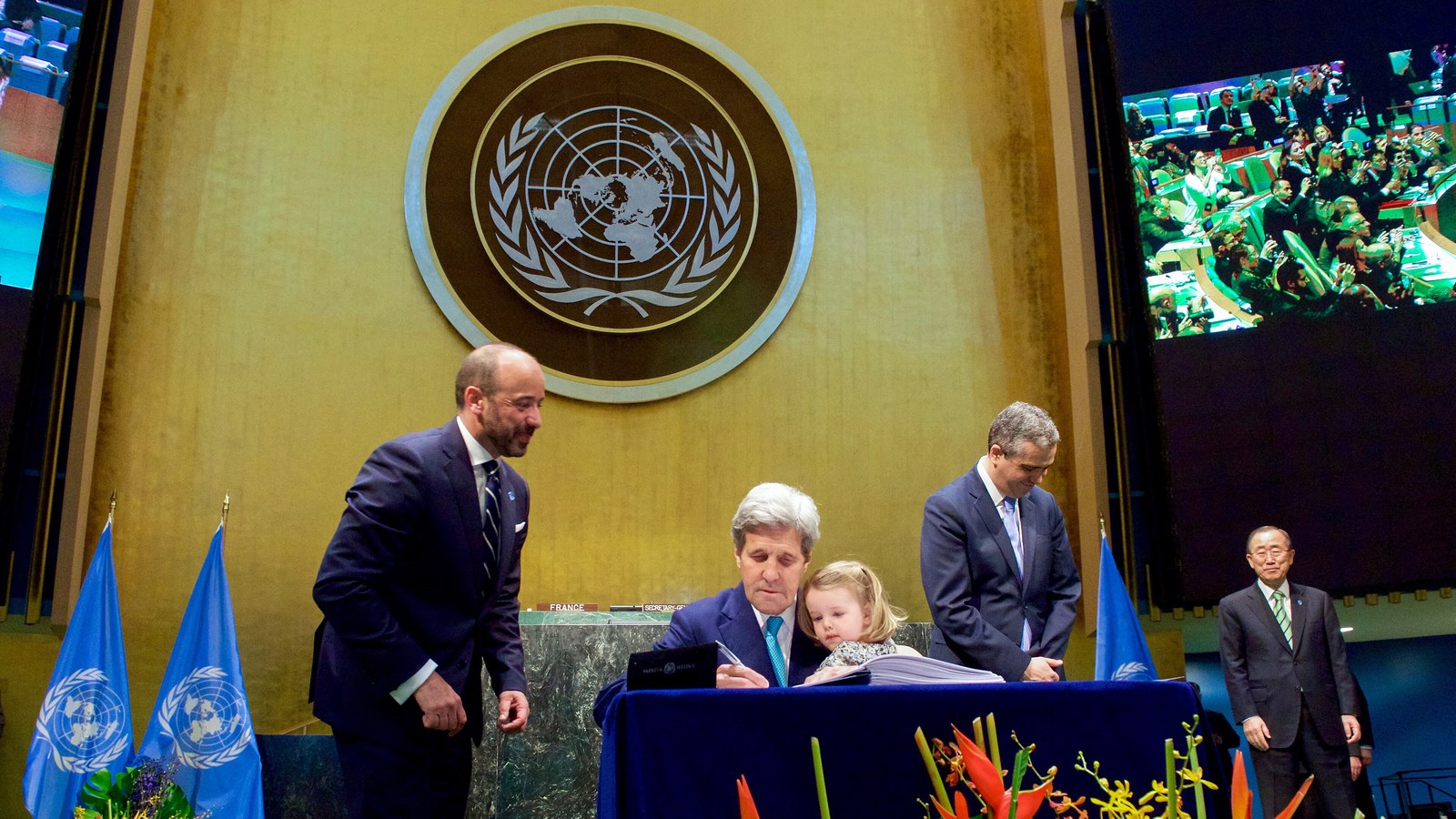
At United Nations Headquarters in New York, on 22 April 2016, the Paris Agreement was opened for signature. Article 20 states that it is open for signature, ratification, acceptance or approval by States and regional economic integration organizations that are Parties to the Framework Convention, at UN Headquarters, until 21 April 2017; thereafter it remains open for accession. Instruments are deposited with the Depositary, the Secretary-General, under Article 26. On the first day 175 Parties signed: 174 States and the European Union. It is not the adoption of 12 December 2015 at Le Bourget, at COP21.
Article 2 aims to strengthen the global response to the threat of climate change, in the context of sustainable development and efforts to eradicate poverty: holding the increase in global average temperature to well below 2 °C above pre-industrial levels and pursuing efforts to limit it to 1.5 °C; increasing the ability to adapt, in a manner that does not threaten food production; and making finance flows consistent with a pathway towards low greenhouse-gas emissions and climate-resilient development. Implementation is to reflect equity and common but differentiated responsibilities and respective capabilities, in the light of different national circumstances.
Article 3 requires all Parties to undertake ambitious efforts, communicated as nationally determined contributions, representing a progression over time. Article 4 aims at global peaking of greenhouse-gas emissions as soon as possible, recognizing that peaking will take longer for developing country Parties, then rapid reductions so as to achieve a balance between anthropogenic emissions and removals by sinks in the second half of this century. It is not the Kyoto Protocol of 1997, with binding cuts only for a list of developed countries.
Article 21 provides that the Agreement enters into force on the thirtieth day after at least 55 Parties to the Convention accounting for at least 55 per cent of total global greenhouse-gas emissions have deposited their instruments. For that threshold, total global emissions means the most up-to-date amount communicated on or before the date of adoption. An instrument deposited by a regional economic integration organization is not counted as additional to those of its member States. Article 27 allows no reservations. Article 28 permits withdrawal, by written notification to the Depositary, at any time after three years from the date the Agreement entered into force for that Party; withdrawal takes effect one year after receipt of the notification, or on a later date specified. A Party that withdraws from the Convention is considered as also having withdrawn from this Agreement.
The Agreement is not the Copenhagen Accord of 2009 and not the United States communication C.N.464.2017 of 4 August 2017, in which the US Mission announced its intention to exercise the right to withdraw. The 2015 text, opened for signature in New York, fixes the temperature aim, nationally determined contributions, the 55/55 threshold and the withdrawal rules; it does not set binding emission quotas for each Party.
Image: John Kerry signs the Paris Agreement, with Ban Ki-moon; UN General Assembly Hall, 22 April 2016; U.S. Department of State, public domain, Wikimedia Commons. Cropped to 16:9.
Source consulted: Paris Agreement. Treaty text: Wikisource: Paris Agreement.











0 Comments
No comments on this article yet. Be the first!