
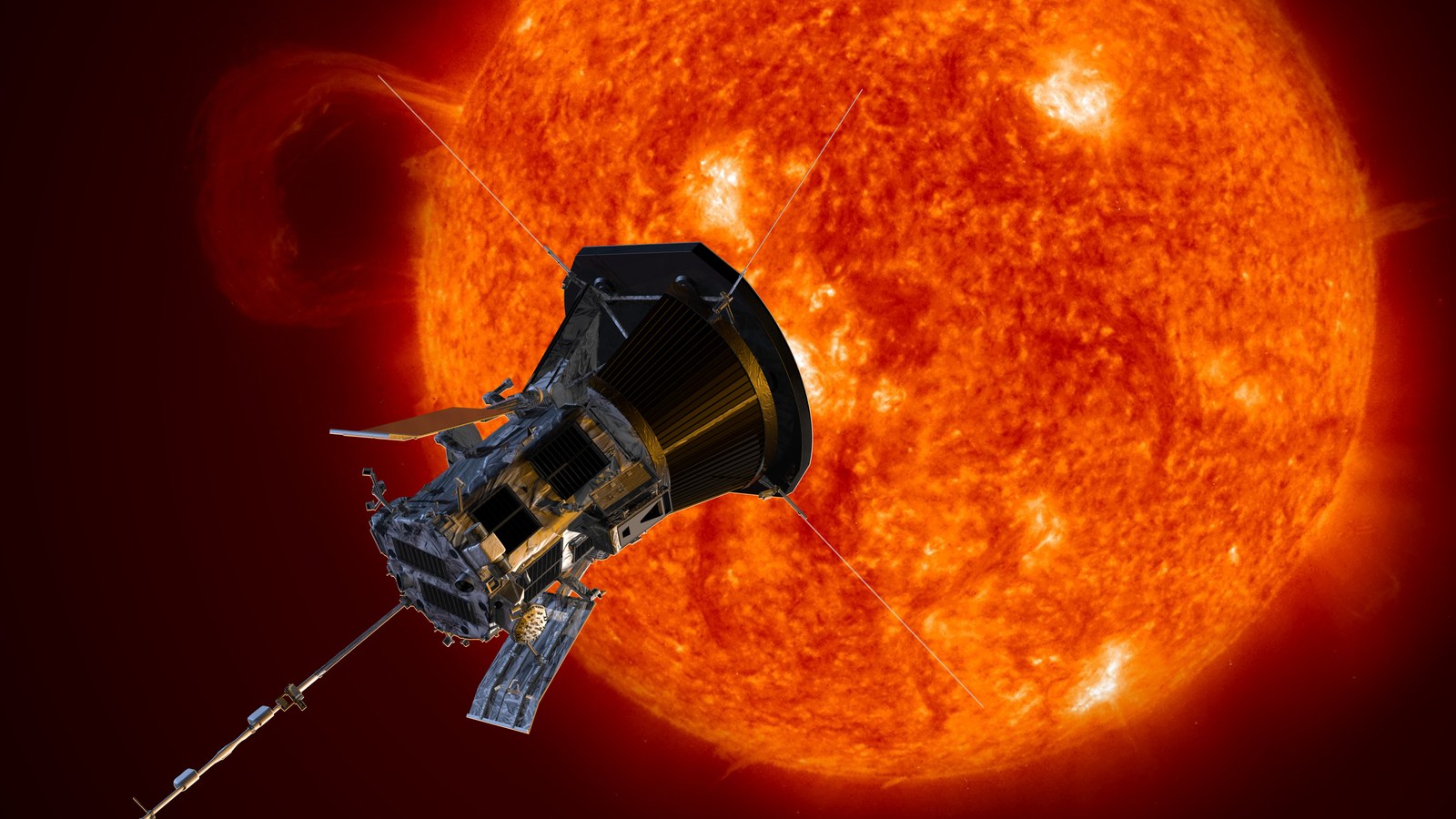
NASA’s Parker Solar Probe has completed another encounter with the Sun, once again flying through the solar corona and matching its existing records for both proximity to our star and spacecraft speed.
NASA announced that Parker Solar Probe completed its 29th close approach to the Sun on 4 September 2026. The spacecraft came within approximately 3.8 million miles — about 6.1 million kilometres — of the solar surface and reached a top speed of around 430,000 miles per hour, about 692,000 kilometres per hour. Those figures match records first established during Parker’s 24 December 2024 close approach and subsequently equalled during several later flybys, most recently on 4 September 2026.
During the encounter, Parker’s position relative to the Sun limited communications with Earth. As planned, the spacecraft operated autonomously for nine days around the time of closest approach. On 7 September, Parker transmitted a beacon tone confirming that its systems were operating normally.
The solar encounter ran from 30 August through 9 September. During this period, Parker’s four scientific instrument packages collected data from inside the Sun’s atmosphere — the corona. The spacecraft’s speed allowed it to sample almost 40% of the Sun’s circumference within a single day. For this flyby, Parker trained its camera on structures and activity near the Sun’s north pole.
NASA scheduled the return of detailed spacecraft telemetry to begin on 11 September. Transmission of the scientific data collected during the encounter is scheduled to run from 13 through 27 September 2026. The complete scientific results of the encounter are therefore not yet available and will be analysed after the data reaches Earth. This article does not present discoveries NASA has not announced.
Why Parker gets so close to the Sun
Parker Solar Probe was designed to investigate the Sun in ways that were impossible for previous spacecraft. In 2021, Parker became the first spacecraft to fly through the solar corona, the Sun’s upper atmosphere. Its instruments study particles, magnetic fields, the solar wind and processes occurring within the Sun’s atmosphere. One of the mission’s major objectives is to improve scientists’ understanding of the origin and evolution of the solar wind.
The research has implications far beyond astronomy. Solar flares and coronal mass ejections can produce powerful space-weather events that can pose risks to satellites, communications, astronauts, space missions, air travel, technological infrastructure and power grids on Earth. Parker’s observations of the solar wind, coronal mass ejections and the aftermath of solar flares contribute to understanding the physics driving these events. A better understanding of those processes can eventually contribute to more reliable space-weather forecasting.
Space weather is also important for future human exploration beyond Earth. Astronauts travelling beyond Earth’s immediate environment can face increased risks from energetic particles originating from the Sun. NASA says understanding the fundamental physics of space weather can help improve forecasts and protect astronauts during future deep-space missions, including journeys to the Moon and Mars.
From solar minimum to solar maximum, extended to 2029
Parker Solar Probe launched in August 2018, when the Sun was near the minimum of its approximately 11-year activity cycle. In 2024, NASA, NOAA and the international Solar Cycle Prediction Panel announced that the Sun had reached its solar maximum period. Parker’s 29 encounters therefore allow scientists to study the solar atmosphere across very different levels of activity.
The spacecraft will remain in its current orbit and continue making observations as solar activity moves into the declining phase of the cycle. NASA says the mission has been extended into 2029 following the 2026 Heliophysics Senior Review. Parker was developed as part of NASA’s Living With a Star programme, managed by Goddard Space Flight Center. The Johns Hopkins Applied Physics Laboratory designed and built Parker Solar Probe and continues to manage and operate the spacecraft for NASA.
The next important stage is scheduled to begin on 13 September, when transmission of the scientific observations collected during Parker’s 29th close encounter with the Sun is due to start.
Source consulted: NASA Science, After Latest Swing Past Sun, NASA’s Parker Solar Probe Checks in.
Image: artist’s concept of Parker Solar Probe approaching the Sun — not a photograph of the spacecraft at the Sun. Credit: NASA / Johns Hopkins APL / Steve Gribben. Public domain (NASA).








0 Comments
No comments on this article yet. Be the first!