
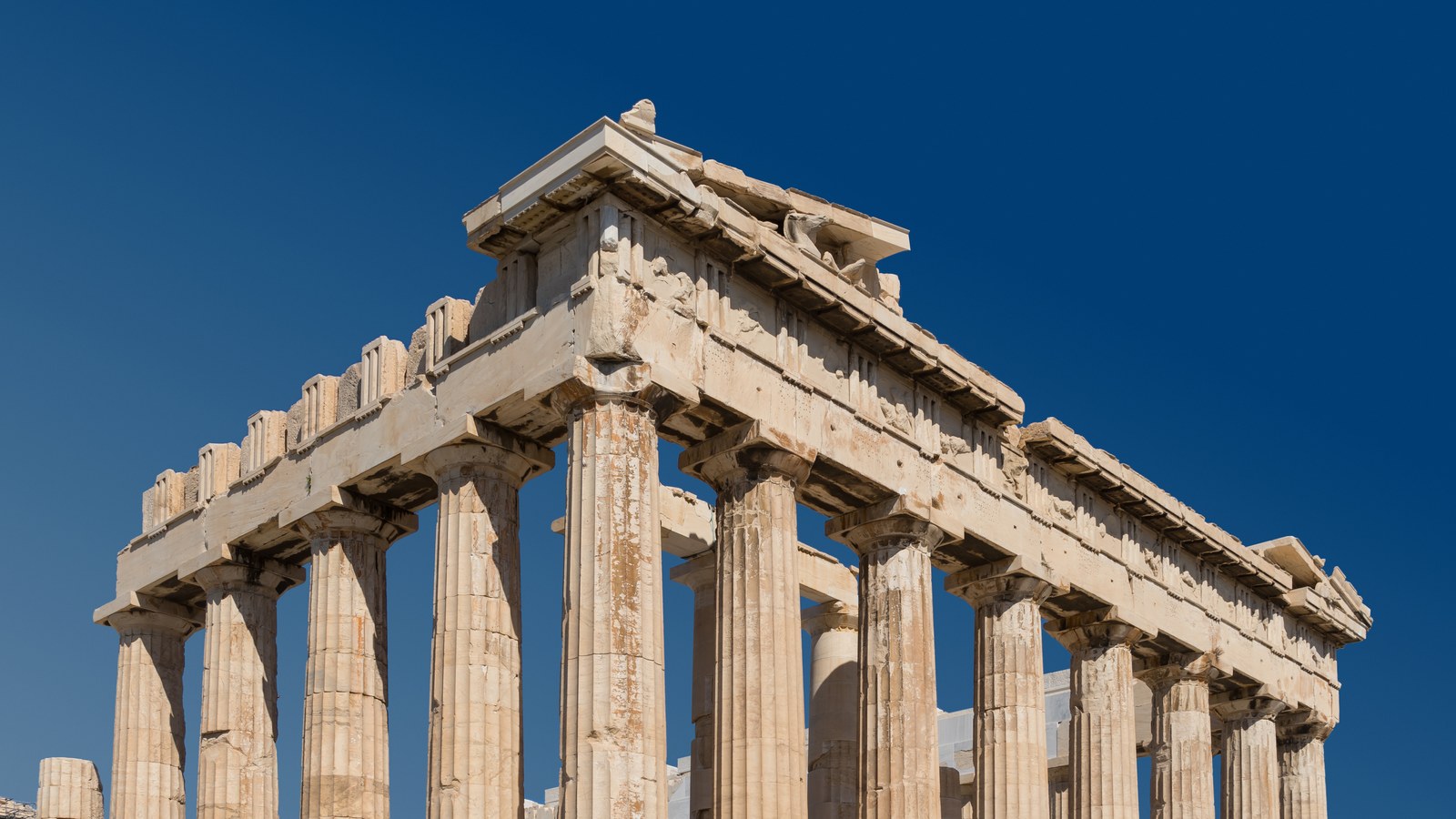
The Parthenon in Athens is famous not only for its proportions but also because lines that look straight are not always perfectly so. The temple’s base has subtle curves, and the columns show carefully executed variations, including the swelling known as entasis. For generations a popular explanation has been that Greek architects introduced these refinements to compensate for the viewer’s optical illusions.
A study by Professor Alain Goriely, of the Mathematical Institute at the University of Oxford, published in Royal Society Open Science, challenges that interpretation. The paper, “The illusion of illusions: there are no optical corrections in the Parthenon” (volume 13, issue 9, 1 September 2026; DOI 10.1098/rsos.260999), does not dispute the existence of the measured curves. It disputes the idea that they were designed as, or function as, “optical corrections”.
Goriely analyses mathematically several of the at least 12 corrections proposed over time, including the claim that a long perfectly horizontal line would appear to sag in the middle and that entasis would correct an apparent thinning of the columns. His conclusion is that the invoked illusions are either unsupported by evidence or too small to be perceptible under typical viewing conditions.
The paper’s thesis, also reported by The Guardian on 16 September, is that there is insufficient historical evidence and no scientific evidence for the extraordinary claim that the Parthenon’s refinements were implemented as optical corrections or achieved that purpose. The study does not prove why the curves were built. It reopens the question: if not for illusions, then with what intent?
The myth is traced to Vitruvius, a first-century Roman architect and engineer, who wrote about such refinements more than four centuries after the Parthenon was built. He was not a contemporary witness of the construction. His account entered architectural treatises and, in the nineteenth century, was revived when curved profiles were carefully measured.
Goriely extends the argument, with a caveat, to almost all classical and modern buildings: there is no evidence for the existence or necessity of optical corrections, with the possible exception of a few modern buildings in which architects have deliberately played with illusions. For the Parthenon the geometry remains real; it is the “correction” interpretation that is in doubt.
Almost two and a half millennia later, the temple’s geometry continues to generate research. The curves exist. The classical explanation of optical illusions, the Oxford mathematician argues, does not have the support usually claimed for it.
Photo: Jebulon, Wikimedia Commons, CC0. South-east view of the Parthenon, Acropolis, Athens. Cropped to 16:9.
Source consulted: The illusion of illusions: there are no optical corrections in the Parthenon (Royal Society Open Science); UK mathematician debunks myth around Parthenon’s optical illusions (The Guardian).








0 Comments
No comments on this article yet. Be the first!