


After Otto III’s death, Bolesław I of Poland backed Eckard I of Meissen for the throne. Eckard was murdered at Pöhlde, on 30 April 1002. Bolesław then took Meissen and the Lusatian march, with Bautzen. Henry II, crowned king of Germany in June, cut the quarrel at the Merseburg Hoftag, on 25 July: Lusatia and Milsko (Upper Lusatia) stayed with Bolesław as a fief, Meissen went back to the Crown, the duke pledged allegiance. On leaving he was ambushed; the king did not punish the attackers. Bolesław believed the attempt came from Henry.
In 1003 he took Bohemia, imprisoned Boleslaus III Přemyslid and held Moravia. Henry allied with the pagan Lutici and, in 1004, drove him from Prague, gave the duchy to Jaromír and took Bautzen. The peace near Poznań, in 1005, took Poland out of Lusatia. Bolesław recaptured Bautzen in 1007. The campaigns of 1010 and 1012 failed. At Merseburg, in 1013, the fief was renewed: Bolesław carried the sword at the marriage of Mieszko II to Richeza, Otto III’s niece, and promised Italy. He did not come. Henry was crowned emperor in Rome, on 14 February 1014, by Benedict VIII.
In 1015, with the Lutici, Henry resumed the war. Two hundred knights and Margrave Gero fell to Polish bowmen near Krosno. In 1017 he bypassed fortified Głogów and besieged Niemcza; the defenders raised a cross towards the Lutici. Part of the army fell ill, the road into Saxony was blocked by troops at Wrocław, the emperor withdrew through Bohemia. He declared Bolesław hostis publicus. That winter the Poles crossed between the Mulde and the Elbe.
The peace was sworn on 30 January 1018, in the town of Budusin, today Bautzen. Thietmar of Merseburg writes that it was made “non ut decuit, set sicut tunc fieri potuit” — not as it should have been, but as could then be done — by the emperor’s order and at the duke’s insistence, by bishops Gero and Arnulf, counts Hermann and Dietrich and chamberlain Frederick. Hostages were exchanged. Henry did not come. Thietmar does not say whether Lusatia and Milsko remained an imperial fief, a nominal vassalage or land without obligation; later chroniclers split on that line.
Four days later Oda, Eckard’s daughter, arrived at night at Cziczani, with lights, and married Bolesław after Septuagesima, without canonical authority. Regelinda, the duke’s daughter from an earlier marriage, was already the wife of Hermann I of Meissen, Oda’s brother. Henry promised three hundred knights for the Kiev expedition that summer. Bolesław entered Kiev and took back the Cherven Cities.
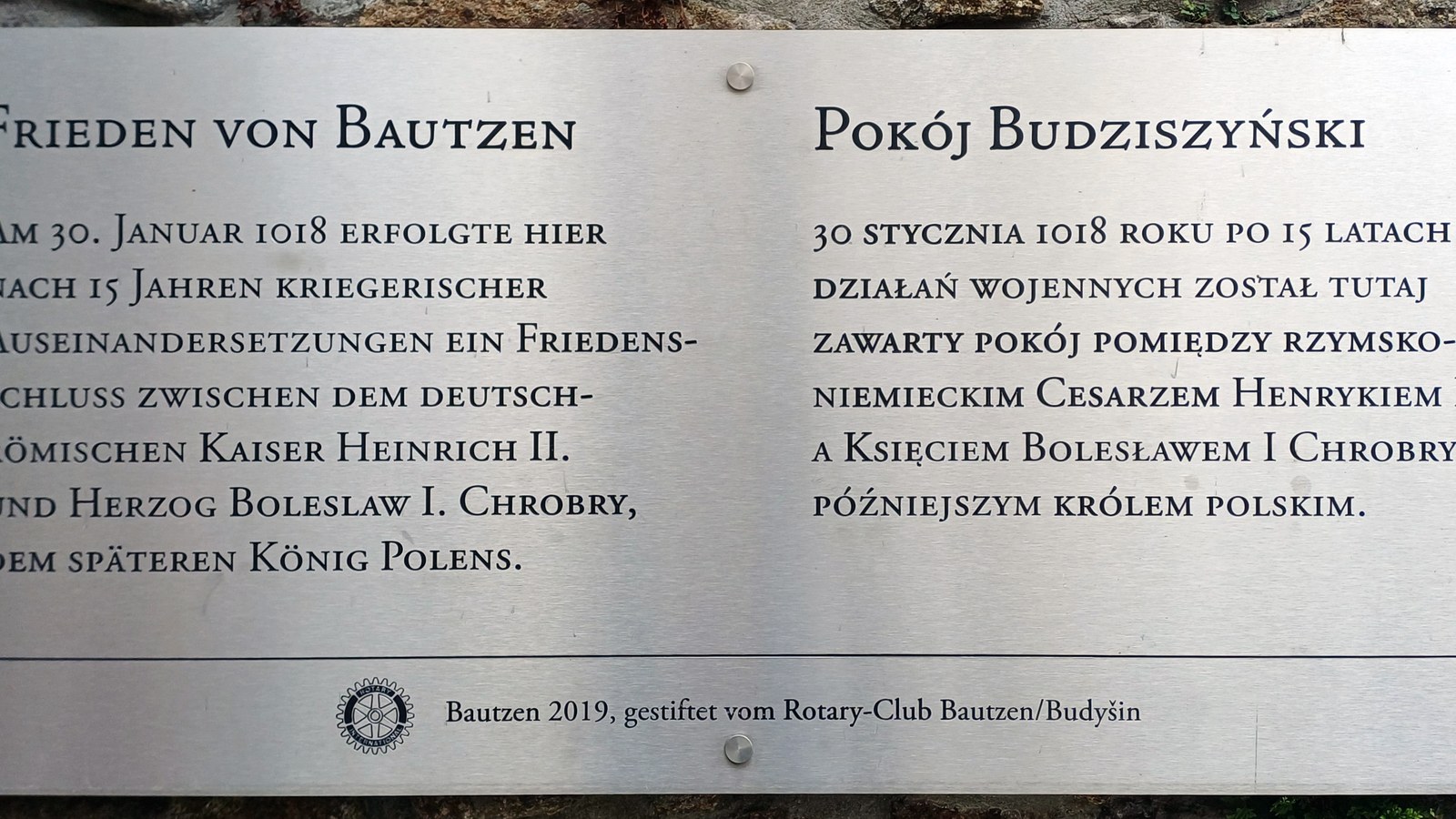
The CC BY-SA 3.0 plaque at the Ortenburg, in Bautzen, recalls the peace; the original parchment has not survived. The working text remains Book VIII of Thietmar’s chronicle, written the same year.
Bautzen closed sixteen years of Polish-German war without a field victory for the emperor. Lusatia stayed with the Piasts.
Sources: Peace of Bautzen; Thietmar of Merseburg, Chronicon, liber VIII.











0 Comments
No comments on this article yet. Be the first!