


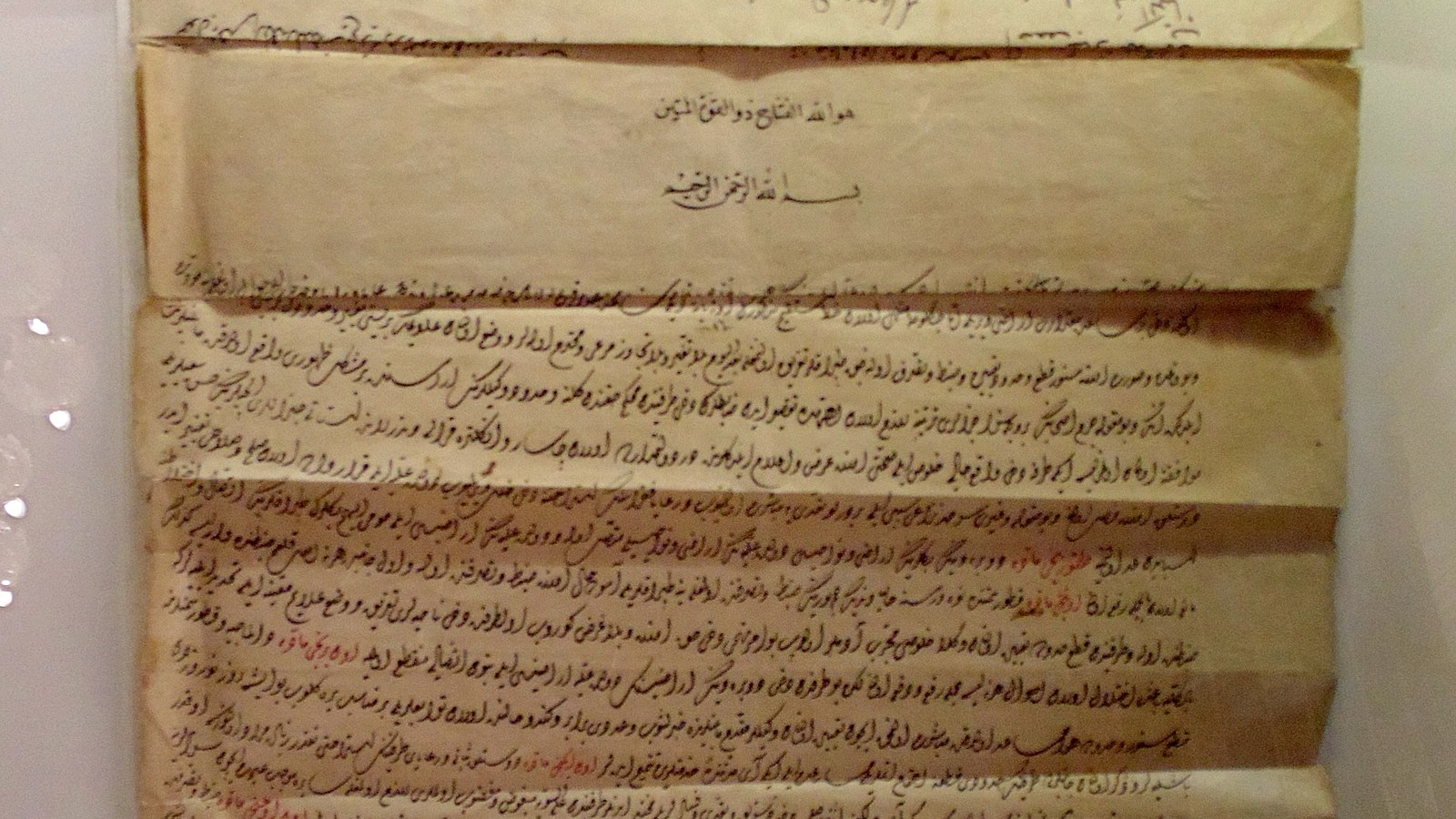
After the siege of Vienna in 1683, Pope Innocent XI gathered the Holy League: the Habsburgs, Poland-Lithuania, Venice, then Peter’s Russia. The Great Turkish War broke at Zenta, on 11 September 1697, where Eugene of Savoy smashed Sultan Mustafa II’s army. The congress opened on 16 November 1698, in tents, at Karlowitz, on the Habsburg Military Frontier — today Sremski Karlovci, in Syrmia. The mediators were William Lord Paget, for William III, and Jacob Colyer, for the States General of the Netherlands.
The peace was signed on 26 January 1699. For the Porte: Rami Mehmed Pasha, reis ül-küttab, and Alexander Mavrocordatos, the dragoman. For Leopold I: Counts Kinsky, Oettingen and Leopold Schlick. For Venice: Carlo Ruzzini. For Poland: Stanisław Małachowski, palatine of Poznań. Prokofy Voznitsyn signed a Russian truce; peace with Moscow came at Constantinople, in 1700. The Habsburg-Ottoman instrument is in Latin; the Venetian one, in Ottoman Turkish. The principle was uti possidetis: each kept what it held.
The Habsburgs took the Eğri and Varat eyalets, most of the Buda eyalet, the north of Temesvár and strips of Bosnia — that is, almost all of Hungary, Croatia and Slavonia. Transylvania remained a principality under Austrian governors. The Porte kept Belgrade, the Banat of Temesvár and suzerainty over Wallachia and Moldavia. Hungarians and Transylvanians who had gone over to the Ottomans stayed subjects of the Porte; the Mureș and the Tisza, between the Banat and the emperor’s lands, were in common use, with free navigation down to the Danube.
Poland recovered Podolia and Kamianets, lost at Buchach in 1672, evacuated the fortresses in Moldavia, stopped the tribute and the Tatar raids. Małachowski signed, also in a tent, eleven articles of perpetual peace with Mustafa. Venice took most of Dalmatia and the Morea; the Morea went back to the Ottomans, twenty years later, at Passarowitz. Russia received Azov only in 1700 and gave it back after the Pruth, in 1711. The Holy Sepulchre at Jerusalem was left unsettled.
Luigi Ferdinando Marsili marked the Croatian and Bihać border by mid-1700, and the Temesvár border by early 1701, with physical landmarks, for the first time. The Habsburgs gained some 160,000 square kilometres of Hungarian land; the Banat came at Passarowitz, in 1718. For the Porte it was the first great territorial loss in Europe, after three and a half centuries of advance. After the mid-eighteenth century the line settled, largely, south of the Sava.
The CC0 photograph shows a copy of the instrument, not the tent. The Chapel of Peace stands on the congress site today. The Polish Sejm judged the Right-Bank Cossack regiments surplus; Paliy’s rising broke out at once.
Karlowitz made the Habsburg monarchy the dominant power in Central Europe and closed, for Poland, the wars with the Porte.
Sources: Treaty of Karlowitz; Wikisource, Treaty of Karlowitz (Poland and Turkey).











0 Comments
No comments on this article yet. Be the first!