


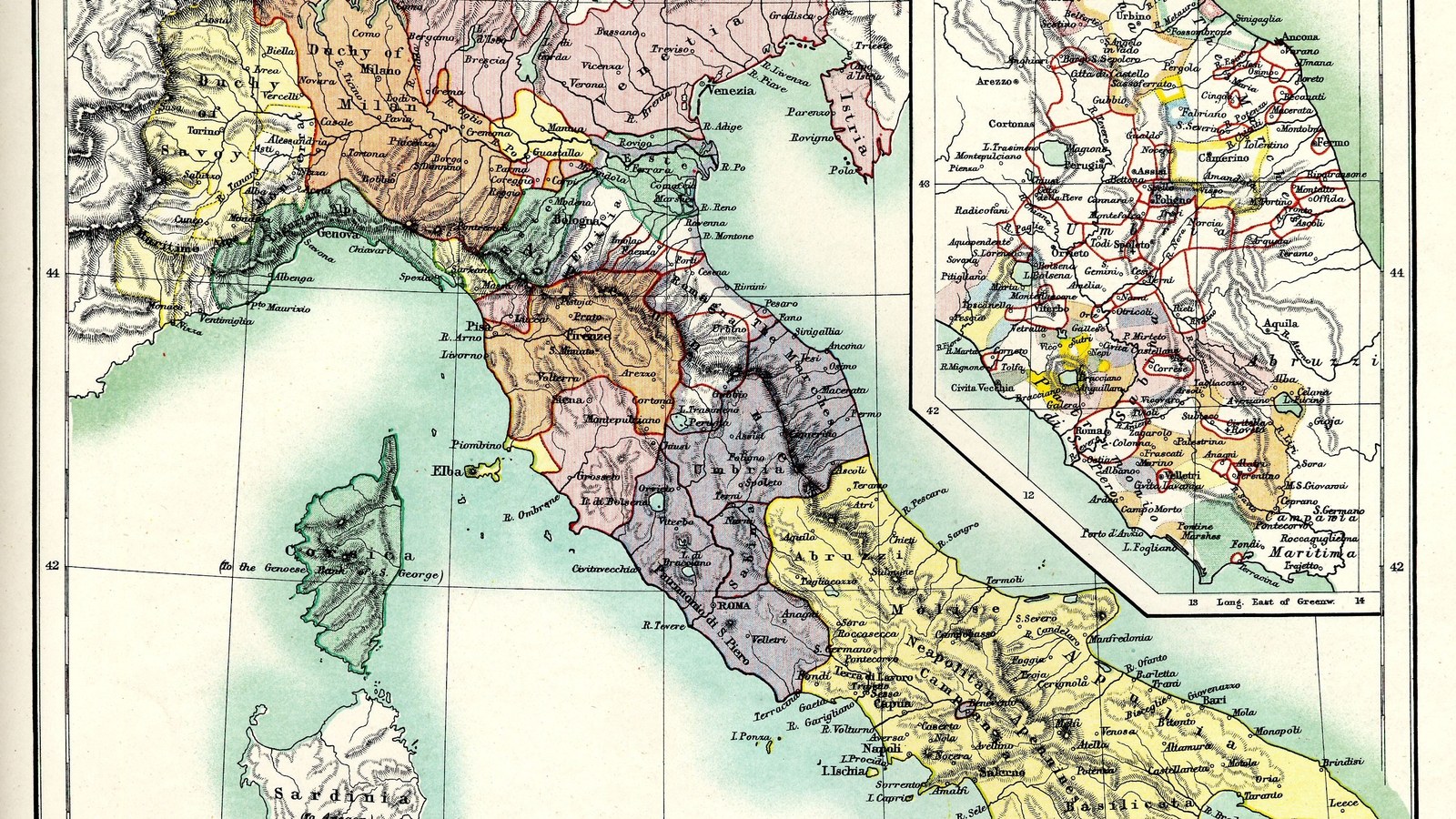
After the death of Filippo Maria Visconti, in 1447, without a son, Milan proclaimed the Golden Ambrosian Republic and gave the army to Francesco Sforza, husband of Bianca Maria. In 1450 Sforza proclaimed himself duke. Venice, with Alfonso V of Aragon, king of Naples, and Emperor Frederick III, stood against him. The fall of Constantinople, in 1453, put Venetian holdings in the Aegean at risk; the Serenissima wanted peace on the peninsula. The peace was signed on 9 April 1454, at Lodi, in the court where Duke Francesco lodged, at the Broletto. Venetian signatories: Simone da Camerino, an Augustinian sent also by Pope Nicholas V, and Paolo Barbo. On the Milanese side, among others, Angelo Simonetta.
The treaty recognises Sforza’s succession to the duchy. The Milanese-Venetian frontier is set on the Adda: left bank Venice, right bank Milan, with a buffer of villages on the left (Crespiatica, Boffalora, Terraverde, Cerreto) so the Venetians do not come under the walls of Lodi. Venice recovers Bergamasco and Bresciano; it receives Crema and the Cremasco. Milan keeps the Gera d’Adda, Caravaggio, Treviglio, Brignano, Mozzanica, Vailate, Agnadello, Rivolta, Pandino; Lodi stays with the duchy. Asola, Lonato and Peschiera stay with the Serenissima; the Gonzaga go without them. Border marks, crosses cut in stone, along the line.
Florence, through Cosimo de’ Medici, Sforza’s old ally, ratified first. Genoa, Mantua, Naples, Savoy, Montferrat followed. In August 1454, with Nicholas V and Alfonso of Aragon, the Italic League took shape: mutual defence, no conquests among them. Five powers hold the balance: Milan, Venice, Florence, Naples, the Papal States. Savoy, Genoa, Gonzaga, Este remain outside the partition, but in the forty-year peace.
Cosimo stood, with Sforza, as the fulcrum. Lorenzo the Magnificent, later, was the guarantor of the equilibrium. Negotiators: Diotisalvi Neroni for Florence; Giovanni Ventimiglia and Onorato Caetani for Naples. The Wars in Lombardy, begun at the end of the fourteenth century, close here.
The peace did not quench every war: Ferrara, the Ottoman landing in the south, the Pazzi conspiracy, the Barons’ conspiracy. It did give the peninsula a settlement in which diplomacy took the place of open hostility, long enough for the Renaissance. In 1494 Charles VIII came down into Italy and the League broke. The cover is the map of Italy just after the peace, on Commons; today’s Broletto is too small for 1600 palms.
Sources: Treaty of Lodi; Encyclopaedia Britannica, Peace of Lodi.











0 Comments
No comments on this article yet. Be the first!