


On 30 January 1648, at Münster, in Westphalia, the plenipotentiaries of Philip IV of Spain and of the States General of the United Netherlands conclude the peace treaty. For Spain: Gaspar de Bracamonte y Guzmán, Count of Peñaranda, and Antoine Brun. For the Dutch, eight: Barthold van Gent (Gelderland), Johan van Matenesse and Adriaan Pauw (Holland), Johan de Knuyt (Zeeland), Godard van Reede van Nederhorst (Utrecht), Frans van Donia (Friesland), Willem Ripperda (Overijssel), Adriaen Clant tot Stedum (Groningen). The text, Dutch and French, four copies. It is not the emperor’s Instrumentum Pacis Monasteriense — that comes in October. Here the Eighty Years’ War ends.
Article 1: the King recognises that the States General and the provinces, with their associated lands, are free and sovereign states, provinces and lands, over which he pretends nothing, now or ever, for himself, his successors and descendants. The peace is perpetual. Article 2: cessation of all hostilities, by sea, waters and land, in all kingdoms and dominions, without distinction of place or person. The model: the Twelve Years’ Truce of 1609, copied across dozens of articles.
Article 3: each keeps what he holds. Remaining to the States: the Meierij of ’s-Hertogenbosch, Bergen op Zoom, Breda, Maastricht with its ressort, Grave and the land of Cuijk, Hulst and Hulster Ambacht, Axele Ambacht, the forts in the Land of Waas, and the other places held in Brabant, Flanders and elsewhere, with the same rights of sovereignty as the United Provinces. The rest of the Land of Waas, except the forts, remains the King’s. The three Overmaze quarters — Valkenburg, Dalhem, ’s-Hertogenrade — stay as they are; dispute, to the chambre mi-partie. The Southern Netherlands remain Spanish.
Article 5: navigation and trade in the East and West Indies, according to the patents of the Dutch East India Company and the West India Company, including places taken from the Dutch by the Portuguese after 1641, in Brazil and elsewhere. The Spaniards remain with the navigation they have in the East Indies, without extending it; the Dutch keep away from the Castilian places there. Article 6: in the West, each avoids the ports held by the other. Article 7: peace within the East Company limits begins after a year; within the West Company’s, after half a year, unless word has arrived sooner.
Article 8: subjects pay no more duties than the inhabitants of the country; the Dutch are exempt from the twenty per cent Spain levied during the Truce. Article 14: the river Scheldt, the channels of the Sas, the Zwijn and the other sea-gates remain closed on the States’ side. Article 19: the public exercise of religion, with modesty, without scandal. Article 21: a mixed chamber, equal numbers of judges, for duties, contraventions, Overmaze.
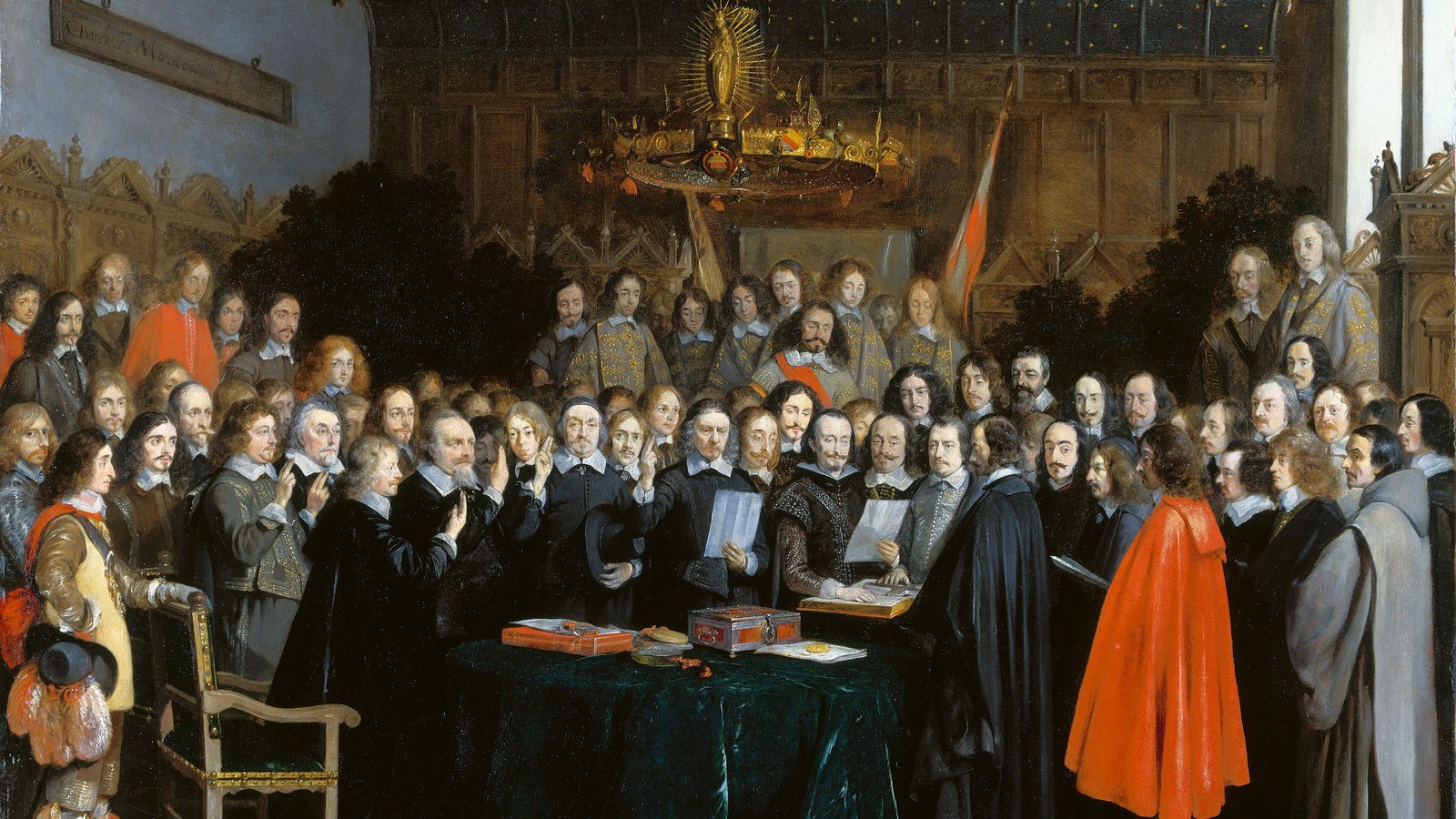
Philip ratifies in Madrid on 1 March. The States, at The Hague, on 18 April. Nederhorst of Utrecht refuses his seal, then is forced, on 30 April. Zeeland sends no man to the oath. On 15 May, in Münster town hall, the envoys swear, a crowd looking on. Gerard ter Borch paints the scene. The States narrowly approve on 5 June. Andries Bicker, Pauw, the Amsterdam clan had pushed the peace; opposition remains: the Catholic South stays Philip’s.
Image: Gerard ter Borch, the oath of the Peace of Münster, 1648, public domain, Rijksmuseum / Wikimedia Commons. Cropped to 16:9.
Source consulted: Peace of Münster. Treaty text: Traktaat van vrede te Münster, 30 January 1648.











0 Comments
No comments on this article yet. Be the first!