


On 2 December 1983 the Protocol on Prohibitions or Restrictions on the Use of Incendiary Weapons (Protocol III) entered into force. It is annexed to the Convention on Certain Conventional Weapons, adopted at Geneva on 10 October 1980 and opened for signature in New York on 10 April 1981. The authentic texts are Arabic, Chinese, English, French, Russian and Spanish. It is not Additional Protocol I of 1977 to the Geneva Conventions.
The framework Convention, Article 1: it shall apply in the situations referred to in Article 2 common to the Geneva Conventions of 12 August 1949, including any situation described in paragraph 4 of Article 1 of Additional Protocol I. Article 4: consent to be bound by any of the annexed Protocols shall be optional, provided that at the time of deposit the State shall notify the Depositary of its consent to be bound by any two or more of those Protocols; any Protocol by which a Party is bound shall form an integral part of this Convention. Article 2: nothing shall be interpreted as detracting from other obligations of international humanitarian law.
Protocol III, Article 1: "incendiary weapon" means any weapon or munition which is primarily designed to set fire to objects or to cause burn injury to persons through the action of flame, heat, or a combination thereof, produced by a chemical reaction of a substance delivered on the target. They can take the form of flame throwers, fougasses, shells, rockets, grenades, mines, bombs and other containers of incendiary substances. They do not include munitions which may have incidental incendiary effects, such as illuminants, tracers, smoke or signalling systems, nor munitions designed to combine penetration, blast or fragmentation effects with an additional incendiary effect, such as armour-piercing projectiles, fragmentation shells and explosive bombs, in which the incendiary effect is not specifically designed to cause burn injury to persons, but to be used against military objectives such as armoured vehicles, aircraft and installations.
Article 1 also defines a concentration of civilians as any concentration, permanent or temporary, such as inhabited parts of cities, inhabited towns or villages, camps or columns of refugees or evacuees, or groups of nomads. A military objective, so far as objects are concerned, is any object which by its nature, location, purpose or use makes an effective contribution to military action and whose total or partial destruction, capture or neutralization, in the circumstances ruling at the time, offers a definite military advantage. Civilian objects are all objects which are not military objectives. Feasible precautions are those which are practicable or practically possible taking into account all circumstances ruling at the time, including humanitarian and military considerations.
Article 2: it is prohibited in all circumstances to make the civilian population as such, individual civilians or civilian objects the object of attack by incendiary weapons. It is prohibited in all circumstances to make any military objective located within a concentration of civilians the object of attack by air-delivered incendiary weapons. It is further prohibited to make any such military objective the object of attack by incendiary weapons other than air-delivered ones, except when the objective is clearly separated from the concentration of civilians and all feasible precautions are taken with a view to limiting the incendiary effects to the military objective and to avoiding, and in any event to minimizing, incidental loss of civilian life, injury to civilians and damage to civilian objects. It is prohibited to make forests or other kinds of plant cover the object of attack by incendiary weapons except when such natural elements are used to cover, conceal or camouflage combatants or other military objectives, or are themselves military objectives.
Convention Article 5: the Convention shall enter into force six months after the twentieth instrument; each annexed Protocol six months after twenty States have notified their consent to be bound by it. Article 6: dissemination, including in programmes of military instruction. The Depositary is the Secretary-General of the United Nations. It is not Protocol IV of 1995 on blinding laser weapons and not Amended Protocol II of 1996.
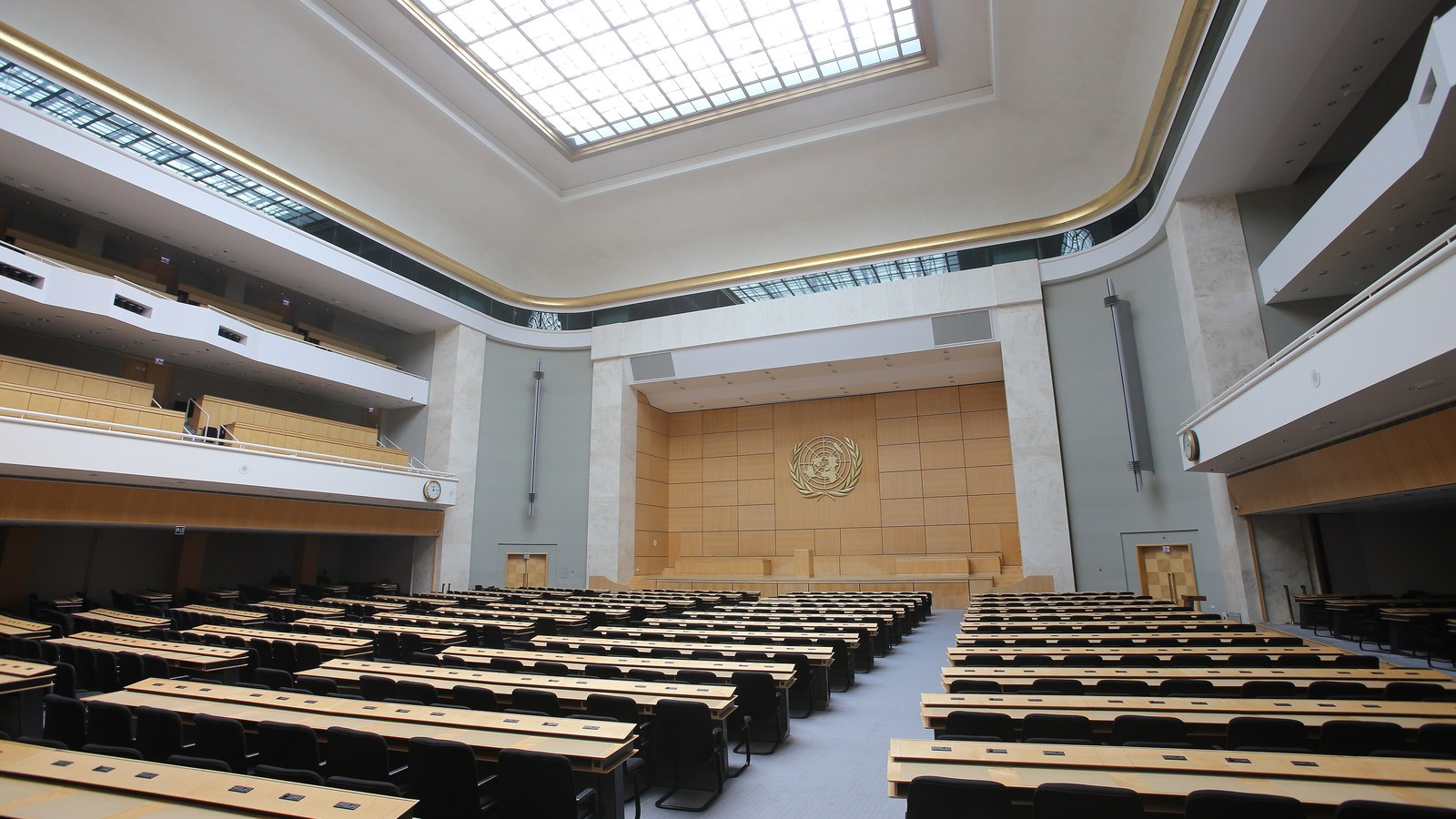
Image: Assembly Hall, Palais des Nations, Geneva; Ludovic Courtes, 5 August 2015; CC BY-SA 3.0, Wikimedia Commons. Cropped to 16:9.
Source consulted: Protocol on Incendiary Weapons. Treaty text: Protocol on Prohibitions or Restrictions on the Use of Incendiary Weapons (Protocol III), Geneva, 10 October 1980.











0 Comments
No comments on this article yet. Be the first!