


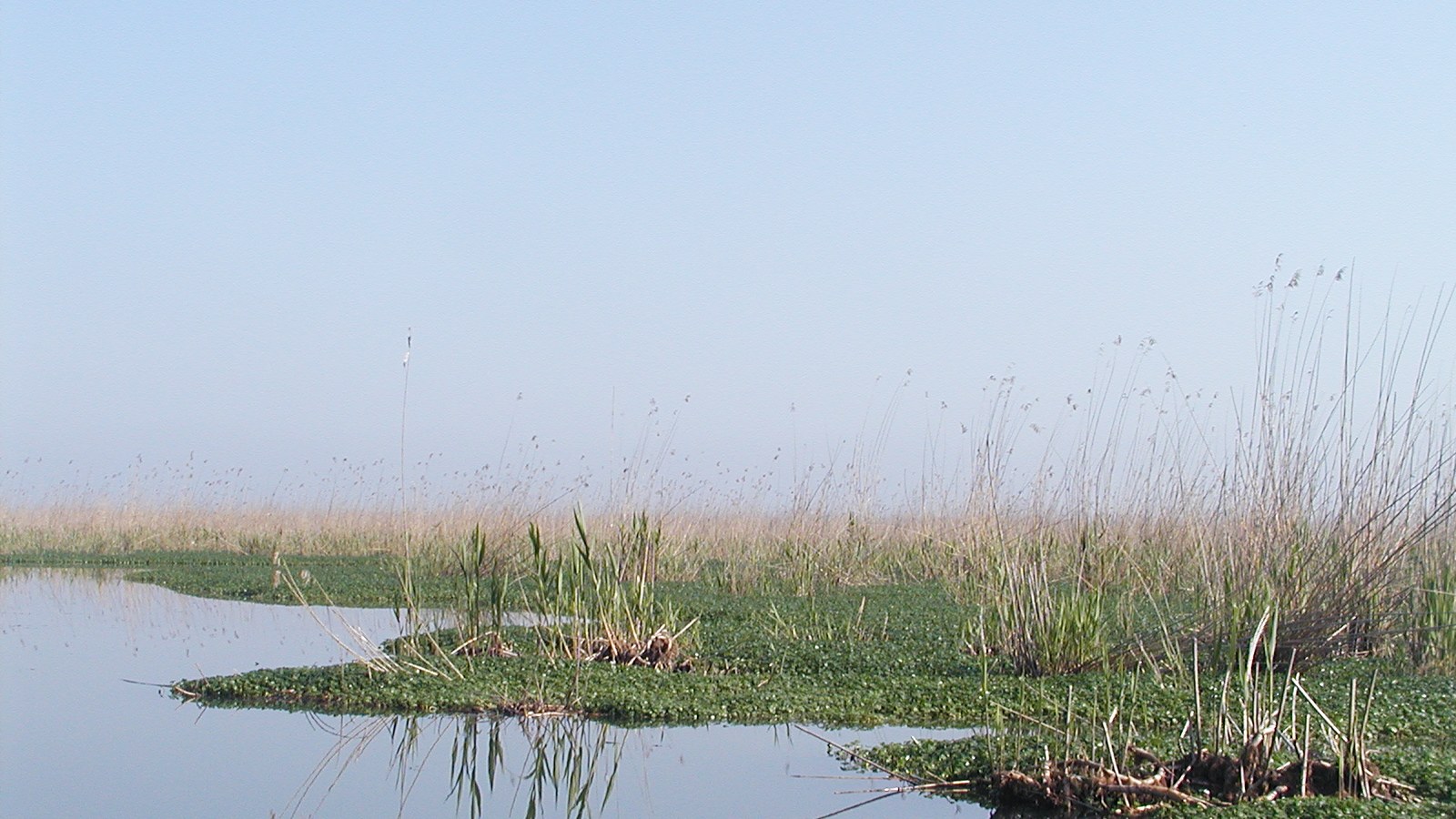
At Ramsar, on the Caspian shore of Iran, on 2 February 1971, the Convention on Wetlands of International Importance especially as Waterfowl Habitat is concluded. The text is done in a single original in the English, French, German and Russian languages — the English text prevailing in case of divergence — deposited with the Depositary, which shall send true copies to all Contracting Parties. The Director-General of UNESCO is the Depositary.
The preamble recognises the interdependence of man and his environment, the fundamental ecological functions of wetlands as regulators of water régimes and as habitats supporting a characteristic flora and fauna, especially waterfowl, the economic, cultural, scientific and recreational value of wetlands, the loss of which would be irreparable, and the desire to stem progressive encroachment on and loss of wetlands. Waterfowl in their seasonal migrations may transcend frontiers and should be regarded as an international resource; conservation can be ensured by combining far-sighted national policies with co-ordinated international action.
Article 1 defines wetlands as areas of marsh, fen, peatland or water, whether natural or artificial, permanent or temporary, with water that is static or flowing, fresh, brackish or salt, including marine areas whose depth at low tide does not exceed six metres, and waterfowl as birds ecologically dependent on wetlands. Article 2 requires each Contracting Party to designate suitable wetlands within its territory for inclusion in a List of Wetlands of International Importance maintained by the bureau under Article 8, with boundaries precisely described and delimited on a map; selection turns on international significance in ecology, botany, zoology, limnology or hydrology, in the first instance for waterfowl. Inclusion does not prejudice the exclusive sovereign rights of the Party. At signature or when depositing ratification or accession, each Party shall designate at least one wetland; it may add, extend or, because of urgent national interests, delete or restrict entries, informing the bureau.
Article 3 requires the Parties to formulate and implement their planning so as to promote the conservation of wetlands included in the List and, as far as possible, the wise use of wetlands in their territory, and to arrange to be informed at the earliest possible time if the ecological character of any listed wetland has changed, is changing or is likely to change as a result of technological developments, pollution or other human interference, passing that information without delay to the bureau.
Article 4 requires promotion of conservation by establishing nature reserves on wetlands, whether listed or not, with adequate wardening; compensation as far as possible for any loss when a Party deletes or restricts a listed wetland for urgent national interest; encouragement of research and exchange of data; endeavour through management to increase waterfowl populations; and promotion of training of competent personnel. Article 5 requires consultation among Parties, especially where a wetland extends over more than one territory or a water system is shared, and co-ordination of policies on conservation of wetlands and their flora and fauna.
Article 6 provides that the Parties shall, as the necessity arises, convene Conferences on the Conservation of Wetlands and Waterfowl, advisory in character, competent to discuss implementation and List changes, consider ecological-character information, make recommendations and request reports from international bodies. Article 7 requires expert representatives and one vote per Party, recommendations being adopted by a simple majority provided that not less than half the Contracting Parties cast votes. Article 8 entrusts the International Union for the Conservation of Nature and Natural Resources with continuing bureau duties until another organisation or government is appointed by a two-thirds majority of all Contracting Parties.
Article 9 leaves the Convention open for signature indefinitely; any member of the United Nations or of a Specialized Agency or of the IAEA or Party to the Statute of the International Court of Justice may become a party by signature without reservation as to ratification, signature subject to ratification followed by ratification, or accession, instruments being deposited with UNESCO. Article 10 provides for entry into force four months after seven States have become Parties, and thereafter four months after each subsequent signature without reservation or deposit of an instrument. Article 11 allows denunciation after five years from entry into force for that Party, effective four months after receipt of notice. Article 12 fixes the Depositary’s notifications and registration with the United Nations Secretariat after entry into force.
Image: Anzali Lagoon, Caspian shore of Iran; public domain, Wikimedia Commons. Cropped to 16:9.
Source consulted: Ramsar Convention. Treaty text: Convention on Wetlands of International Importance especially as Waterfowl Habitat, Ramsar, 2 February 1971, UNESCO.







0 Comments
No comments on this article yet. Be the first!