


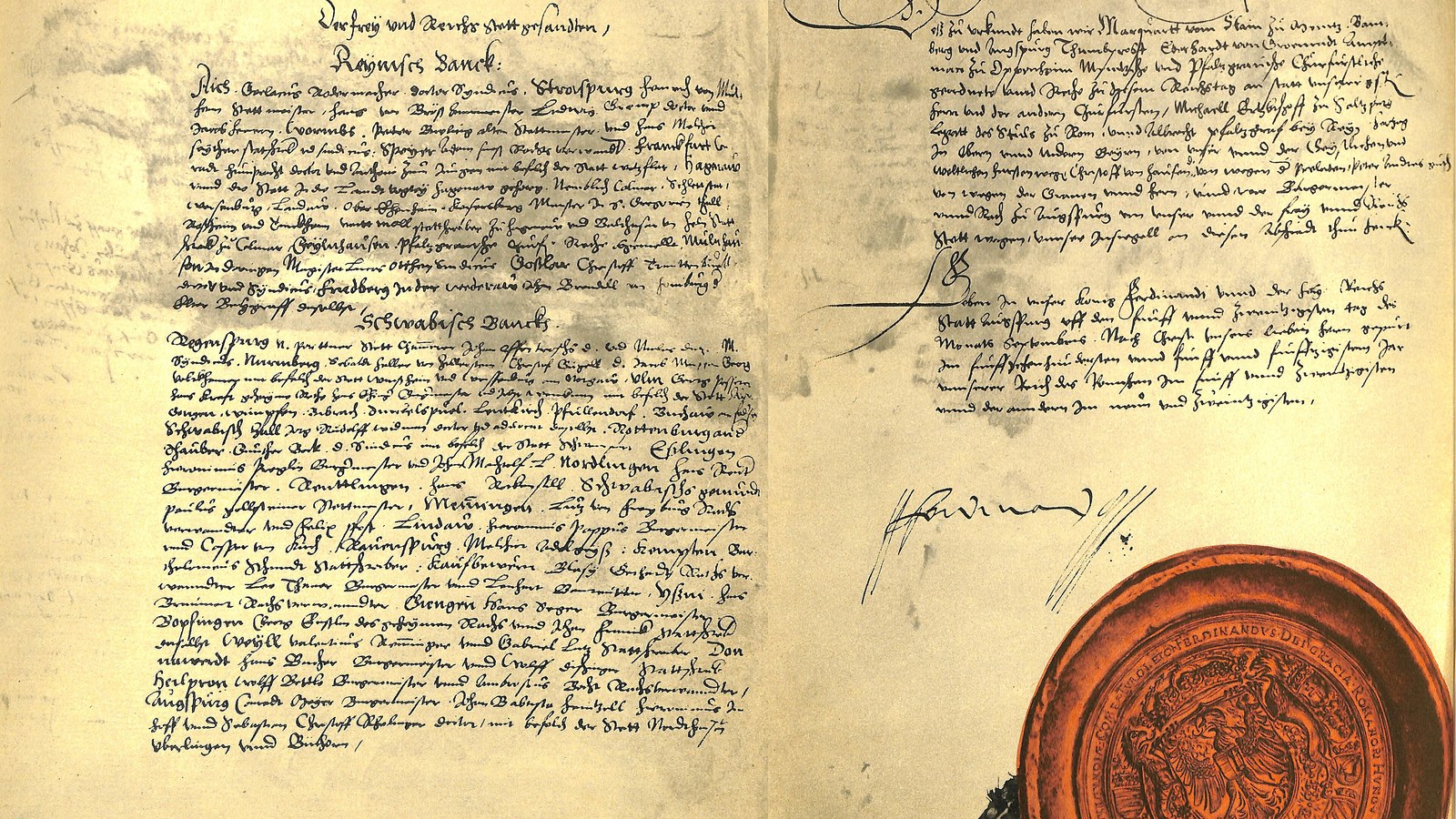
On 25 September 1555, in Augsburg, King of the Romans Ferdinand issued, in the name of his brother Emperor Charles V, the diet recess that contains the religious peace. The dating clause names the twenty-fifth year of the imperial reign. The diet had first been called to Ulm after the Peace of Passau of 1552, then moved. It is not the Augsburg Confession of 1530, not the Interim of 1548, and not the Westphalian peace of 1648.
Paragraph 14 forbids feuds, sieges, fire and the cutting-off of supplies among the estates. Paragraph 15 binds the emperor, the king and the electors, princes and estates not to make war on any estate of the Empire on account of the Augsburg Confession and its doctrine, religion and faith, nor to force it, against conscience, to abandon the usages, ordinances and ceremonies already established, or hereafter established, in its principalities, lands and dominions. A complete peace in the disputed Christian religion is to be sought only by Christian, friendly means, under penalty for breach of the public peace.
Paragraph 16 requires the Confession estates to leave the adherents of the old religion in like manner: faith, usages, possessions, rents, interest and tithes. Paragraph 17 cuts off the rest: all who belong to neither of the two named religions are not included in this peace but altogether excluded. Calvinism, Zwinglianism and Anabaptism thus receive no cover; the later Latin tag “cuius regio, eius religio” does not appear in the recess, being coined only in 1586.
Paragraph 18, the ecclesiastical reservation, is mandated by Ferdinand with the imperial authority fully delegated to him, because the estates could not agree. If an archbishop, bishop, prelate or other spiritual incumbent leaves the old religion, he immediately abandons his see, benefices and fruits, without prejudice to his honour; the chapter elects a successor of the old religion. All of this is subject to a future Christian restoration. Paragraph 19 leaves confiscated abbeys and church goods already converted to churches, schools and charities, unless they belonged to immediate imperial subjects or were still in clerical hands at Passau, and orders the Imperial Chamber Court to accept no suit over those goods.
Paragraph 20 suspends spiritual jurisdiction against adherents of the Confession until a final religious peace, without cutting the chapters’ rents and tithes. Paragraph 23 forbids one estate to draw another’s subjects into its religion. Paragraph 24 allows those who wish to leave, with wives and children, to sell their goods after paying a reasonable sum for freedom from servile obligations and arrears of tax; honorary posts are unrecompensed. Paragraph 26 includes the free knights immediately subject to the emperor. Paragraph 27 leaves both religions standing in many free and imperial cities where they had already been practised, neither party to abolish the other.
Paragraph 25 says the peace holds until a Christian, friendly and final restoration of religious unity, by general council, national council, colloquies or diet; if reunion cannot be obtained, the articles nonetheless remain in force. The Declaratio Ferdinandei, which exempted knights and some cities from religious uniformity, was kept out of the published text for nearly two decades. It is not the Peace of Passau of 1552 and not the Edict of Restitution of 1629.
First edition of the Augsburg recess, Mainz. Image: Wikimedia Commons, public domain.
For context: Peace of Augsburg. The text: The Religious Peace of Augsburg (September 25, 1555).











0 Comments
No comments on this article yet. Be the first!