


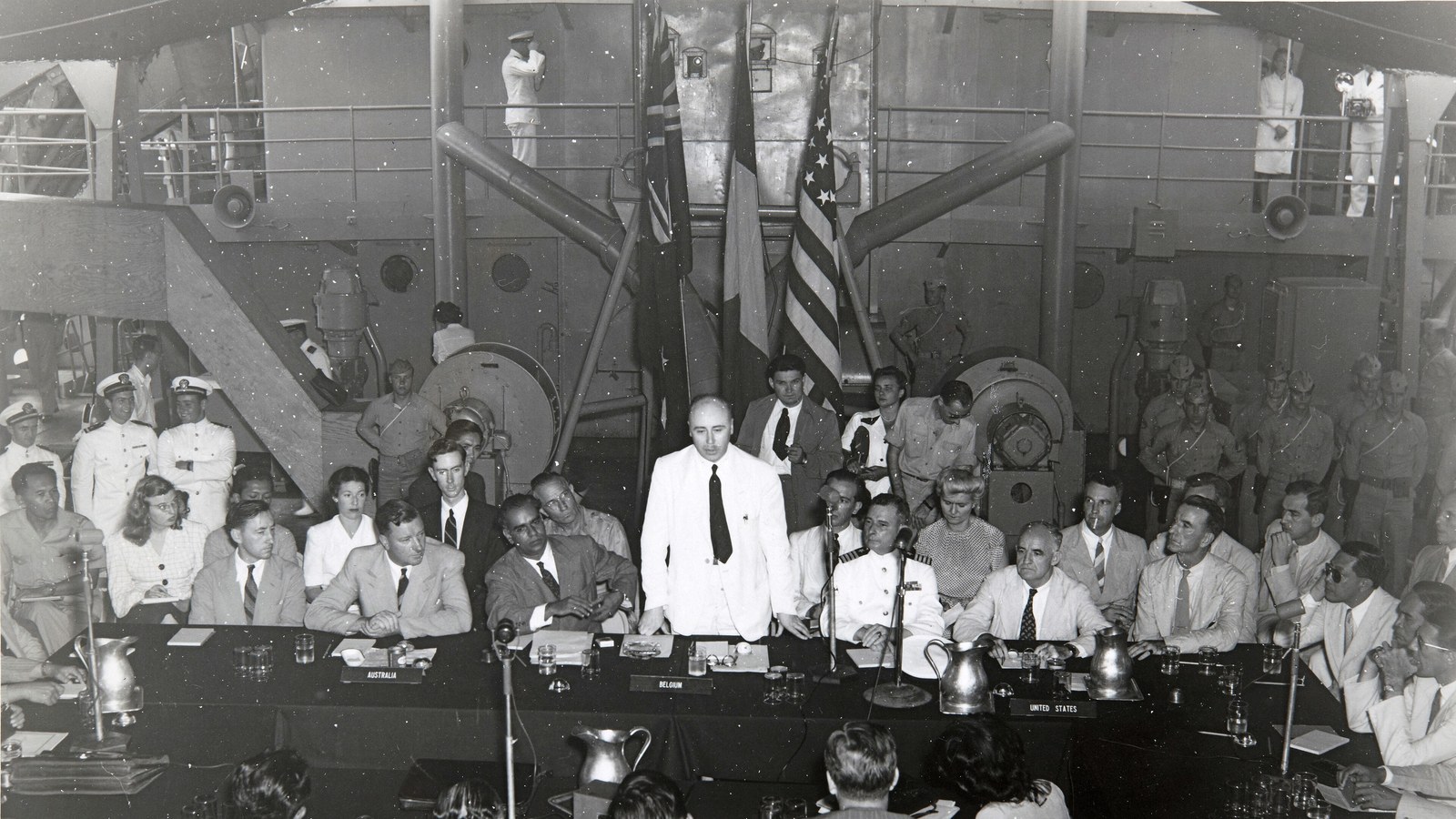
Aboard the American ship USS Renville, anchored in Jakarta Bay, the Government of the Kingdom of the Netherlands and the Government of the Republic of Indonesia sign a truce agreement on 17 January 1948. For the Netherlands the signatory is Raden Abdulkadir Widjojoatmodjo, chairman of the delegation; for the Republic, Amir Sjarifuddin, also chairman of the delegation. The signatures are subscribed in the presence of the representatives on the United Nations Security Council Committee of Good Offices on the Indonesian question: Richard C. Kirby (Australia, chairman), Paul van Zeeland (Belgium) and Frank P. Graham (United States), together with the Committee secretary, T. G. Narayanan. Immediately after the truce, the parties sign twelve political principles as the agreed basis for discussions toward a settlement.
Paragraph 1 provides that a stand-fast and cease-fire order be issued separately and simultaneously by both parties immediately upon signing and be fully effective within forty-eight hours. The order applies to the troops of both parties along the boundary lines of the areas described in the proclamation of the Netherlands Indies Government on 29 August 1947, which shall be called the status quo line, and in the areas specified in the following paragraph. Paragraph 2 provides that, in the first instance and for the time being, demilitarized zones be established in general conformity with that line, comprising as a rule the territories between the status quo line and, on one side, the line of the Netherlands forward positions and, on the other, the line of the Republican forward positions, the average width of each of the zones being approximately the same. Paragraph 3 provides that the establishment of the demilitarized zones in no way prejudices the rights, claims or position of the parties under the Security Council resolutions of August and November 1947.
Paragraph 4 provides that the Committee will place at the disposal of both parties its military assistants, instructed in the first instance to determine whether any incident requires enquiry by the higher authorities of either or both parties. Paragraph 5 leaves, pending a political settlement, responsibility for the maintenance of law and order and of security of life and property in the demilitarized zones vested in the civil police forces of the respective parties; the temporary use of military personnel in the capacity of civil police is not excluded, it being understood that the police forces will be under civil control. The military assistants may call upon pools of police officers; police officers of one party will not move into and throughout the demilitarized zone of the other unless accompanied by a military assistant of the Committee and a police officer of that other party. Paragraph 6 provides that trade and intercourse between all areas should be permitted as far as possible; such restrictions as may be necessary will be agreed upon by the parties with the assistance of the Committee.
Paragraph 7 prohibits sabotage, intimidation, reprisals and destruction of property; requires the parties to refrain from broadcasts or propaganda aimed at provoking or disturbing troops and civilians; requires measures to inform troops and civilians; gives full opportunity for observation by military and civil assistants of the Committee; stops daily operational communiques except weekly lists of those killed or who have died of injuries received in action; and accepts the principle of the release of prisoners without regard to the number held by either party. Paragraph 8 provides that the Committee military assistants will immediately enquire whether, especially in West Java, elements of the Republican military forces continue to offer resistance behind the present Netherlands forward positions; if so, those forces would withdraw as quickly as practicable and in any case within twenty-one days. Paragraph 9 requires that all forces of each party in any area accepted as a demilitarized zone, or on the other party's side of such a zone, move peacefully, under observation and with arms and warlike equipment, to territory on that party's own side. Paragraph 10 keeps the agreement binding unless one party notifies the Committee and the other party that it considers the truce regulations are not being observed and that the agreement should therefore be terminated. An annex allows the forty-eight-hour time limit to be extended up to a maximum of twelve days if a party meets special difficulties.
The twelve principles provide that the assistance of the Committee of Good Offices be continued in the working out and signing of an agreement for the settlement of the political dispute in the islands of Java, Sumatra and Madura, based upon the principles underlying the Linggadjati Agreement. Neither party has the right to prevent the free expression of popular movements looking toward political organizations in accord with those principles; each party will guarantee freedom of assembly, speech and publication at all times, provided that this guarantee is not construed so as to include the advocacy of violence or reprisals. Decisions concerning changes in administration of territory should be made only with the full and free consent of the populations of those territories and at a time when their security and freedom from coercion will have been ensured. On the signing of the political agreement, provision is to be made for the gradual reduction of the armed forces of both parties. As soon as practicable after the signing of the truce, economic activity, trade, transportation and communications are to be restored through the co-operation of both parties, taking into consideration the interests of all the constituent parts of Indonesia.
Provision is made for a period of not less than six months nor more than one year after the signing of the political agreement, during which uncoerced and free discussion of vital issues will proceed; at the end of this period free elections will be held for self-determination by the people of their political relationship to the United States of Indonesia. A constitutional convention is to be chosen according to democratic procedure to draft a constitution for the United States of Indonesia. If, after signing the agreement referred to in the first principle, either party should ask the United Nations to provide an agency to observe conditions up to the point at which sovereignty is transferred from the Government of the Netherlands to the Government of the United States of Indonesia, the other party will take this request in serious consideration. The last four principles, taken from the Linggadjati Agreement, are independence for the Indonesian peoples, co-operation between the peoples of the Netherlands and Indonesia, a sovereign State on a federal basis under a constitution arrived at by democratic processes, and a union between the United States of Indonesia and other parts of the Kingdom of the Netherlands under the King of the Netherlands.
At the same meeting the Committee presents six additional principles. Sovereignty throughout the Netherlands Indies is and shall remain with the Kingdom of the Netherlands until, after a stated interval, the Kingdom transfers its sovereignty to the United States of Indonesia; prior to the termination of that interval the Kingdom may confer appropriate rights, duties and responsibilities on a provisional federal government of the territories of the future United States of Indonesia. The United States of Indonesia, when created, will be a sovereign and independent State in equal partnership with the Kingdom of the Netherlands in a Netherlands-Indonesian Union at the head of which shall be the King of the Netherlands; the status of the Republic of Indonesia will be that of a State within the United States of Indonesia. In any provisional federal government created prior to ratification of the constitution, all States will be offered fair representation. Prior to the dissolution of the Committee, either party may request that its services be continued to assist in adjusting differences relating to the political agreement during the interim period; the other party will interpose no objection, and the request would be brought to the attention of the Security Council by the Government of the Netherlands. Within a period of not less than six months or more than one year from the signing of this agreement, a plebiscite will be held to determine whether the populations of the various territories of Java, Madura and Sumatra wish their territory to form part of the Republic of Indonesia or of another State within the United States of Indonesia, under observation by the Committee should either party so request; the parties may agree that another method of ascertaining the will of the populations may be employed. Following the delineation of the States, a constitutional convention will be convened through democratic procedures, with representation of the various States in proportion to their populations. Should any State decide not to ratify the constitution and desire, in accordance with Articles 3 and 4 of the Linggadjati Agreement, to negotiate a special relationship with the United States of Indonesia and the Kingdom of the Netherlands, neither party will object. This text is not the Linggadjati Agreement, nor the later Round Table instruments.
Image: first plenary session of the Committee of Good Offices aboard USS Renville, 8 December 1947; unknown author, Tropenmuseum / NMvWereldculturen TM-60042227; public domain, Wikimedia Commons. Cropped to 16:9.
Source consulted: Renville Agreement. Treaty text: Truce Agreement between the Governments of the Kingdom of the Netherlands and of the Republic of Indonesia, Department of State Bulletin, 14 March 1948.











0 Comments
No comments on this article yet. Be the first!