


On 19 November 1973, in Montevideo, Juan Carlos Blanco, Minister for Foreign Affairs of the Eastern Republic of Uruguay, and Alberto J. Vignes, Minister for Foreign Affairs and Worship of the Argentine Republic, signed and sealed two copies of the same tenor of the Treaty concerning the Río de la Plata and the Corresponding Maritime Boundary. The preamble invokes the Ramírez–Sáenz Peña Protocol of 1910, the Joint Declaration of 30 January 1961 on the outer limit of the river and the 1964 Protocol. The heads of State do not sign. On the same day, reverse notes complete the list of port access channels and the limits of the freedom of overflight in Article 72.
Article 1: the Río de la Plata extends from the Punta Gorda parallel to the imaginary straight line joining Punta del Este and Punta Rasa del Cabo San Antonio. Article 2: a belt of exclusive jurisdiction seven nautical miles wide between the outer limit of the river and the Colonia–Punta Lara line, and two nautical miles wide from that line to the Punta Gorda parallel, inflected so as not to pass the edges of channels in shared waters and so that port access channels are included. Article 7: freedom of navigation throughout the river for vessels flying each Party’s flag, permanently. Article 10: use, on equal terms, of all channels in shared waters.
Article 41: each Party may explore and exploit the bed and subsoil up to the line of geographical points on charts H-118, H-117 and H-113. Article 44: existing or future islands belong to one or other Party according to that line, except Martín García Island. Article 45: Martín García shall be used exclusively as a nature reserve for indigenous fauna and flora, under the jurisdiction of Argentina, without prejudice to Article 63. Article 53: exclusive fishing in each Party’s own coastal belt; outside those belts, freedom to fish for vessels of the other flag.
Article 59: a joint Administrative Commission of the Río de la Plata is established, with an equal number of representatives. Article 63: its headquarters are on Martín García Island, with a park dedicated to heroes common to both peoples; Argentina retains the premises needed for the jurisdiction in Article 45. Article 70: the maritime lateral limit and that of the continental shelf is the equidistance line determined by the adjacent coasts method, from the mid-point of the Punta del Este–Punta Rasa line. Article 73: a common fishing zone beyond 12 nautical miles, determined by two arcs of 200 nautical miles centred on those same points. Article 80: a Joint Technical Commission, with headquarters in Montevideo (Article 83), co-ordinates conservation of living resources and protection of the marine environment in the common zone.
Article 85: matters relating to the defence of the entire Río de la Plata focal area fall within the exclusive competence of the Parties. Article 87: any dispute concerning interpretation or application which cannot be settled by direct negotiations may be submitted by either Party to the International Court of Justice. Article 92: the Treaty shall be ratified in accordance with each Party’s legal system and shall enter into force by the exchange of instruments of ratification in Buenos Aires. The exchange took place on 12 February 1974.
It is not the Treaty concerning the boundary constituted by the River Uruguay of 7 April 1961, not the 1975 Statute of the River Uruguay and not an agreement on pulp mills on the Uruguay.
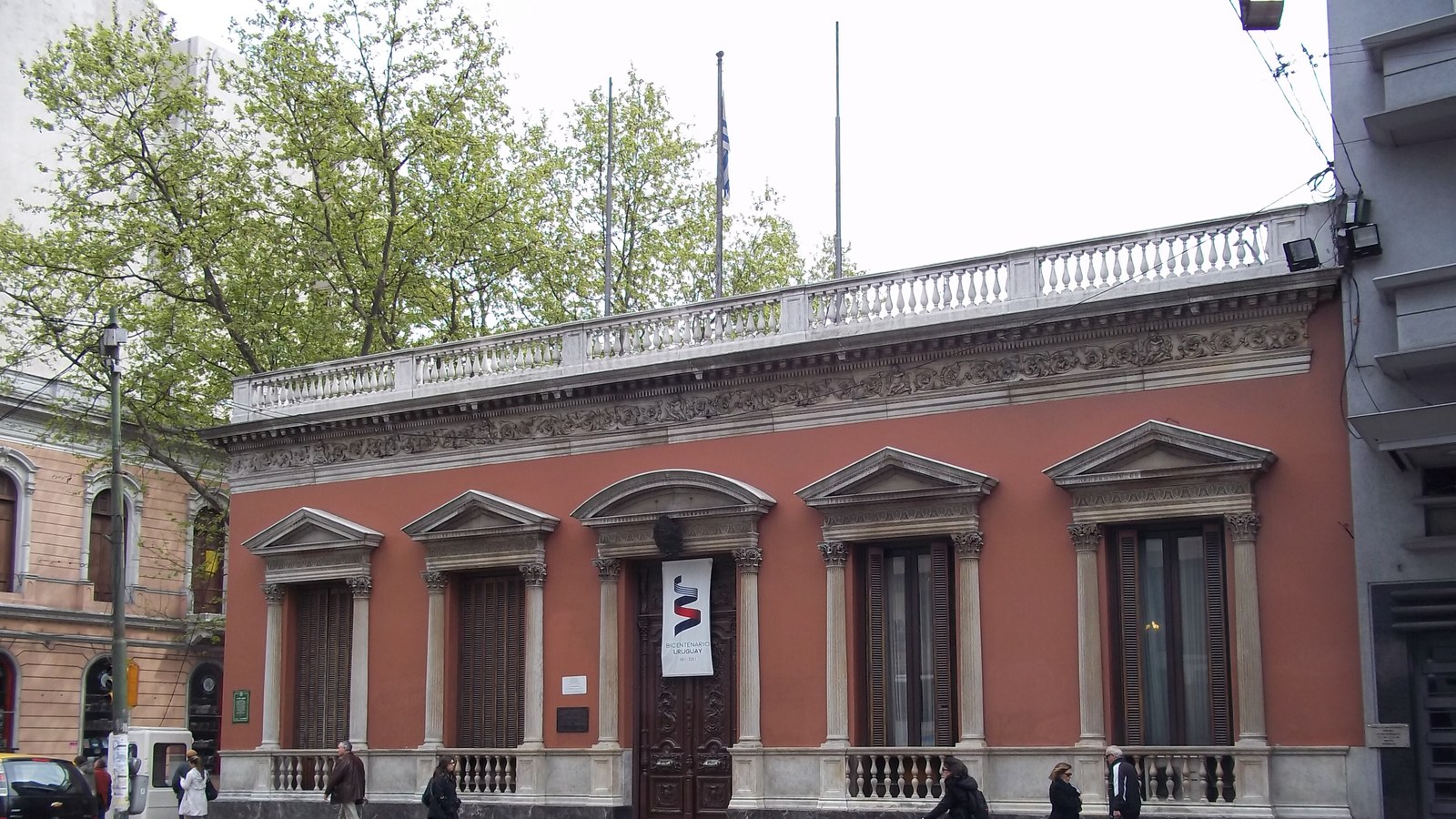
Image: Palacio Santos, seat of the Uruguayan Ministry of Foreign Affairs, Montevideo; Andrea Mazza, 8 October 2011; CC BY-SA 3.0, Wikimedia Commons. Cropped to 16:9.
Source consulted: 1973 Boundary Treaty between Uruguay and Argentina. Treaty text: Treaty between Uruguay and Argentina concerning the Río de la Plata and the Corresponding Maritime Boundary, Montevideo, 19 November 1973.











0 Comments
No comments on this article yet. Be the first!