
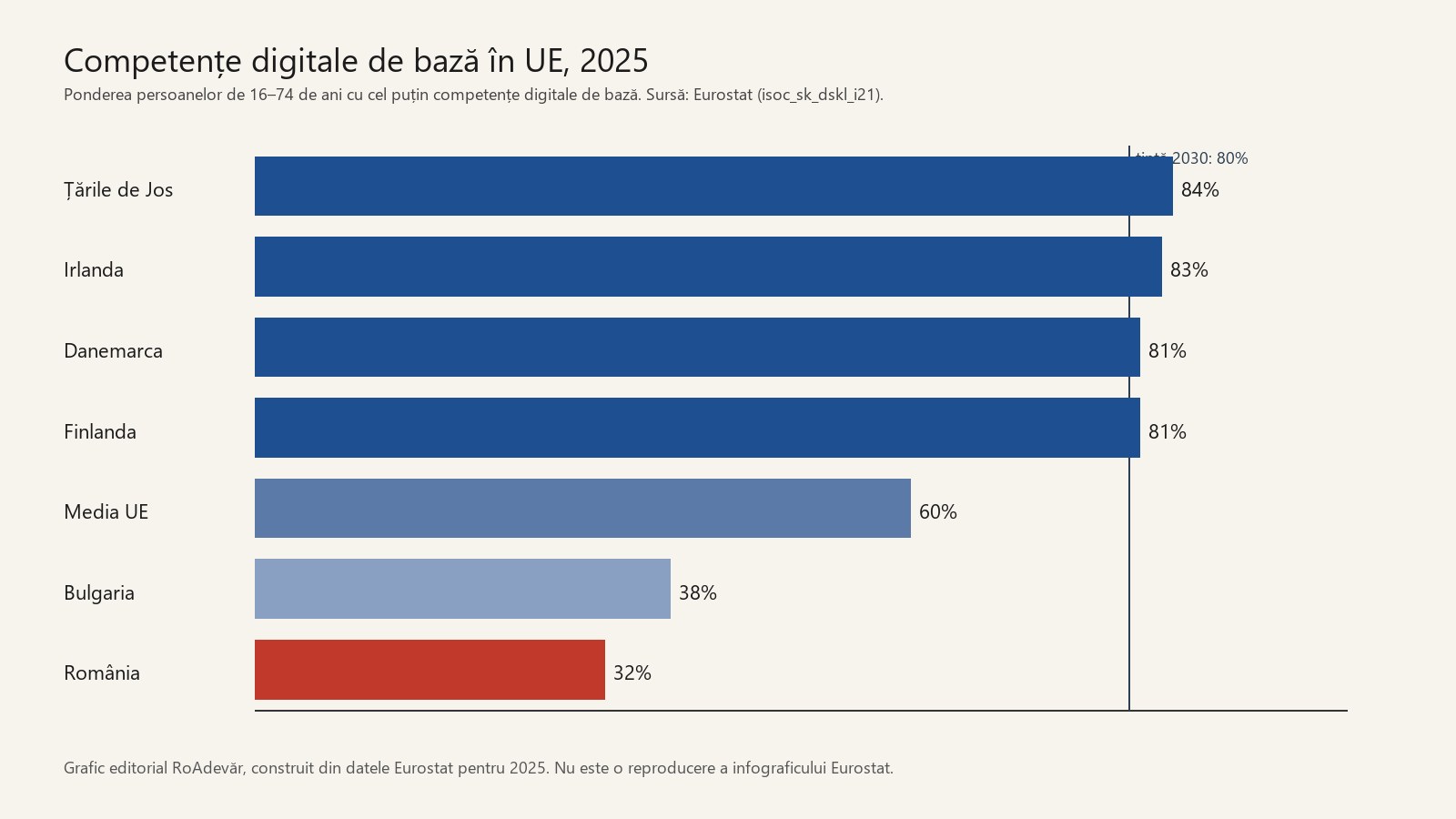
Romania recorded the European Union’s lowest share of people with at least basic digital skills in 2025: 32% of those aged 16–74, according to Eurostat data extracted in June 2026. The EU average was 60%, 20 percentage points below the 80% target set for 2030 in the Digital Decade programme. The Netherlands stood at 84%, Ireland at 83%, and Denmark and Finland at 81% each. Bulgaria followed Romania, at 38%.
The indicator does not measure ownership of a phone or simple internet access. The Digital Skills Indicator covers five DigComp areas: information and data, communication and collaboration, content creation, safety and problem-solving. For the “at least basic” level, a person must have carried out relevant activities in each of those areas, according to the methodology. Daily use of social networks is not, by itself, enough.
The 32% figure does not mean that 68% of Romanians “do not know how to use the internet”. Someone may go online without meeting every criterion for the basic or above-basic classification. Eurostat treats the indicator as a proxy for skills, built from reported activities, not as a practical exam.
At European level there is a clear generational gap. In 2025 about three-quarters of 16–24-year-olds and of 25–34-year-olds had at least basic digital skills, while among 65–74-year-olds the shares fall towards one-third. In a separate July 2026 article Eurostat reported that 53.3% of Romanians aged 16–24 met the threshold in 2025: better than the national 16–74 average, but still towards the bottom of the European ranking for that age group.
Digitalisation cannot be reduced to a single percentage. Among ICT specialists, women accounted in 2025 for 27.8% of such employment in Romania, one of the highest shares in the EU, against 19.5% at Union level. At the same time the share of ICT specialists in total employment remains low (2.7%), and the use of e-government, electronic identification, cloud services by firms and artificial intelligence in enterprises places Romania, in the same 2025 data, among the last-ranked countries.
Digital skills matter for jobs, online public services, banking, education, information and protection against internet risks. Four years before the Digital Decade deadline, Romania starts from 32% among 16–74-year-olds, while the European leader is already at 84%. The gap to the average and to the target is substantial, without turning a methodological indicator into a verdict of mass “digital illiteracy”.
RoAdevăr editorial chart built from Eurostat data (isoc_sk_dskl_i21) for 2025. Not a reproduction of Eurostat’s own infographic.
Source consulted: Towards Digital Decade targets for Europe (Eurostat).








0 Comments
No comments on this article yet. Be the first!