


On 26 October 1961, in Rome, the International Convention for the Protection of Performers, Producers of Phonograms and Broadcasting Organisations was concluded, in a single copy in English, French and Spanish, equally authentic; official texts also in German, Italian and Portuguese. Depositary: the Secretary-General of the United Nations. It is not the Berne Convention of 1886, nor the Geneva Phonograms Convention of 1971, nor the WPPT of 1996. The diplomatic conference, 10–26 October, was convened by the ILO, UNESCO and the Berne Union (BIRPI), at Italy’s invitation. Article 1: the protection leaves intact copyright in literary and artistic works.
Article 3: performers — actors, singers, musicians, dancers and others who perform literary or artistic works; phonogram — any exclusively aural fixation of sounds; producer — the person or entity which first fixes the sounds; broadcasting — wireless transmission for public reception. Article 2: national treatment, subject to the Convention’s minima. Articles 4–6: points of attachment — place of performance, of fixation, of publication, the organisation’s headquarters and the transmitter; simultaneous publication within thirty days. States may, by notification to the United Nations, exclude the criterion of publication or of fixation.
Article 7: performers may prevent, without their consent, the broadcasting and communication to the public of their live performance, its fixation, and the reproduction of a fixation if the original was made without consent or is used for another purpose. Article 8: representation when several take part. Article 9: protection may be extended to variety and circus artists. Article 10: the producer authorises or prohibits direct or indirect reproduction. Article 11: formalities are treated as fulfilled if copies bear the symbol (P) and the year of first publication. Article 12: when a commercially published phonogram is used for broadcasting or communication to the public, a single equitable remuneration is paid to the performers, the producers, or both. Article 13: broadcasting organisations — rebroadcasting, fixation, reproduction, communication to the public of television broadcasts in places open against an entrance fee.
Article 14: at least twenty years from the end of the year of fixation, of the unfixed performance, or of the broadcast. Article 15: exceptions — private use, short excerpts in reporting current events, ephemeral fixation by a broadcasting organisation, teaching and scientific research; the same kinds of limits as for copyright, without compulsory licences incompatible with the Convention. Article 16: reservations to Article 12 and to Article 13(d). Article 19: once a performer has consented to incorporation in a visual or audiovisual fixation, Article 7 has no further application. No retroactivity; special agreements may grant wider rights.
Article 23: open for signature until 30 June 1962, for States invited to the conference that are parties to the Universal Copyright Convention or members of the Berne Union. Article 25: it comes into force three months after the sixth instrument; it entered on 18 May 1964 (496 UNTS 43). Denunciation after five years in force for that State, taking effect twelve months later. Unsettled disputes go to the ICJ, unless another mode is agreed. An intergovernmental committee of the ILO, UNESCO and BIRPI. Among the day’s signatories: Italy, France, Germany, Argentina, Brazil, Mexico. Romania acceded only on 22 July 1998.
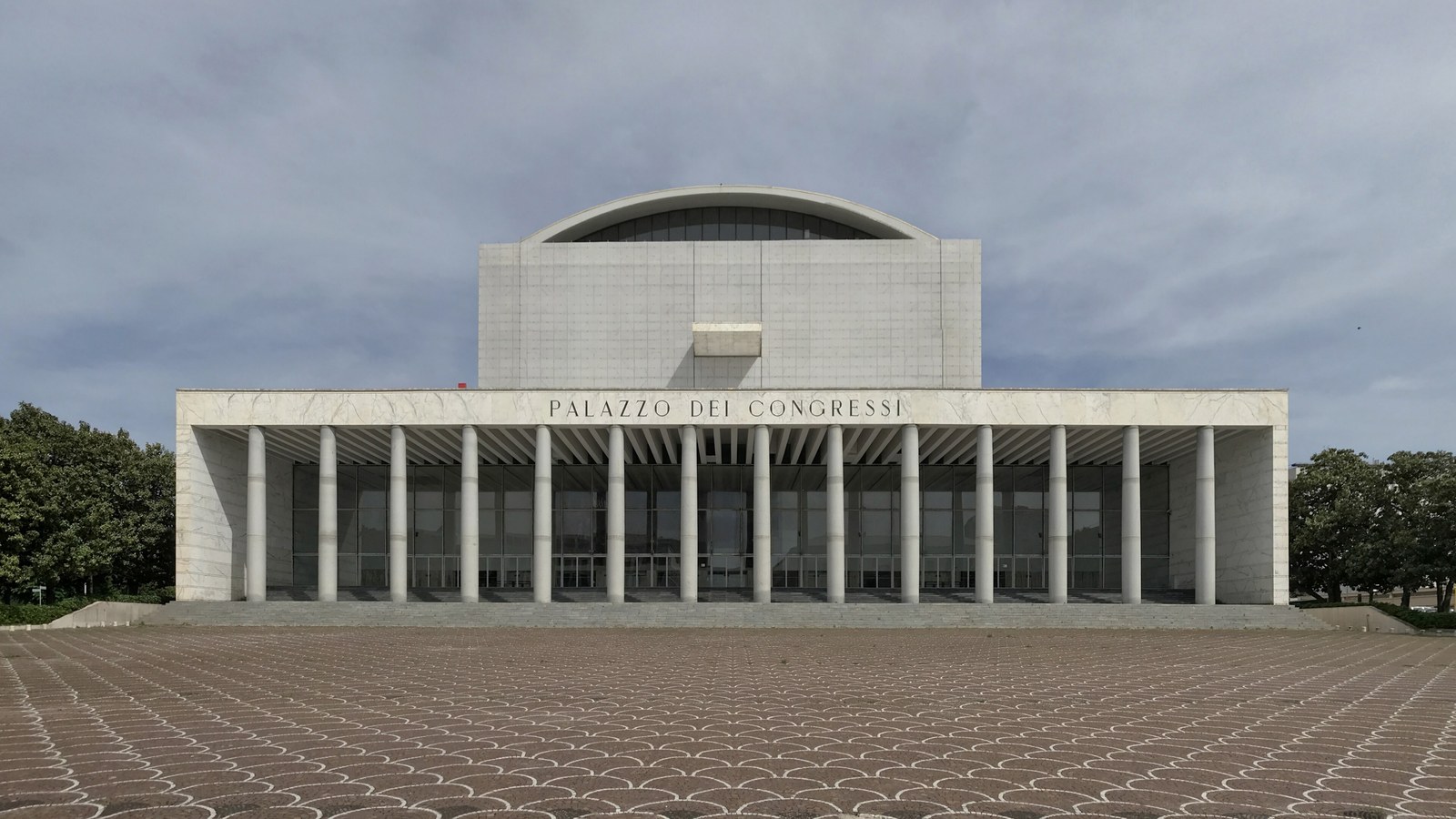
Palazzo dei Congressi, EUR, Rome. Recent façade, not the conference hall of 1961. Wikimedia Commons, CC BY-SA 4.0.
For context: Rome Convention for the Protection of Performers, Producers of Phonograms and Broadcasting Organisations. The text: International Convention (Rome, 26 October 1961).











0 Comments
No comments on this article yet. Be the first!