


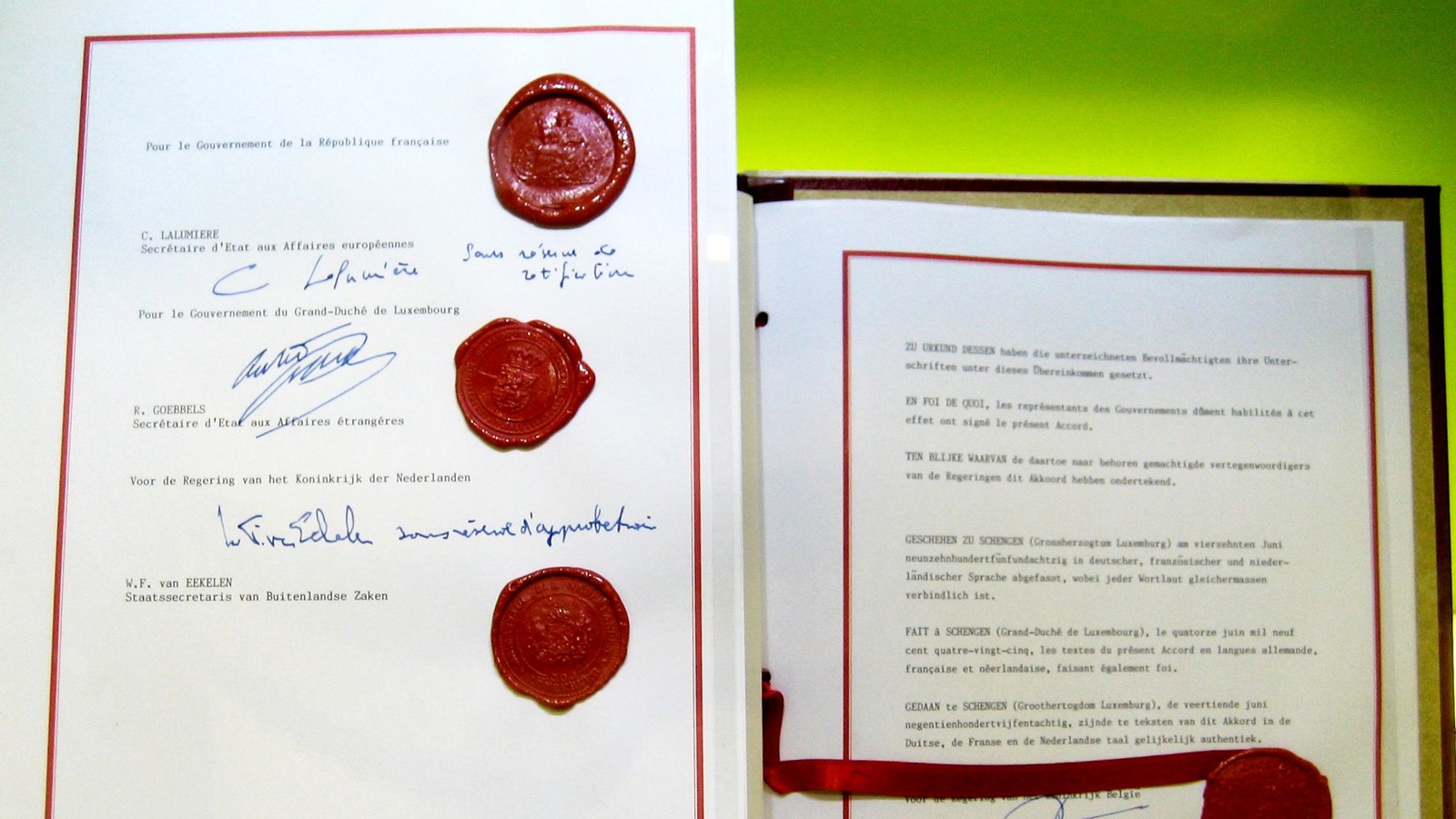
At Schengen, on 14 June 1985, aboard the Princesse Marie-Astrid, moored on the Moselle at the tripoint of Luxembourg, France and Germany, the agreement on the gradual abolition of checks at the common borders was signed by Paul de Keersmaeker, Belgian State Secretary for European Affairs; Waldemar Schreckenberger, State Secretary in the Federal Chancellery of the FRG; Catherine Lalumière, French State Secretary for European Affairs; Robert Goebbels, Luxembourg State Secretary for Foreign Affairs; and Wim F. van Eekelen, Netherlands State Secretary for Foreign Affairs. The instrument has 33 articles, in German, French and Dutch, all authentic. The depositary is the Government of the Grand Duchy. It binds the five governments, not the European Community.
The Schengen Agreement of 1985 is not the Implementing Convention of 19 June 1990, nor the opening of the Area on 26 March 1995, nor the Treaty of Amsterdam of 1999, nor the Benelux abolition of 1970, nor the Saarbrücken agreement of 13 July 1984. Presidents and chancellors did not sign; the state secretaries did.
Title I contains the short-term measures. Article 2: from 15 June 1985 the police and customs authorities as a rule carry out only a visual check of private vehicles crossing the common border at reduced speed, without stopping them; more thorough checks, by sampling, are as far as possible made off the lane. Article 3: a green disc of at least 8 cm on the windscreen means that the occupants comply with frontier-police, goods and currency rules. Article 6: residents of communes on the common borders may cross away from authorised crossing-points and outside opening hours, if the goods they carry are within the allowances. Article 7: approximation of visa policy, preferably by 1 January 1986.
Articles 8–10 require coordinated action against narcotics trafficking, weapons, illegal stay and smuggling, and regular meetings of the competent authorities. Articles 11–16 ease road haulage (from 1 July 1985, no systematic checks of driving times, weights or technical condition), rail and inland-waterway transport. Title II, Articles 17–28, sets the long-term measures: abolition of checks at the common borders, police, customs and judicial cooperation, visas, arms, narcotics and the movement of goods, to be pursued if possible by 1 January 1990 (Art. 30).
Article 29: the agreement also applies to Land Berlin unless the FRG declares otherwise within three months of entry into force. Article 31: without prejudice to Articles 5, 6 and 8–16 of the Saarbrücken treaty. Article 32: signature with or without reservation of ratification; provisional application from the day after signature; entry into force 30 days after deposit of the last instrument. Article 33: deposit in Luxembourg. For the Netherlands, entry into force was 2 March 1986.
The 1990 Convention, not the 1985 Agreement, abolished systematic internal checks and made the Area. The 1985 Agreement is not that Convention, nor the later list of the 29 states in the Area.
Image: signatures of the 1985 Schengen Agreement, on display at the Schengen Treaty Museum, Schengen, 22 May 2011; Zinneke, CC BY-SA 3.0, Wikimedia Commons. Cropped to 16:9.
Source consulted: Schengen Agreement. Treaty text: EUR-Lex: OJ L 239, 22.9.2000, Schengen Agreement (1985).











0 Comments
No comments on this article yet. Be the first!