


On 19 October 1466, a Sunday, at about the hour of terce, actum et datum in Thorun, in the third year of Pope Paul II, King Casimir IV Jagiellon and Grand Master Ludwig von Erlichshausen sealed the Second Peace of Thorn, in Latin. It is not the first peace of February 1411, after Grunwald, not Melno of 1422 and not the Cracow homage of 1525. The treaty ends the Thirteen Years’ War, begun in February 1454 by the Prussian Confederation of Danzig, Elbing, Kulm and Thorn, with the gentry, asking to join the Polish Crown.
Talks opened on 23 September at Nieszawa, now Mała Nieszawka, and moved to Toruń. After Chojnice fell, on 28 September, the Order gave more ground. Legate Rudolf von Rüdesheim, Bishop of Lavant, went to the Grand Master at Chełmno and came back on 9 October with fresh offers. The signing was in the Artus Court; the thanksgiving mass, in the Gothic Franciscan church of the Assumption. Both sides agreed to seek confirmation from Paul II and Emperor Frederick III, but the Polish side held, and the Teutonic side accepted, that confirmation was not needed for the act to stand.
The Order dropped its claims to Pomerelia, with Danzig and the Żuławy, to Chełmno Land and to Michałów Land, which return to Poland. East of the Nogat, Poland takes Marienburg, Elbing, Lake Druzno, Tolkmicko, the Pasłęk district, Dzierzgoń and Warmia. What remains in the east stays with the Order, seated at Königsberg, as a fief of the Crown. The diocese of Chełmno becomes a suffragan of Gniezno. Pomesania remains a territorial lordship of the Order.
Every new Grand Master, within six months of taking office, swears fealty to the Polish king. The Grand Master is a prince and counsellor of the king, summoned to the council. Poles are admitted to the Order. The knights aid Poland in war and do not wage war on Catholics without the king’s consent. Prisoners on both sides are released. The treaty shuts the path of dissolving the vassalage through pope or emperor.
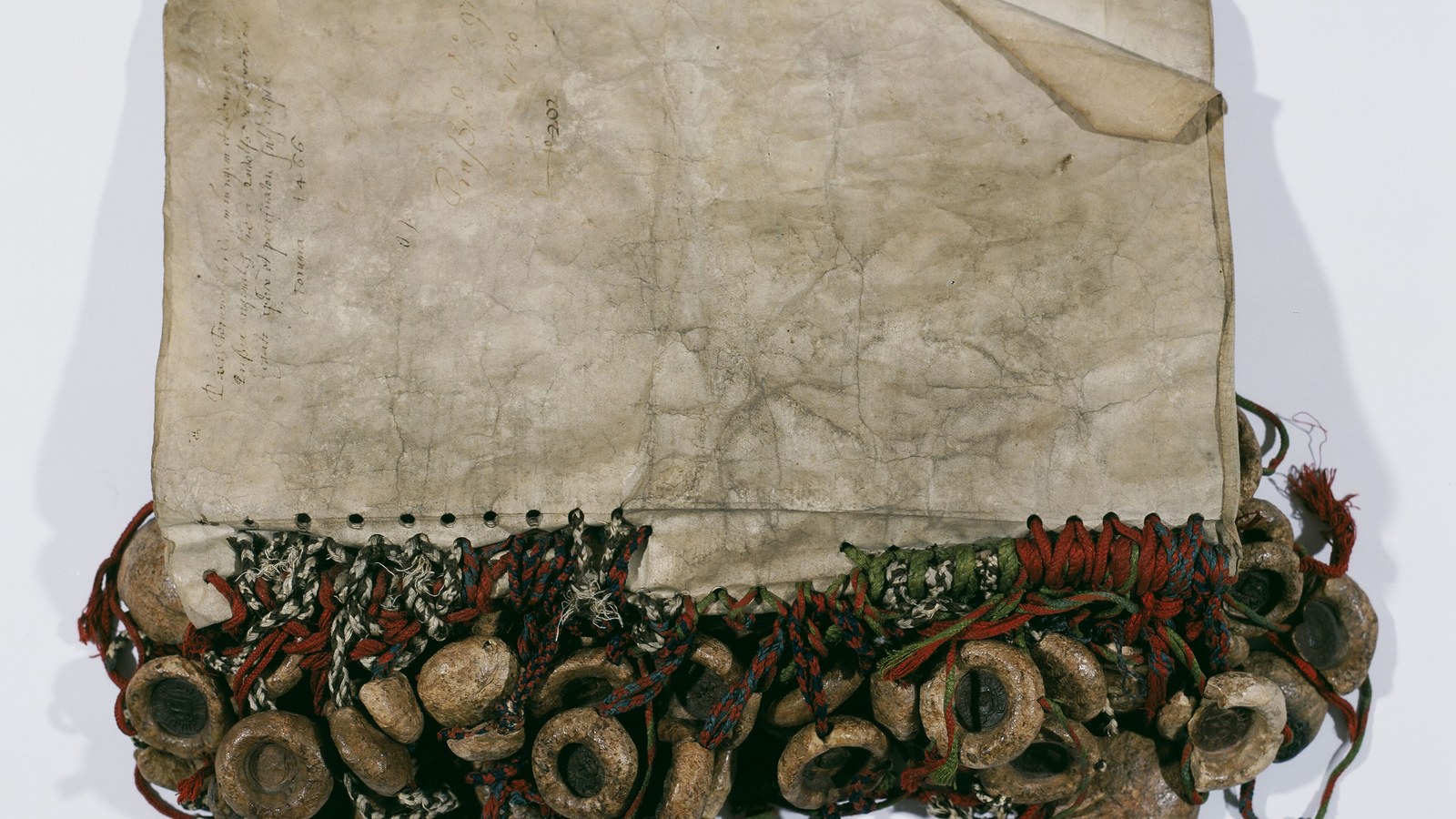
The originals are six parchments: two Polish, four Teutonic. The Polish copy in AGAD, Zbiór dokumentów pergaminowych no. 1140, bears the seals of Archbishop Jan Gruszczyński, of the bishops, of Cracow, Poznań, Toruń and Old Danzig. The Order copy no. 1144, described by Nowak, is a booklet of twelve leaves, sealed by Rudolf, by Heinrich Reuss von Plauen and by the Order’s bull. It is not the peace of Brześć Kujawski of 1435.
Painting of 1873 by Marian Jaroczyński, District Museum in Toruń, not a picture from the day of the signing. Public domain, Wikimedia Commons.
For context: Second Peace of Thorn (1466). The parchment: II Traktat Toruński.











0 Comments
No comments on this article yet. Be the first!