


Napoleon escaped from Elba in February 1815, entered Paris on 20 March and reopened the Hundred Days. After Waterloo he abdicated again on 22 June. Louis XVIII, who had fled, took the throne on 8 July. The first Treaty of Paris, of 30 May 1814, had been negotiated by Talleyrand in two months. The second took five months of bitter talks. The victors of Waterloo — the British and the Prussians — dominated; the Austrians, the Russians and the French sat in the background. The Prussian general staff, backed by Blücher, demanded Alsace, Lorraine, the Saarland, Luxembourg and Savoy, plus 1.2 billion francs. Castlereagh, anxious not to alienate the French from the restored Bourbons, kept the treaty only moderately harsher than that of 1814.
The Definitive Treaty between France and each of the four great powers of the Seventh Coalition — Austria, Great Britain, Prussia and Russia — was signed on 20 November 1815 in Paris, in French, with identical stipulations. For Great Britain the signatories were Robert Stewart, Viscount Castlereagh, and the Duke of Wellington; for France, Armand-Emmanuel du Plessis, Duc de Richelieu. The same day saw the conventions on the pecuniary indemnity, the military line and private claims, the additional article on the slave trade, the act of Swiss neutrality and the renewal of the Quadruple Alliance.
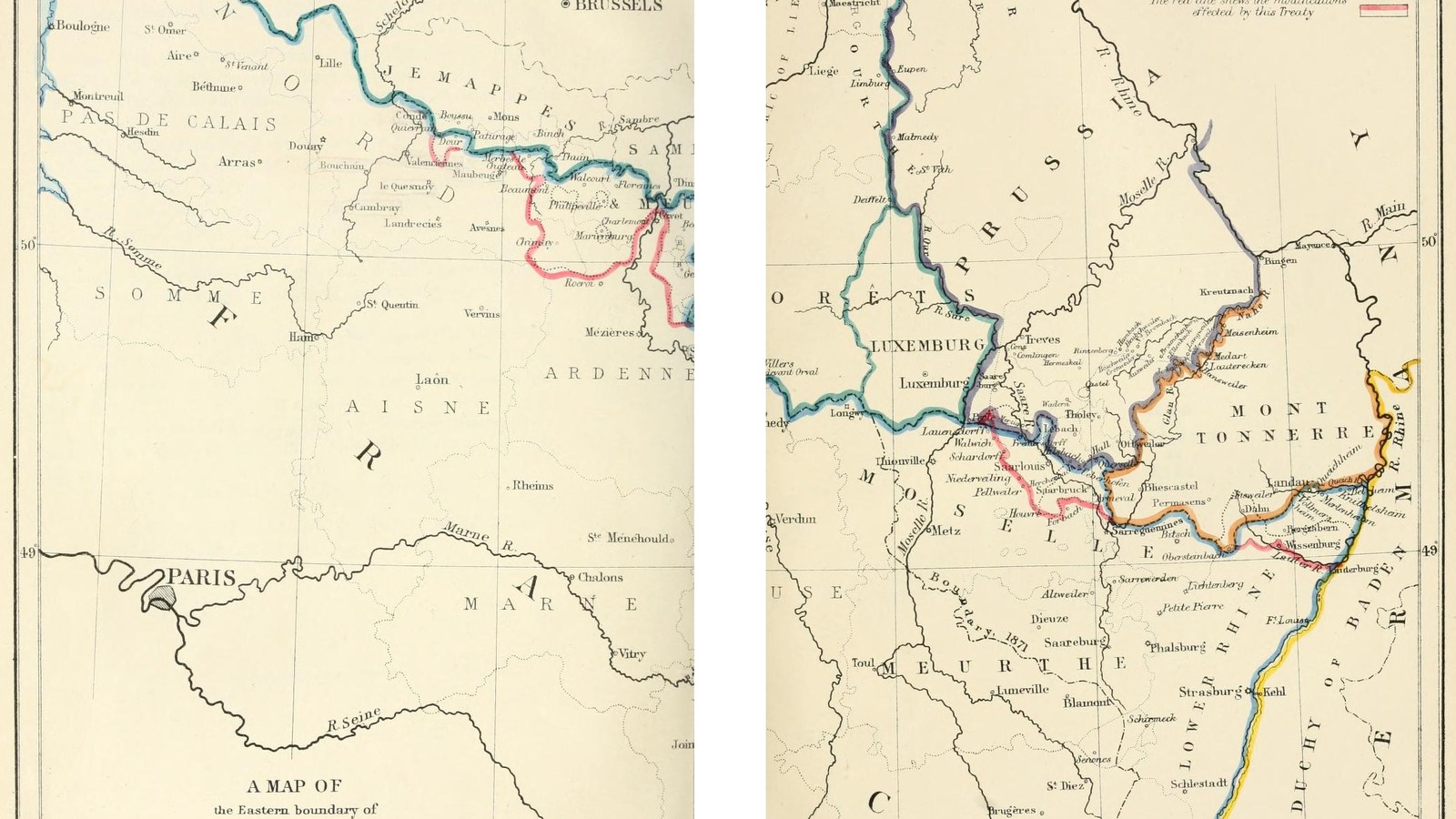
The frontiers return to those of 1790, with modifications: France keeps the Comtat Venaissin, Montbéliard and Mulhouse, but loses strips in the north, the former duchy of Bouillon (annexed in 1795), Landau, the Saarlouis exclave (French since 1697) and six communes in the Pays de Gex, ceded to the Canton of Geneva so that it connect with the rest of Switzerland. The treaty of 30 May 1814 and the Final Act of Vienna of 9 June 1815 are confirmed in so far as they are not modified here. The preamble repudiates “the revolutionary system reproduced in France” and seeks to consolidate royal authority and the Constitutional Charter.
The pecuniary indemnity is 700 million francs, to be paid over five years from 1 December 1815, in daily portions, against 15 bonds of 46⅔ million, the first due on 31 March 1816. A fund of interest of 7 million on a capital of 140 million, inscribed in the Grand Livre, covers shortfalls. Austria, Russia, Great Britain and Prussia each receive 100 million; the German states, the Netherlands and Sardinia share another 100 million by men furnished; 50 million is a gratuity to the armies of Wellington and Blücher; 137.5 million goes to fortresses against France. The total cost, with interest and the upkeep of the occupation, approached 1.7 billion.
The temporary occupation, along the Pas-de-Calais–Nord–Ardennes–Meuse–Moselle–Lower and Upper Rhine line, is not to exceed 150,000 men, under Wellington, at France’s expense, for a maximum of five years, with the possibility of ending after three if the allied sovereigns, in concert with the King, find that the motives have ceased. The evacuation came in 1818, at the Congress of Aix-la-Chapelle. Louis XVIII’s sovereignty is not prejudiced.
The additional article reaffirms the Declaration of the Powers of 8 February 1815 on the abolition of the slave trade (Act XV of Vienna) and calls for measures “for the entire and definitive abolition of a Commerce so odious”. The Quadruple Alliance, signed the same 20 November, introduces the peacetime congress “for the maintenance of peace in Europe”. Princes and free towns are invited to accede: the treaty becomes part of the public law of Europe, with the exclusion of the Ottoman Empire.
Sources: Treaty of Paris (1815); Wikisource, Treaty of Paris (1815).











0 Comments
No comments on this article yet. Be the first!