


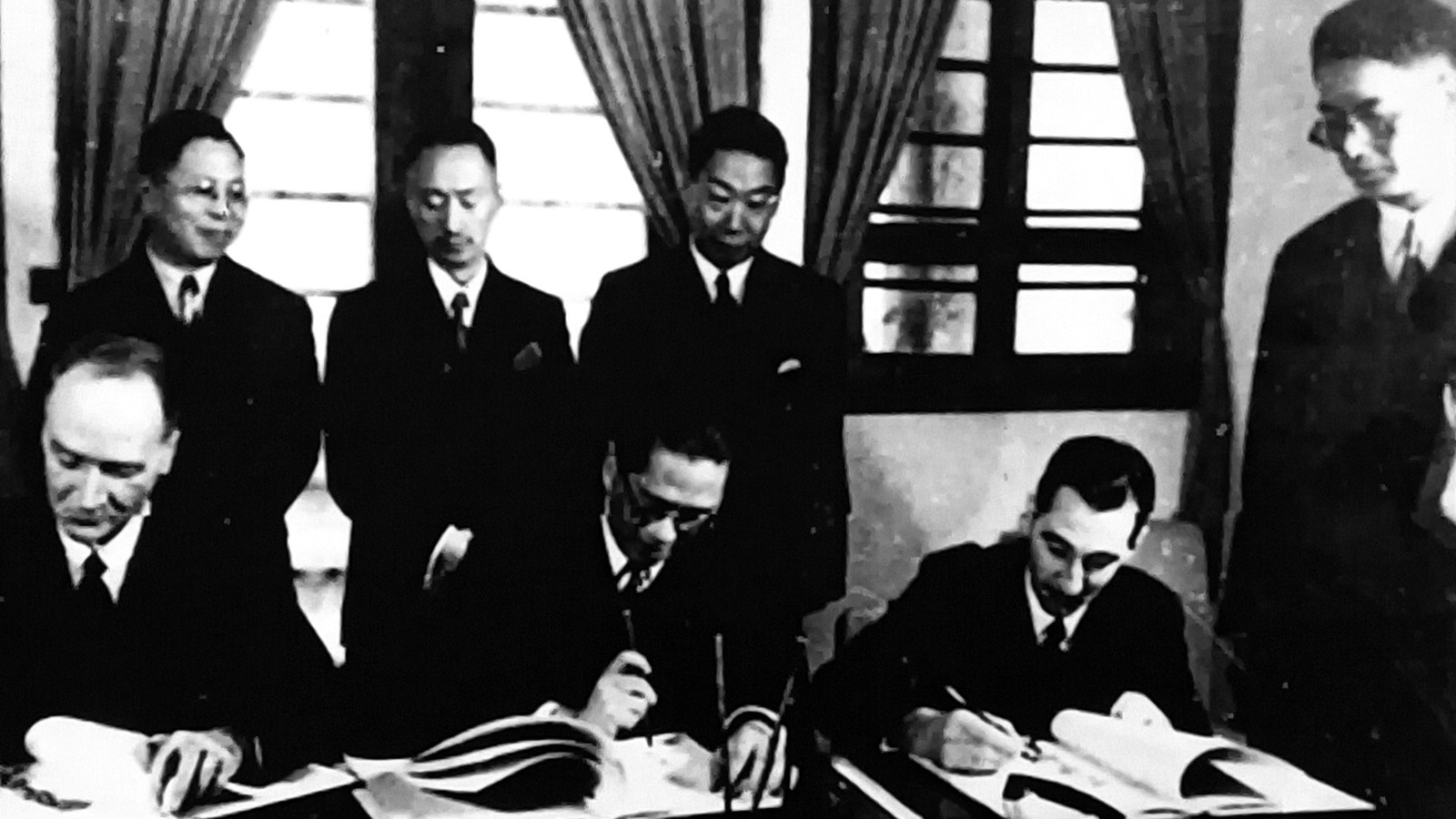
On 11 January 1943, at Chongqing (Chungking in the official text), the Treaty between His Majesty in respect of the United Kingdom and India and His Excellency the President of the National Government of the Republic of China for the Relinquishment of Extra-Territorial Rights in China and the Regulation of Related Matters was signed. Plenipotentiaries: Sir Horace James Seymour, British Ambassador; Hugh Edward Richardson, an officer of the Indian Political Service; and T. V. Soong (Tse Vung Soong), Minister for Foreign Affairs. Duplicate in English and Chinese, both texts equally authentic. The exchange of notes and Agreed Minute form part of the Treaty.
Article 1: it applies, on the British side, to the United Kingdom, India, colonies, protectorates and mandates administered from London; on the Chinese side, to all the territories of the Republic of China. Article 2 abrogates the clauses authorising extra-territorial jurisdiction; His Majesty’s nationals and companies are subject, in Chinese territory, to the jurisdiction of the Government of the Republic of China, in accordance with international law.
Article 3: the Final Protocol concluded at Peking on 7 September 1901 (Boxer) is treated as terminated; British rights under that Protocol and its supplementary agreements cease. London will co-operate in transferring administration of the diplomatic quarter at Peiping, with assumption of official obligations; it retains a continued right to use the land allocated there for official purposes. Article 4: the International Settlements at Shanghai and Amoy (Xiamen) and the British Concessions at Tientsin (Tianjin) and Canton (Guangzhou) revert to Chinese administration; British rights in relation to them cease. Peking, Shanghai and the concessions were then under Japanese occupation; the clauses are legal, not an operational report.
Article 5: existing rights and titles to real property of British nationals and companies remain indefeasible, open to challenge only upon proof of fraud through due process; their exercise is subject to Chinese laws on taxation, national defence and eminent domain; alienation to a third country requires the express consent of the Chinese Government. Article 6: reciprocity in travel, residence and commerce; treatment not less favourable than that accorded to a party’s own nationals in legal proceedings and taxation. Article 7: consuls with exequaturs, communication with nationals, notification of arrest, visits within the consular district. This is not a consular handbook.
Article 8: negotiations for a comprehensive modern treaty of friendship, commerce, navigation and consular rights, upon request or in any case within six months after the cessation of hostilities in the war against the common enemies; pending that, uncovered questions are decided according to generally accepted principles of international law. Article 9: ratification; instruments to be exchanged at Chongqing as soon as possible; the Treaty comes into force on the day of the exchange. The exchange took place on 20 May 1943. Registered in the League of Nations Treaty Series, volume 205.
The annex to the notes: His Majesty relinquishes the Treaty Port system, the special courts in the Shanghai and Amoy Settlements, foreign pilots, the treaty right of naval entry, and any claim to appoint a British Inspector-General of the Chinese Customs; the closed British courts’ acts are res judicata; coasting trade and inland navigation, with reciprocity if granted to a third country; China relinquishes special rights on the Irrawaddy under Article 12 of the Convention signed at London on 1 March 1894. Point 4: questions affecting Chinese sovereignty not covered by the Treaty are to be discussed according to international law. Chiang Kai-shek had sought to place the Kowloon concession on the agenda; London refused; China signed and reserved the right to raise Hong Kong later. The later fate of the territory is not set out here.
The Chinese and British delegations at the signing, Chongqing. Wikimedia Commons, free licence.
For context: Sino-British Treaty for the Relinquishment of Extra-Territorial Rights in China. The text: Treaty Series No. 2 (1943), Cmd. 6456.











0 Comments
No comments on this article yet. Be the first!