


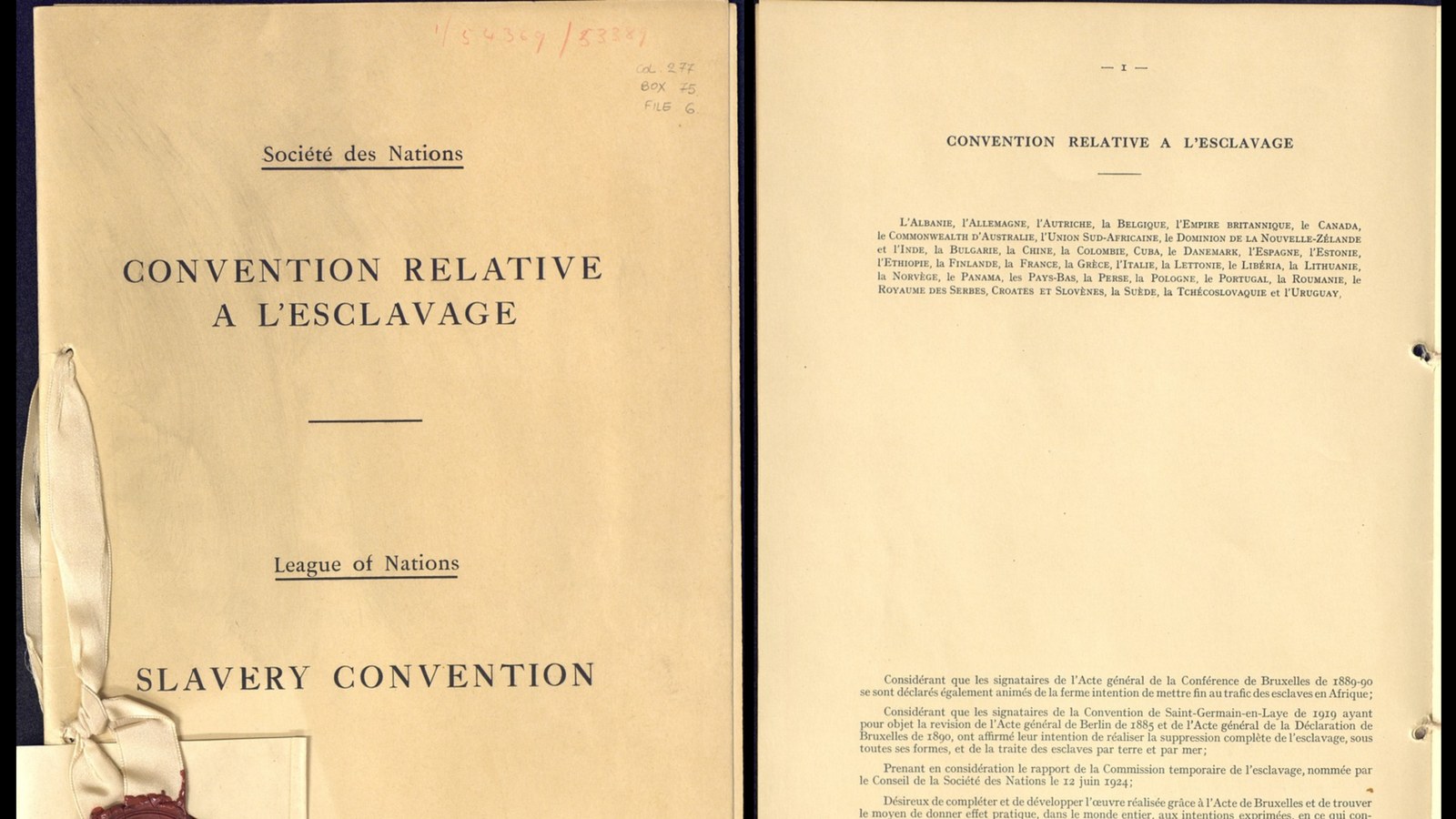
In Geneva the plenipotentiaries sign the Slavery Convention, in one copy, deposited in the archives of the League of Nations. The date of the instrument is 25 September 1926. It is not the Brussels Act of 1890, and it is not the Convention of Saint-Germain-en-Laye of 10 September 1919.
The authentic texts are French and English. Among those who sign are Viscount Cecil of Chelwood for the British Empire, L. de Brouckère for Belgium, Fridtjof Nansen for Norway and Nicolae Titulescu for Romania. Cecil declares that his signature does not bind India or the Dominions which sign separately.
The preamble cites the report of the Temporary Slavery Commission, appointed by the League Council on 12 June 1924, and says forced labour must be kept from developing into conditions analogous to slavery. Article 1: slavery is the status or condition of a person over whom any or all of the powers attaching to the right of ownership are exercised. The slave trade includes capture, acquisition, sale, exchange and transport.
Article 2: each party, in respect of the territories under its sovereignty, jurisdiction, protection, suzerainty or tutelage, undertakes to prevent and suppress the slave trade and to bring about, progressively and as soon as possible, the complete abolition of slavery in all its forms. It is not an immediate abolition written as a single date.
Article 5: compulsory or forced labour, after a transition, only for public purposes; where it still survives for other purposes, it is ended progressively, remains exceptional, is paid, and does not remove labourers from their usual place of residence. Responsibility rests with the central authorities. Article 6: severe penalties for infractions.
Article 11: the convention remains open for signature by League members until 1 April 1927; the Secretary-General then invites States outside the League as well. Article 12: ratifications are deposited with the Secretary-General; for each State the convention comes into operation on deposit. First registration in the League Treaty Series is 9 March 1927, volume 60.
It is not the Protocol of 7 December 1953, which moves the depositary to the United Nations and enters into force on 7 July 1955. It is not the Supplementary Convention of 7 September 1956. It is not the ILO Forced Labour Convention of 1930.
Article 9 allows a reservation for some territories; India uses it for Articles 2(b), 5, 6 and 7 in certain frontier tracts. The signature of South Africa applies also to South-West Africa.
Image: Slavery Convention, Geneva, 25 September 1926; copy of the original, World Digital Library; public domain, Wikimedia Commons. Cropped to 16:9.
Source consulted: 1926 Slavery Convention. Treaty text: UKTS 16 (1927) Cmd. 2910, Slavery Convention, 25 September 1926.











0 Comments
No comments on this article yet. Be the first!