


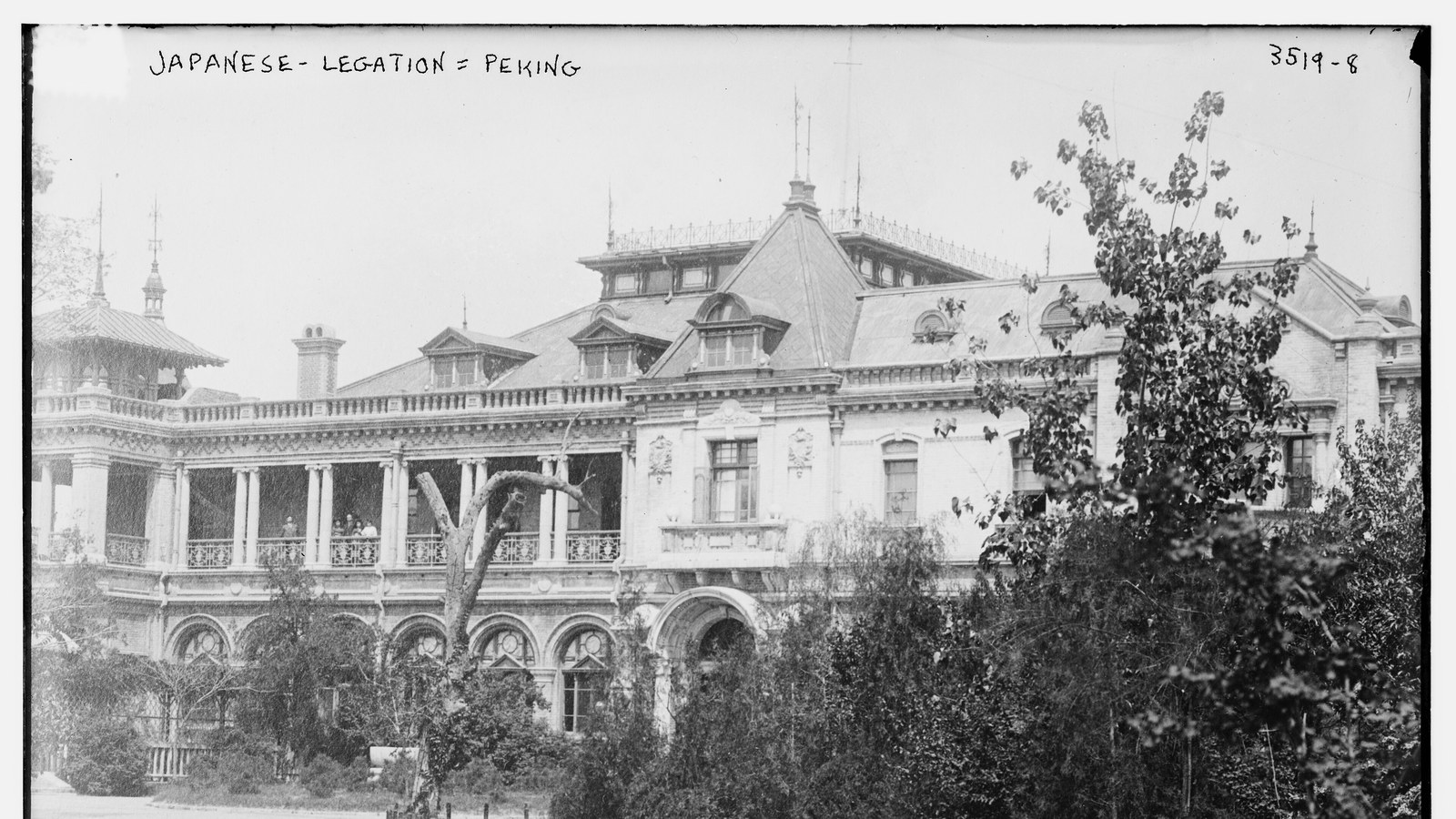
At Peking, Japan and the Union of Soviet Socialist Republics conclude on 20 January 1925 the Convention embodying Basic Rules of the Relations between them. For the Emperor of Japan, Kenkichi Yoshizawa, Envoy Extraordinary and Minister Plenipotentiary to the Republic of China, signs; for the Central Executive Committee of the Union, Lev Mikhailovitch Karakhan, Ambassador to the Republic of China. The instrument is done in duplicate in the English language, both texts authentic. On the same day there are also signed Protocol A, Protocol B, a declaration, an exchange of notes, an annexed note and the protocol of signature.
Article I provides that, upon the coming into force of the Convention, diplomatic and consular relations shall be established. Article II leaves the Treaty of Portsmouth in full force; the other treaties, conventions and agreements concluded between Japan and Russia before the October Revolution are to be re-examined at a subsequent conference and are liable to revision or annulment as circumstances may require. In the declaration signed with the Convention, Karakhan states that recognition of the validity of the Treaty of Portsmouth does not signify that the Government of the Union shares with the former Tsarist Government the political responsibility for concluding it.
Article III requires, upon entry into force, revision of the Fishery Convention, taking into account changes in general conditions; pending the revised convention, the Union maintains the practices relating to the lease of fishery lots to Japanese subjects. Article IV requires conclusion of a treaty of commerce and navigation; pending that treaty, intercourse is governed by liberty to enter, travel and reside, protection of life and property, the right of private ownership and liberty to engage in commerce, navigation and industries, on condition of reciprocity, and most-favoured-nation treatment, without discriminatory prohibition, restriction or impost. Special arrangements on commerce and navigation may follow from time to time.
Article V affirms the desire and intention to live in peace and amity, to respect the right of a State to order its own life within its own jurisdiction, and to restrain persons in any governmental service and organisations receiving financial assistance from any act, overt or covert, liable to endanger order and security in any part of the territories of the other Party. Neither Party shall permit, in territories under its jurisdiction, organisations or groups pretending to be the Government for any part of the territories of the other, or alien subjects or citizens actually carrying on political activities for such groups.
Article VI records that, taking into consideration the needs of Japan with regard to natural resources, the Government of the Union is willing to grant to Japanese subjects, companies and associations concessions for the exploitation of minerals, forests and other natural resources in all the territories of the Union. Article VII requires ratification; each Party shall communicate it as soon as possible through its diplomatic representative at Peking, and the Convention comes into full force from the date of the later of such communications. The formal exchange of ratifications shall take place at Peking as soon as possible.
Protocol A, signed with the Convention, requires each Party to place in the possession of the other the movable and immovable property of that other's embassy and consulates actually existing in its territories, with a reservation as to the land of the former Russian Government at Tokyo. Questions of debts on public loans and treasury bills of the former Russian Governments, and other claims, are reserved for subsequent negotiations, Japanese interests not to be placed, other conditions being equal, in any position less favourable than that accorded to any other country. Japanese troops in Northern Sakhalin are to be completely withdrawn as soon as climatic conditions permit, and every district so evacuated is immediately restored in full sovereignty to the authorities of the Union; details of the transfer of administration are arranged at Alexandrovsk between the commander of the occupation army and the representatives of the Union. The Parties declare that there exists no treaty of military alliance or other secret agreement with a third party constituting an infringement upon or a menace to the sovereignty, territorial rights or national safety of the other. The Protocol is considered ratified with the Convention.
Protocol B sets the principles of the concession contracts to follow complete evacuation of Northern Sakhalin: one half of the area of each oilfield mentioned in the Japanese memorandum, divided into checker-board squares of from fifteen to forty dessiatines, as a rule non-contiguous, including wells already drilled or worked; prospecting on the eastern coast over one thousand square versts; coal on the western coast and in the Doue district; a term of from forty to fifty years; royalty of 5 to 8 per cent of gross coal output and 5 to 15 per cent of oil, up to 45 per cent in the case of a gusher; duty-free import and export and protection. The exchange of notes permits continuation of Japanese oil and coal work until the contracts, without export or sale of the produce. The annexed note tenders the Union's regrets for the Nikolaievsk incident. The Convention is not a peace treaty closing a war.
Image: Japanese Legation, Peking; Bain News Service, circa 1915, public domain, Library of Congress / Wikimedia Commons. Cropped to 16:9.
Source consulted: Soviet-Japanese Basic Convention. Treaty text: Convention Embodying Basic Rules of the Relations between Japan and the Union of Soviet Socialist Republics, Wikisource.











0 Comments
No comments on this article yet. Be the first!