


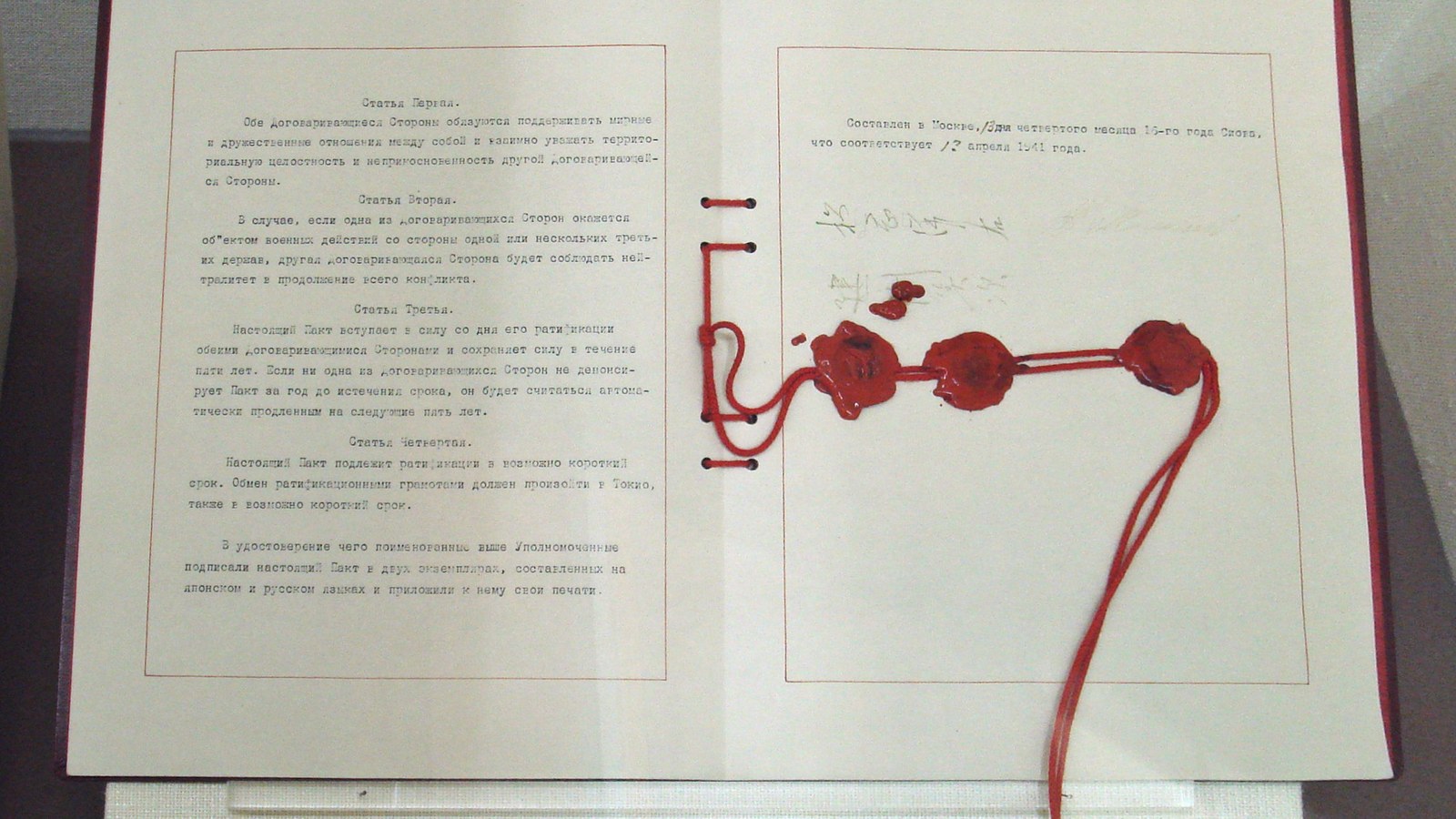
In Moscow on 13 April 1941, Vyacheslav Molotov, Chairman of the Council of People’s Commissars and People’s Commissar for Foreign Affairs, signed the Pact of Neutrality between the Union of Soviet Socialist Republics and Japan. For the Emperor of Japan the signatories were Foreign Minister Yōsuke Matsuoka and Ambassador Extraordinary Yoshitsugu Tatekawa. The preamble records that the Presidium of the Supreme Soviet and His Majesty the Emperor of Japan, guided by a desire to strengthen peaceful and friendly relations, concluded the pact after exchanging credentials found in due and proper form. The instrument was drawn up in two copies, in Russian and Japanese, with seals affixed. The Japanese date on the same act is the 13th day of the fourth month of the 16th year of Shōwa.
Article One binds both Contracting Parties to maintain peaceful and friendly relations and to respect each other’s territorial integrity and inviolability. Article Two provides that if one Party becomes the object of hostilities on the part of one or several third powers, the other Party will observe neutrality throughout the duration of the conflict. The clause is neutrality, not a military alliance and not mutual assistance.
Article Three states that the pact comes into force from the day of ratification by both Parties and remains valid for five years. If neither Party denounces it one year before the term expires, it is considered automatically prolonged for the next five years. Article Four requires ratification as soon as possible and the exchange of instruments in Tokyo, also as soon as possible.
On the same day, still in Moscow, the three signatories added a separate declaration “in conformity with the spirit” of the pact. The Soviet Government pledges to respect the territorial integrity and inviolability of Manchukuo; the Japanese Government pledges to respect the territorial integrity and inviolability of the Mongolian People’s Republic. The declaration is not an article of the pact; it is a parallel act under the same three names.
The pact is not the Anti-Comintern Pact and not the Soviet–German non-aggression pact of 23 August 1939. It is not the Khalkhin Gol cease-fire and not the Treaty of Portsmouth of 1905. The Kremlin signatories were not Joseph Stalin as a contracting party: the instrument names Molotov, Matsuoka and Tatekawa.
It is not the Soviet denunciation of 5 April 1945, delivered by Molotov to Ambassador Naotake Satō under Article Three, and it is not the declaration of war of 8 August 1945 with hostilities from 9 August. The April 1941 text fixes only the four articles, the place of the exchange of ratifications, and the declaration on Manchukuo and Mongolia.
Image: Soviet–Japanese Neutrality Pact, signatures of Yōsuke Matsuoka and Yoshitsugu Tatekawa, Japan Foreign Ministry Archives; photograph World Imaging, CC BY-SA 3.0, Wikimedia Commons. Cropped to 16:9.
Source consulted: Soviet–Japanese Neutrality Pact. Treaty text: Avalon Project: Soviet-Japanese Neutrality Pact, 13 April 1941.











0 Comments
No comments on this article yet. Be the first!