


In Moscow, on 12 July 1920, the Russian Socialist Federative Soviet Republic and the Lithuanian Democratic Republic signed the Peace Treaty, 19 articles, in duplicate, authentic in Russian and Lithuanian. For Moscow: Adolf Joffe, Julian Marchlewski, Leonid Obolenski. For Kaunas: Tomas Naruševičius, Petras Klimas, Simon Rozenbaum, Juozas Vailokaitis, Vytautas Račkauskas. Exchange of ratifications: also in Moscow, Article 19.
The treaty is not Brest-Litovsk of 1918, nor the Peace of Tartu with Estonia, nor the Soviet–Latvian treaty of August, nor the Peace of Riga with Poland, nor the Suwałki Agreement. It was registered with the League of Nations in Treaty Series volume 3, No. 94, on 8 March 1921.
Article 1: Russia recognises without reserve the sovereignty and independence of Lithuania, with all juridical consequences, and voluntarily and forever renounces sovereign rights over the Lithuanian people and territory; the fact that Lithuania was once under Russian sovereignty creates no obligation. Article 2 draws the eastern frontier: Vilnius, Breslauja, Gardinas, Lyda, Pastovys and Ašmena remain on the Lithuanian side. Remark 1: the line with Poland and with Latvia is to be fixed by arrangement with those states. Towards Suwałki the line stops at Sztabin.
Article 4: neither party shall permit on its territory governments, organisations or groups whose object is armed warfare against the other, nor the transit of troops and war material for countries de facto at war with the other party. Article 5: if Lithuania’s permanent neutrality is internationally recognised, Russia undertakes to respect it. Article 6: Lithuanian citizenship by operation of law for residents who meet the domicile tests; reverse option within one year of ratification. Articles 8–9: waiver of accounts arising from former membership of the Empire; return of libraries, archives and property removed in 1914–1917.
Article 12: Russia releases Lithuania from Russian debts; grants the right to cut timber over 100,000 dessiatins, allocated over twenty years, near the frontier; pays 3,000,000 gold roubles within one and a half months of ratification. Article 13: trade (most-favoured-nation) and transit conventions. The Constituent Assembly ratified on 8 August. The protocol of 14 October, at the People’s Commissariat for Foreign Affairs: Jurgis Baltrušaitis and Lev Karakhan exchanged the instruments.
The July act is not Żeligowski’s seizure of Vilnius in October, nor the Peace of Riga of 1921, nor the non-aggression pact of 1926.
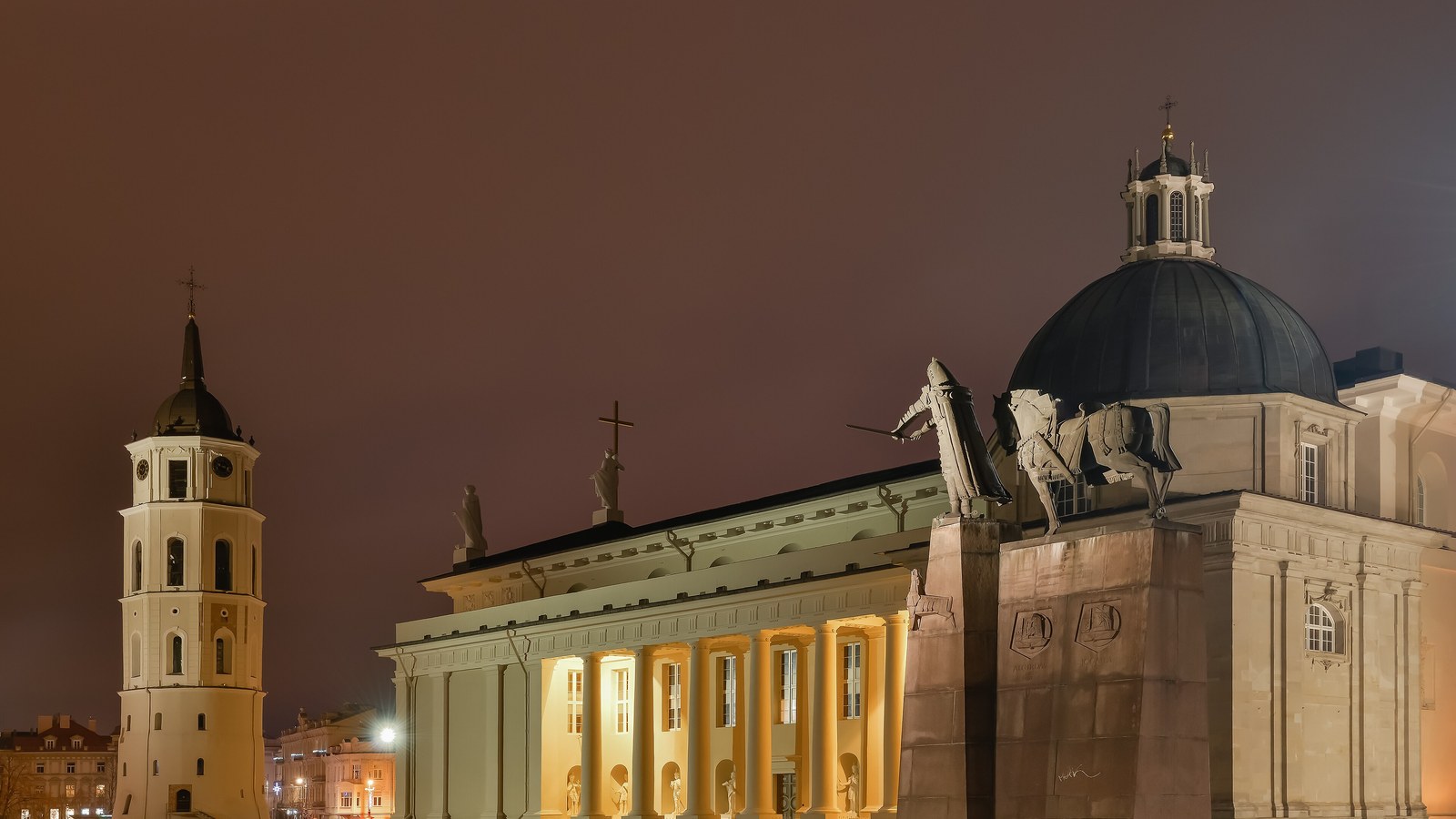
Image: Vilnius Cathedral Square at night, 2 January 2014; Abrget47j, CC BY-SA 3.0, Wikimedia Commons. Cropped to 16:9. Article 2 places Vilnius on the Lithuanian side.
Source consulted: Soviet–Lithuanian Peace Treaty. Treaty text: LNTS vol. 3: Peace Treaty between Lithuania and the Russian Socialist Federal Republic, Moscow, 12 July 1920.











0 Comments
No comments on this article yet. Be the first!