


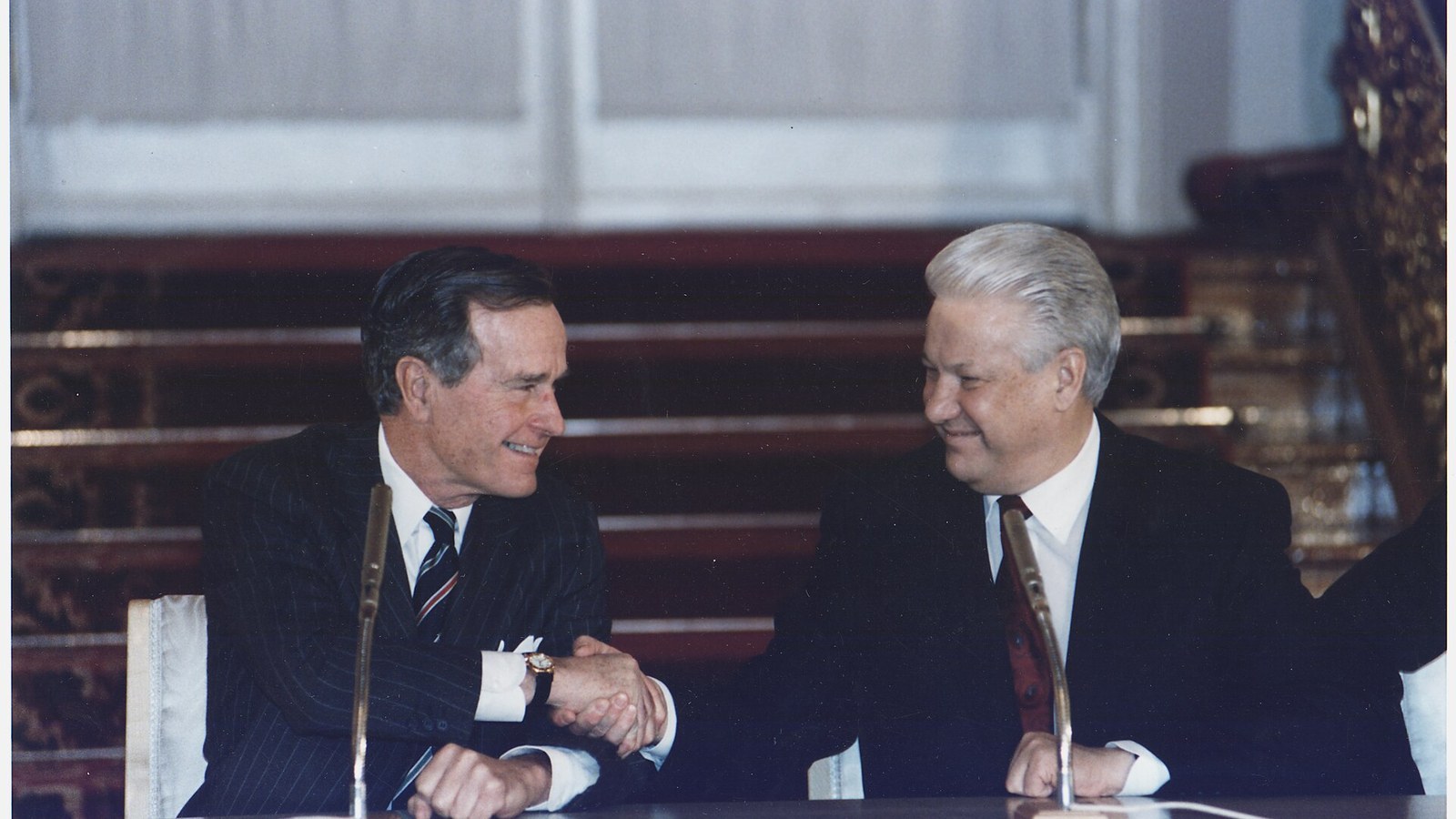
On 3 January 1993, in Vladimir Hall of the Kremlin, George H. W. Bush and Boris Yeltsin sign the Treaty Between the United States of America and the Russian Federation on Further Reduction and Limitation of Strategic Offensive Arms. Two languages: English and Russian. The Joint Understanding of 17 June 1992, also by the two presidents, is put into treaty form. START I, signed on 31 July 1991, remains the foundation; START II cannot enter into force before it.
Article I, as signed in 1993: seven years after START I enters into force, each party is to have between 3,800 and 4,250 warheads attributed to ICBMs, SLBMs and heavy bombers, and in no case more than 4,250. Within that: at most 2,160 on SLBMs; 1,200 on ICBMs to which more than one warhead is attributed; 650 on heavy ICBMs. Then, by 1 January 2003: 3,000–3,500 warheads, and in no case more than 3,500; on SLBMs, 1,700–1,750; zero warheads on MIRVed ICBMs; zero heavy ICBMs.
Article II: by the same date, launchers of ICBMs to which more than one warhead is attributed are eliminated or converted to a single warhead. Heavy ICBMs and their launch canisters disappear, or are used to deliver objects into the upper atmosphere or space. No more than 90 heavy silos may be converted: concrete to a height of five metres from the bottom, a restrictive ring of no more than 2.9 metres in the upper portion. No heavy ICBM is transferred to any recipient, including any other START I party; that prohibition applies provisionally from the date of signature.
Article III: warheads are attributed under START I rules, with a right to reduce the number on existing types other than heavy ICBMs. After a reduction, no missile is produced, flight-tested or deployed with more reentry vehicles than the warheads attributed to it. Article IV: heavy bombers are counted by the nuclear weapons for which they are actually equipped — long-range nuclear ALCMs, air-to-surface missiles under 600 kilometres, nuclear bombs. An exhibition within 180 days of entry into force. A bomber may be reoriented to a conventional role, with 90 days’ notice, if it has never been accountable as equipped for long-range nuclear ALCMs.
Article VI: ratification in accordance with each party’s constitutional procedures; the treaty enters into force on the exchange of instruments of ratification, but not prior to START I. It remains in force so long as START I remains in force. Withdrawal on six months’ notice. Article VIII: registration with the United Nations under Article 102 of the Charter. The New York Protocol of 26 September 1997 moves the deadlines to 31 December 2004 and 31 December 2007; it too must be ratified.
The United States Senate consents on 26 January 1996, 87–4. The State Duma ratifies on 14 April 2000, 288–131–4, on condition that the United States preserve the 1972 ABM Treaty and ratify the 1997 protocol. The Federation Council, 19 April; Yeltsin is no longer in the Kremlin: Vladimir Putin signs the law on 4 May. The Senate does not ratify the protocol. START I has been in force since 5 December 1994; the START II instruments are never exchanged.
On 13 June 2002 the United States withdraws from the ABM Treaty. The next day Moscow announces that it no longer considers itself bound by START II. On 24 May, also in Moscow, Bush and Putin had signed the Strategic Offensive Reductions Treaty, with 1,700–2,200 operationally deployed warheads by 2012. START II remains a signed text, ratified in pieces, never in force.
Image: Susan Biddle, White House / NARA, signing of START II, Vladimir Hall, Kremlin, 3 January 1993, public domain, Wikimedia Commons. Cropped to 16:9.
Source consulted: START II. Treaty text: Treaty Between the United States of America and the Russian Federation on Further Reduction and Limitation of Strategic Offensive Arms (START II).











0 Comments
No comments on this article yet. Be the first!