


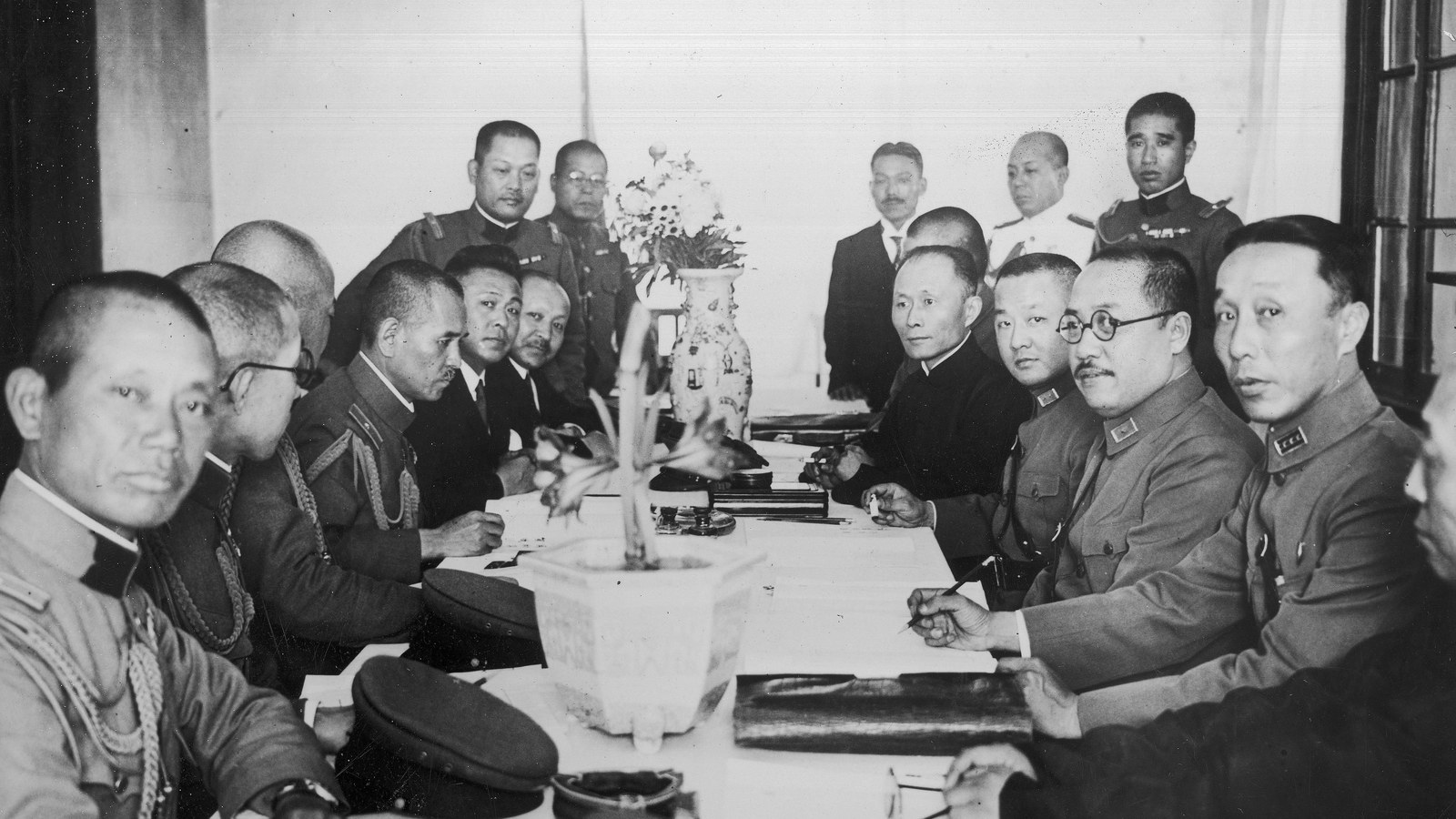
The Tanggu Truce was signed at Tanggu, near Tianjin, on 31 May 1933 by Major-General Okamura Yasuji, vice-chief of staff of the Kwantung Army, and Lieutenant-General Xiong Bin (Hsiung Pin) of the Chinese army, as an agreement between military authorities, not as a diplomatic treaty recognizing Manchukuo. The translation published by the League of Nations and reprinted in FRUS has five articles and takes effect immediately upon signature. It is not the He–Umezu Agreement of 1935 and not the Mukden Incident of 1931.
The setting, at framework level: after the occupation of Manchuria and of Rehe, Japanese forces had crossed the Great Wall into Hebei; the League had condemned the actions, and Japan had left the organization in March. Military talks began in May, with a principle understanding at Beiping and a memorandum at Miyun; the Tanggu ceremony took place in the Japanese barracks. The Nanjing government maintained that the agreement was confined to ending local hostilities and did not affect sovereignty.
Article I: the Chinese army withdraws to the west and south of an agreed line in Hebei and undertakes not to advance beyond that line and to avoid any provocation of hostilities. Article II: the Japanese army may verify the carrying-out of the withdrawal; the Chinese authorities afford protection and facilities. Article III: after ascertaining the withdrawal, the Japanese army undertakes not to cross the said line, not to continue to attack, and to withdraw voluntarily to the Great Wall. An aerial-verification, patrol or pursuit protocol is not transcribed.
Article IV: in the region between the Wall and the line in Article I, the maintenance of peace and order shall be undertaken by the Chinese police authorities. Article V: the agreement comes into effect upon its signature. A demilitarization map or police regulation is not set out here. The American consulate at Tianjin reported the same day the Japanese garrison's announcement. The practical effect was a temporary pause in fighting in the north, not a formal diplomatic recognition of Manchukuo.
Cover: the period photograph of the delegations at the table at Tanggu; we do not claim each officer's identity. Wikimedia Commons, free licence.
Sources consulted: Tanggu Truce; The Truce Agreement Between the Chinese and Japanese Military Authorities, Signed at Tangku (FRUS, League of Nations Official Journal).











0 Comments
No comments on this article yet. Be the first!