


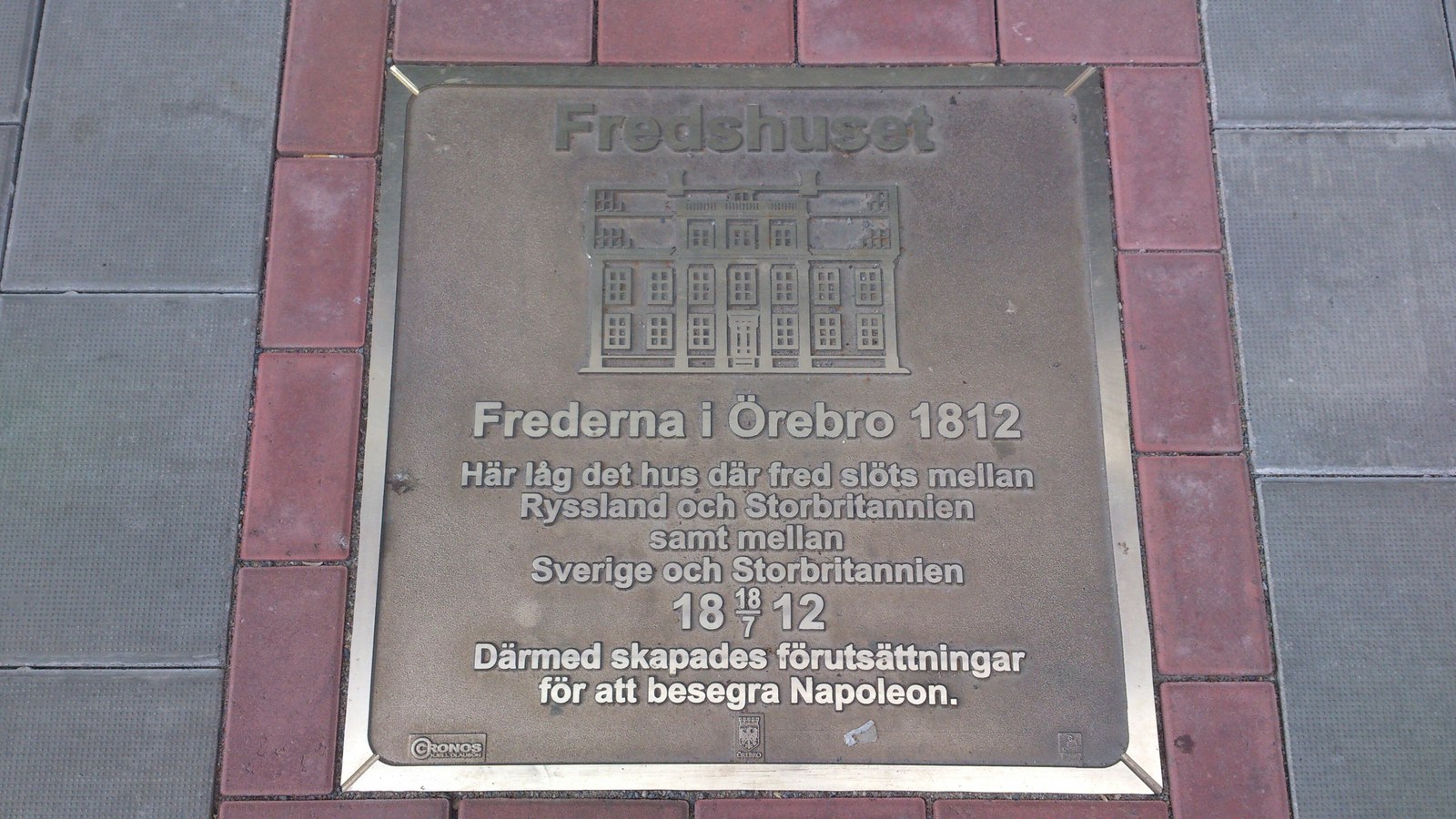
The Prince Regent, in the name of King George III, restored peace with Alexander I’s Russia and Charles XIII’s Sweden by two separate treaties, not a tripartite act. Signature was at Orebro on 18 July 1812 (New Style; 6 July Old Style at the Russian court). Official titles, in the British and Foreign State Papers, vol. 1, translation: Treaty of Peace, Union, and Friendship. The original is French, without a diacritic on Orebro. British plenipotentiary to both: Edward Thornton, Esquire, at the Swedish court. This is not Tilsit in 1807, not the Russo-Swedish alliance of St Petersburg of 5 April 1812, and not the Treaty of Kiel of 1814.
The British–Russian treaty. Russian plenipotentiaries: Peter de Suchtelen, general of engineers, quarter-master-general, member of the Council of State; Paul Baron de Nicolay, chargé d’affaires at Stockholm. Article 1: a firm, true and inviolable peace, and a sincere and perfect union and friendship; every cause of misunderstanding ceases. Article 2: friendship and commerce are restored on the footing of the most favoured nations. Article 3: if, in resentment of the pacification, any Power commits hostilities against either Majesty, the contracting Sovereigns make common cause for the support and security of their States. Article 4: the parties will seek as soon as possible an arrangement of their mutual interests, political and commercial. Article 5: ratification; instruments exchanged in six weeks, or sooner. Signatures: Thornton, Suchtelen, Nicolay. Russian ratification: Kamenoi-Ostrow, 1 August 1812, Alexander, countersigned Count Rumiantzov.
The British–Swedish treaty. Swedish plenipotentiaries: Lawrence Baron d’Engeström, minister of state and of foreign affairs, chancellor of the University of Lund; Gustavus Baron de Wetterstedt, chancellor of the court, one of the eighteen of the Swedish Academy. Article 1: a firm, true and inviolable peace, union and friendship; every cause of misunderstanding ceases. Article 2: friendship and commerce are restored on the footing of 1 January 1791; all treaties and conventions then in force are renewed and confirmed. Article 3: if, in resentment of the pacification, any Power makes war upon Sweden, the British King engages to take measures, in concert with the King of Sweden, for the security and independence of his States. Article 4: ratification; exchange within six weeks, or sooner. Signatures: Thornton, Baron d’Engeström, G. Baron de Wetterstedt. Entry into force, on the Canadian treaty record: 17 August 1812.
The Anglo-Russian War (1807–1812) followed Tilsit and the Continental System; the Anglo-Swedish War (1810–1812) followed the declaration of war France forced on Sweden. Neither produced a serious land campaign among the three Powers. Napoleon had crossed the Niemen on 24 June 1812; Orebro closes, on paper, Britain’s hostilities with the two northern courts while the Russian campaign is already open.
Thornton is not Bernadotte. Crown Prince Charles John (Jean-Baptiste Bernadotte) drove Sweden’s realignment toward Russia and Britain, but he does not sign. George III is under the Regency. Charles XIII remains king. Suchtelen is an engineer and diplomat, not the Tsar. Engeström is the foreign minister, not the king.
The two acts open the way to the 1813 coalition: trade resumed, a pledge of common cause if a third Power attacks in resentment, no territorial cession in the text. Norway is not here; it comes at Kiel. The cover is the “Frederna i Örebro 1812” plaque at the place of signature. The Peace House (Fredshuset) is the building; the Commons façade original is too small for the cover.
Sources: Treaties of Örebro; Treaty of Orebro (Britain and Russia), BFSP vol. 1.











0 Comments
No comments on this article yet. Be the first!