


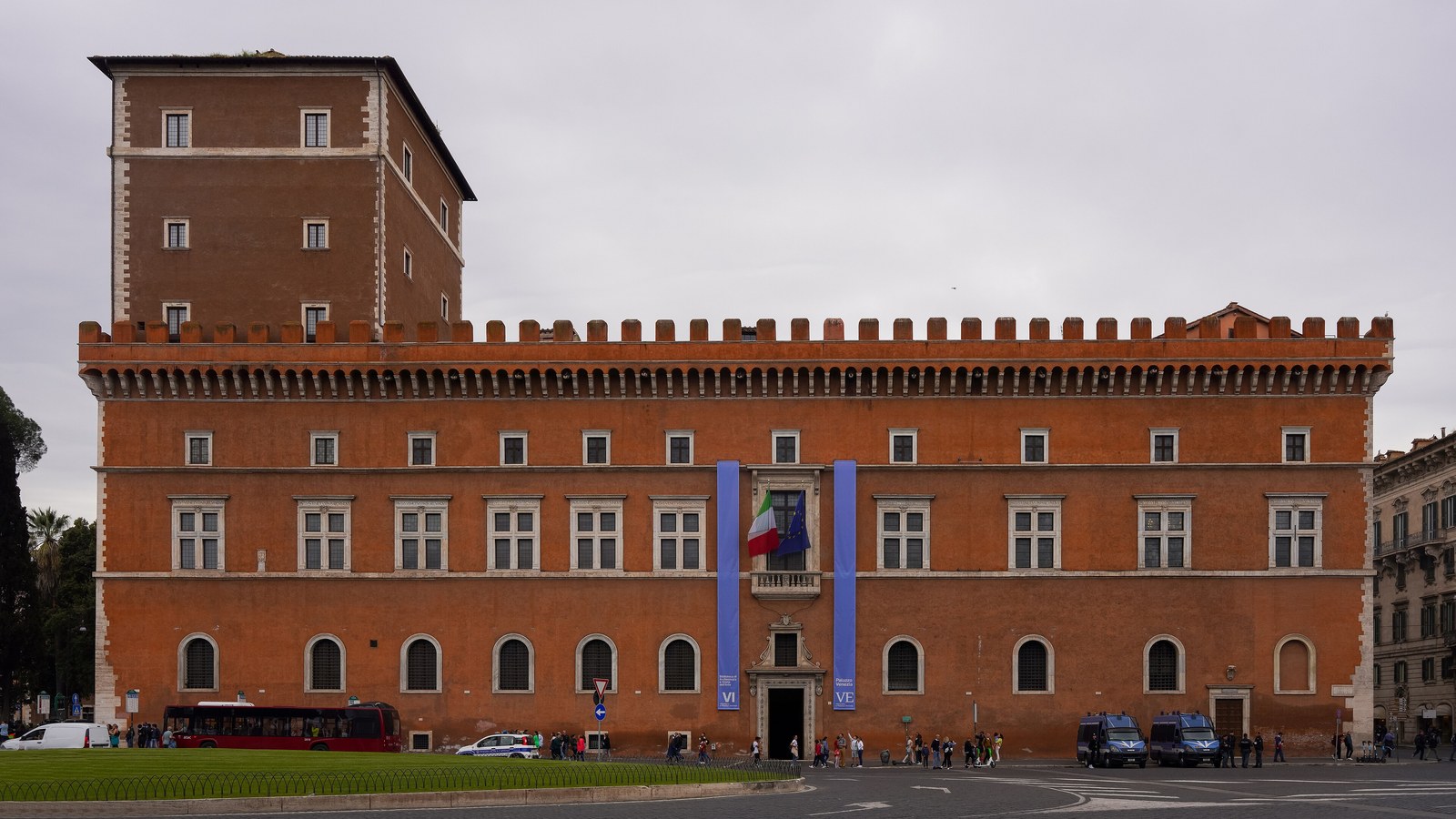
The Treaties of Rome between the Kingdom of Italy and the Kingdom of Croatia were signed at Palazzo Venezia, in the Sala del Mappamondo, on 18 May 1941, by Benito Mussolini and Ante Pavelić, in Italian, in duplicate. They are not the 1957 Treaty of Rome. That morning, at the Quirinale, Pavelić had asked Victor Emmanuel III to designate a Savoy prince for the Crown of Zvonimir; the king named Aimone, Duke of Spoleto. The signing was therefore done in the name of the “Kingdom of Croatia”. The texts entered into force on signature; no ratification was provided for. An Italian royal decree-law incorporated the annexed territories into the Kingdom as the Governorate of Dalmatia, with its seat at Zara.
The Treaty on the Determination of Frontiers recognises as part of Italy districts in the Castua–Sušak–Čabar area, part of Delnice, the islands of the Zara archipelago and most of the Dalmatian littoral, including Šibenik, Trogir and Split with its suburbs, plus the Bocche di Cattaro, excepting the islands of Brač and Hvar. A 1:750,000 map is an integral part. A special convention was to follow for the administration of Split and the island of Korčula. Article 2 provides for a mixed Italo-Croatian commission to demarcate the boundary on the ground, including vis-à-vis the province of Lubiana. No annexation handbook is transcribed.
The Agreement on Military Matters concerning the Adriatic coastal zone commits the Croatian government not to establish, on the islands and in the strip between the sea and the line on the annexed map, military works, bases or stores of war material. It declares that it does not intend to have a navy, other than specialised police and customs units. The modalities of transit of Italian forces along the Fiume–Cattaro coastal road and the Fiume–Ogulin–Split railway were left to a later agreement. No occupation protocol is transcribed.
The Treaty of Guarantee and Collaboration, for 25 years, provides that Italy assumes the guarantee of the political independence of the Kingdom of Croatia and of its territorial integrity within the frontiers determined with the interested states. The Croatian government will assume no international commitments incompatible with that guarantee. Collaboration with the Italian armed forces is provided for organisation and technical instruction, at the level of principle. A standing commission was to study customs and currency relations. The final protocol keeps in force, until new agreements, the applicable treaties between Italy and the former Kingdom of Yugoslavia. An exchange of letters announced a convention for Split and Korčula and guarantees for the Italian minority, analogous to the Treaty of Rapallo.
Pavelić denounced the treaties after Italy’s surrender, in September 1943. The instruments are documents of an Axis satellite state; they do not legitimise the NDH. Cover: the façade of Palazzo Venezia, the place of signature; we do not claim the Sala del Mappamondo. Wikimedia Commons, free licence.
Sources consulted: Treaties of Rome (1941); Garantie- und Freundschaftsvertrag zwischen dem Königreich Italien und dem Königreich Kroatien.











0 Comments
No comments on this article yet. Be the first!