


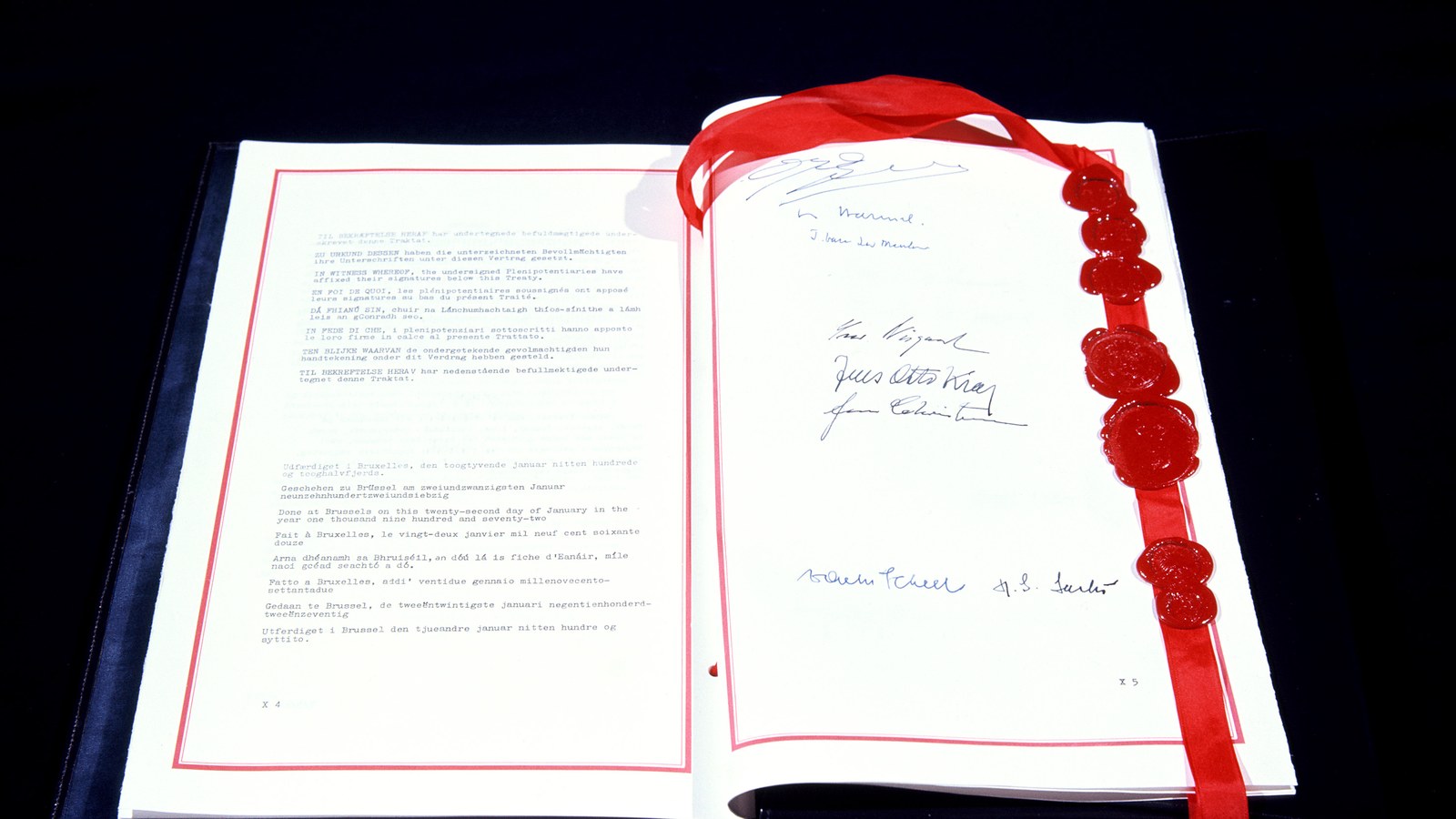
At Brussels, the Member States of the European Communities and the Kingdom of Denmark, Ireland, the Kingdom of Norway and the United Kingdom of Great Britain and Northern Ireland conclude on 22 January 1972 the Treaty concerning the accession of Denmark, Ireland, Norway and the United Kingdom to the European Economic Community and to the European Atomic Energy Community. For Belgium, Gaston Eyskens, Pierre Harmel and J. van der Meulen sign; for Denmark, Jens Otto Krag, Ivar Nørgaard and Jens Christensen; for the Federal Republic of Germany, Walter Scheel and H.-G. Sachs; for France, Maurice Schumann and J.-M. Boegner; for Ireland, Jack Lynch and Patrick Hillery; for Italy, Emilio Colombo, Aldo Moro and G. Bombassei Frascani de Vettor; for Luxembourg, Gaston Thorn and J. Dondelinger; for the Netherlands, W. K. N. Schmelzer, T. E. Westerterp and E. M. J. A. Sassen; for Norway, Trygve Bratteli, Andreas Cappelen and S. Chr. Sommerfelt; for the United Kingdom, Edward Heath, Alec Douglas-Home and Geoffrey Rippon. The instrument is done at Brussels, in a single original in the Danish, Dutch, English, French, German, Irish, Italian and Norwegian languages, all eight texts being equally authentic.
Article I of the Treaty provides that Denmark, Ireland, Norway and the United Kingdom become members of the European Economic Community and of the European Atomic Energy Community and Parties to the Treaties establishing those Communities as amended or supplemented. The conditions of admission and the adjustments to those Treaties are set out in the Act annexed to the Treaty, which forms an integral part of it. The provisions concerning the rights and obligations of the Member States and the powers and jurisdiction of the institutions, as set out in the Treaties referred to, apply in respect of this Treaty.
Article II requires ratification by the High Contracting Parties in accordance with their respective constitutional requirements. The instruments of ratification are to be deposited with the Government of the Italian Republic by the deadline fixed in the Treaty. The Treaty enters into force on the date fixed in the text, provided that all the instruments of ratification have been deposited in due time and that the instruments of accession to the European Coal and Steel Community are deposited on that date. If not all the States referred to in Article I have deposited their instruments in due time, the Treaty enters into force for those States which have deposited them; the Council of the European Communities, acting unanimously, shall immediately decide upon such resulting adjustments as have become indispensable, and may declare that provisions of the Act which refer expressly to a State which has not deposited have lapsed, or may adjust them.
Article III provides that the Treaty, drawn up in a single original in the eight languages, will be deposited in the archives of the Italian Government, which will transmit a certified copy to each of the Governments of the other signatory States. The Plenipotentiaries affix their signatures below the Treaty. The Act concerning the Conditions of Accession and the Adjustments to the Treaties defines the original Treaties (including the Coal and Steel Community Treaty), the original Member States and the new Member States. From the date of accession, the provisions of the original Treaties and the acts adopted by the institutions of the Communities are binding on the new Member States and apply in those States under the conditions laid down in those Treaties and in the Act.
Article III of the Act provides that the new Member States accede to the decisions and agreements adopted by the Representatives of the Governments of the Member States meeting in Council, and undertake to accede from the date of accession to all other agreements concluded by the original Member States relating to the functioning of the Communities. They undertake to accede to the conventions provided for in the EEC Treaty and to the protocols on their interpretation by the Court of Justice, by entering into negotiations with the original Member States. The new Member States are in the same situation as the original Member States in respect of declarations, resolutions or other positions of the Council or of the Member States; they will observe the principles deriving therefrom and take such measures as may be necessary.
The Act annexes product lists, protocols and transitional arrangements by sector, including fisheries, agriculture, the customs union and the institutions. Special protocols regulate, among other matters, customs treatment of the Faroe Islands, the rights of Channel Islanders and Manxmen, arrangements for Greenland, Norway's right to ratify under specified conditions, and a transitional arrangement for United Kingdom imports of butter and cheese from New Zealand. Exchanges of letters and a Final Act, with annexed declarations, complete the package signed on the same day.
The Plenipotentiaries also take note of the Decision of the Council of the European Communities concerning the accession of the same States, adopted likewise at Brussels. The text of the Accession Treaty is not the Treaty of Rome of 1957 and is not a later instrument of accession of other States. The depositary remains the Italian Government.
Image: signature pages of the accession treaty to the European Communities, Brussels, 22 January 1972; European Commission Audiovisual Service, CC BY 4.0, Wikimedia Commons. Cropped to 16:9.
Source consulted: Treaty of Accession 1972. Treaty text: Treaty concerning the accession of Denmark, Ireland, Norway and the United Kingdom, UNTS vol. 1375, No. 23108.








0 Comments
No comments on this article yet. Be the first!