


On 14 September 1829, in Adrianople, Russia’s plenipotentiaries — Counts Alexey Orlov and Fyodor Pahlen — and those of the Porte — Mehmed Sadık Efendi and Abdülkadir Bey — signed the peace that ended the Russo-Turkish war of 1828–1829. The instrument, in sixteen articles, was concluded in the names of Tsar Nicholas I and Sultan Mahmud II, after the Russian army had reached Rumelia and occupied the very city where the treaty was made.
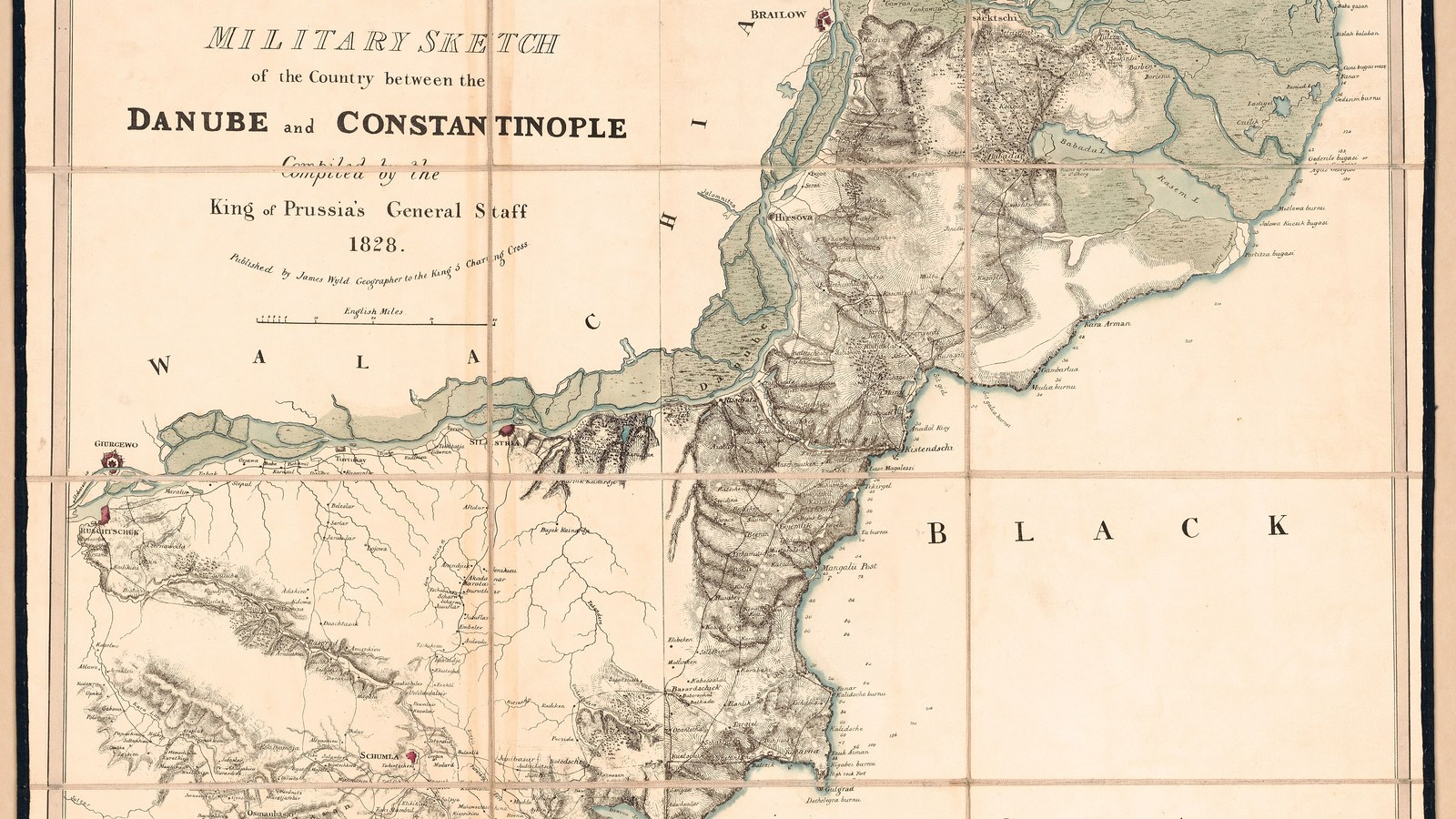
The European boundary returned to the Prut down to the Danube, then followed the river to the St George mouth. The islands of the delta went to Russia; the right bank remained Ottoman, but was to stay uninhabited for a strip two hours’ walk from the water. Merchant ships of both parties might use the Danube; Russian warships were not to go upstream of the Prut confluence. For Wallachia, the frontier with the Ottoman Empire was fixed on the thalweg, and the rayas of Turnu, Giurgiu and Brăila reverted to the principality.
Moldavia and Wallachia stayed under the sultan’s nominal suzerainty, with tribute and investiture, but the treaty recognised freedom of worship, their own administration and the right to trade; a separate act, equal in force to the peace, spelled out those guarantees, which Russia undertook as protector. Russian troops were to remain in the principalities until a war indemnity was paid. The British handbook The History of the Eastern Question, prepared by the Foreign Office for the 1919 conference, summed up what followed: princes elected by assemblies, for life, and a Russian protectorate that left the Porte with tribute and a formula.
In Asia the sultan recognised Russian possession of Georgia — with Imereti, Mingrelia and Guria — and of the khanates of Erivan and Nakhichevan, ceded to the tsar by Persia in the Treaty of Turkmenchay in 1828. The fortresses of Akhalkalaki and Akhaltsikhe remained north of the new line; Anapa and Poti, on the Caucasian shore, passed to Russia. The Bosporus and the Dardanelles were opened to Russian merchantmen and, on the same footing, to merchant ships of all powers at peace with the Porte. The military question of the Straits was settled only later, by the Treaty of Hünkâr İskelesi in 1833.
The article on Serbia bound the Porte to apply, without delay, the separate Akkerman act and to restore the six districts taken from the Serbs. On Greece, the sultan acceded to the Treaty of London of 6 July 1827, concluded by Russia, Great Britain and France, and to the measures of March 1829; independence, or autonomy under suzerainty, was to be negotiated with the three protecting powers. The frontiers of the new Greek state were drawn afterwards, not by the Adrianople text itself.
The peace loosened Ottoman control over the Principalities and gave Russia the Danube mouths and a commercial position on the Black Sea, without resolving the Eastern Question at root. The huge indemnity was later cut down, and the Russian occupation of the principalities ended when the Porte paid. What remained, for the Danube and for the Romanian lands, was the shift of the rayas and of the frontier onto the river — a fact of the map, not a victory monument.
Source consulted: Treaty of Adrianople (1829). Historical study: The History of the Eastern Question.











0 Comments
No comments on this article yet. Be the first!