


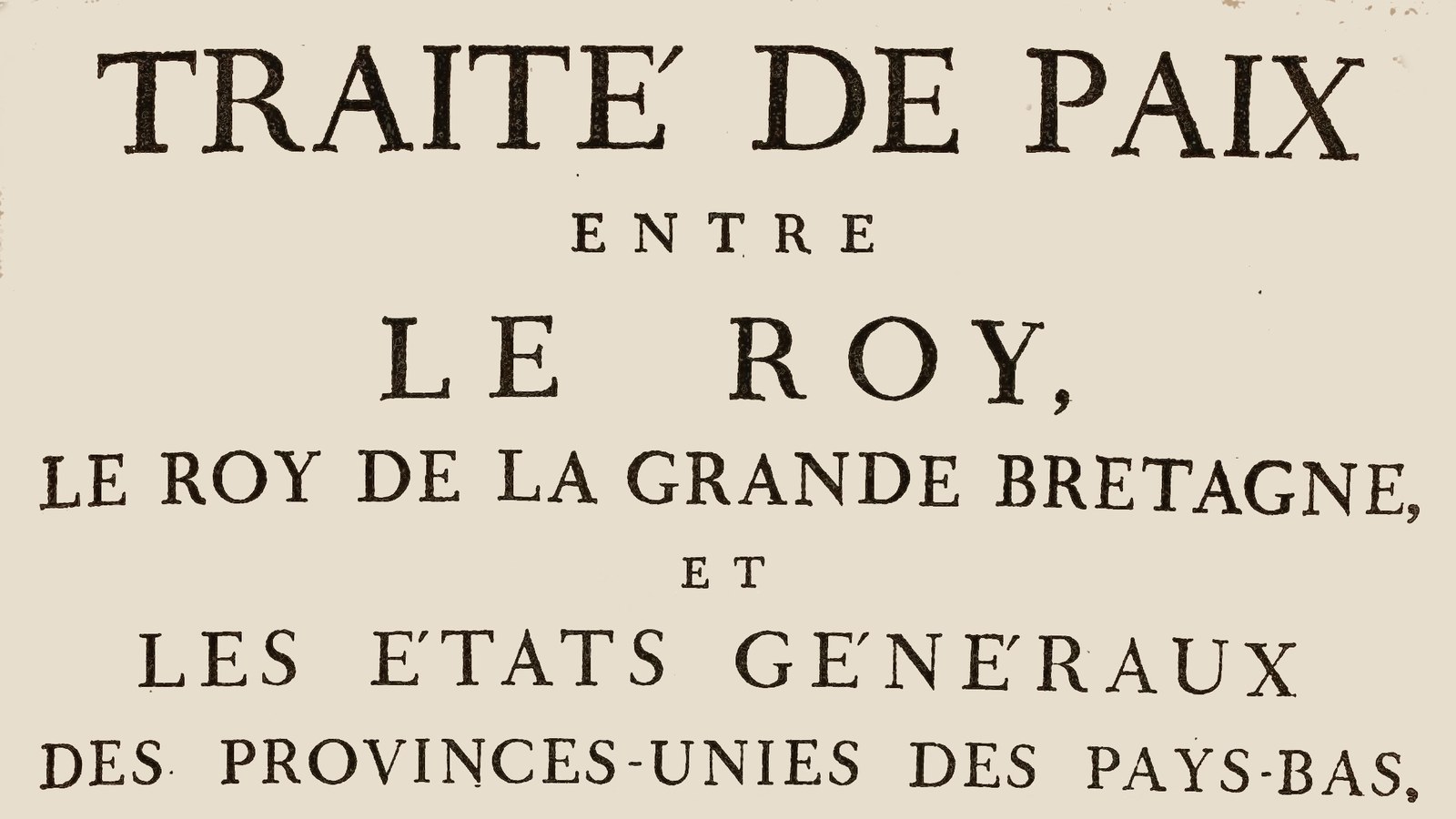
At Aachen (Aix-la-Chapelle), a free imperial city, France, Great Britain and the United Provinces sign the definitive treaty of peace that closes the War of the Austrian Succession. The date of the instrument is 18 October 1748. Saint-Severin d’Aragon and La Porte du Theil sign for France; Sandwich and Thomas Robinson for Great Britain; Bentinck, Hasselaer, Borssele and van Haren for the States General. The congress has sat here since April; the preliminaries among the three powers are of 30 April. Spain, Austria and Sardinia accede later; Modena and Genoa in January. Article I: a Christian, universal and perpetual peace, by sea and land, among the eight powers.
Article II: a general oblivion of what was done in the war; goods, dignities and benefices are restored. Article III: the base remains Westphalia, Madrid, Nijmegen, Rijswijk, Utrecht, Baden, The Hague, the Quadruple Alliance of London and Vienna, save the derogations in this text. Article IV: prisoners and hostages, without ransom, within six weeks of the exchange of ratifications; ships taken after the Indies time-limits are restored.
Article VI: restitutions and cessions in Europe within six weeks. The Most Christian King restores the conquests made upon the Empress and upon the States General. Maria Theresa re-enters the Netherlands, except as otherwise arranged. The Dutch recover Bergen op Zoom, Maastricht and their possessions in Dutch Flanders and Brabant; the Barrier garrisons are restored. Sardinia is re-established in Savoy and Nice. The Duchy of Modena and the Republic of Genoa recover their states, under Articles X, XIII and XIV. Charleroi, Mons, Ath, Oudenaarde and Tournai are restored without artillery, the outer works having been demolished.
Article IX: in consideration of the French and Spanish restitutions, the duchies of Parma, Piacenza and Guastalla pass to Infante Don Philip and his legitimate male descendants, under the acts of cession of Maria Theresa and Charles Emmanuel, with reversion if the Infante dies without sons or mounts the throne of the Two Sicilies or of Spain. Article XVI: the Asiento treaty of Madrid of 26 March 1713 and the annual-ship article are confirmed for the four years interrupted by the war. Article XVII: Dunkirk remains fortified on the land side as it now stands; on the sea side, on the footing of the former treaties.
Article XIX recalls Article V of the Quadruple Alliance of 1718, on the British succession. Article XX: the King’s German possessions as Elector of Brunswick-Lüneburg are included in the guarantee. Article XXI: the powers that guaranteed the Pragmatic Sanction of 19 April 1713 renew it, except cessions already made and those in this treaty. Article XXII: the duchy of Silesia and the county of Glatz, as the King of Prussia now possesses them, are guaranteed by all the contracting parties; Prussia does not sign. Article XXIII: a reciprocal guarantee. Article XXIV: ratifications are exchanged at Aachen within one month of signature.
The general restitution of conquests also restores places overseas: Louisbourg returns to France, Madras to Great Britain. Article XVIII leaves to commissions the unsettled claims: Hanoverian money on Spain, Saint-Hubert, the Hainaut enclaves, the new offices in the Netherlands, the Palatine elector’s pretensions.
It is not the Treaty of Aix-la-Chapelle of 1668, which closed the War of Devolution. It is not the Congress of Aix-la-Chapelle of 1818. It is not the Peace of Dresden, where Austria had already recognised Silesia for Prussia. It is not Utrecht, from which the Asiento comes. It is not the Seven Years’ War.
The Treaty of Madrid, by which Great Britain later surrenders the Asiento for a sum, is not this text. The Silesian guarantee of Article XXII remains the one signed at Aachen.
Image: title page of the Treaty of Aix-la-Chapelle, Imprimerie royale, Paris, 1750; BnF-Gallica; public domain, Wikimedia Commons. Cropped to 16:9.
Source consulted: Treaty of Aix-la-Chapelle (1748). Treaty text: Traité de paix conclu à Aix-la-Chapelle, 18 October 1748 (Wenck).











0 Comments
No comments on this article yet. Be the first!