


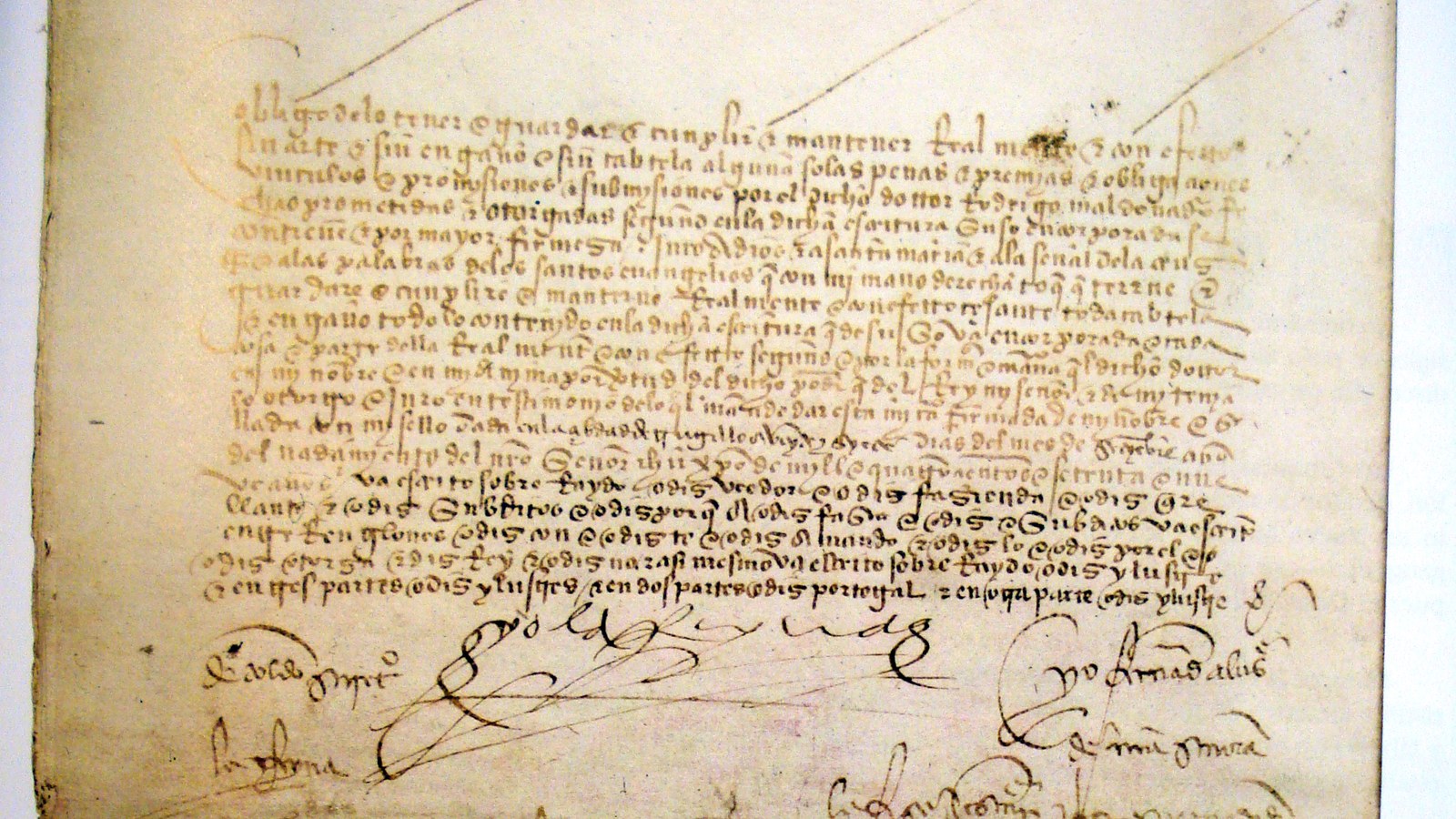
On 4 September 1479, in the houses of the Infanta Dona Beatrice at Alcáçovas, perpetual peace was confirmed between Ferdinand and Isabella, king and queen of Castile and Aragon, and Afonso V of Portugal with his son, Prince João. Castile was represented by Doctor Rodrigo Maldonado; Portugal by João da Silveira, baron of Alvito. Portugal ratified on 8 September; Castile, at Toledo, on 6 March 1480.
The peace renews the 1431 treaty between John I of Portugal and John II of Castile, with new articles. The War of the Castilian Succession, after the death of Henry IV, had set Ferdinand and Isabella against Afonso, who styled himself king of Castile beside Juana de Trastámara. Avalon, after Davenport, preserves the article that divides the Atlantic.
Castile binds itself not to disturb the trade, shores and barter of Guinea, with its gold-mines, nor Madeira, Porto Santo, Desierta, the Azores, Flores, Cape Verde and any islands found or to be conquered from the Canary Islands down toward Guinea. Excepted are the Canaries: Lanzarote, Palma, Fuerteventura, Gomera, El Hierro, Graciosa, Gran Canaria, Tenerife and the rest, which belong to Castile.
No ship from Castilian ports, of subjects or of foreigners fitted out there, is to go to Guinea without Portugal’s licence. The conquest of the kingdom of Fez remains to Portugal, as the earlier sovereigns of Castile had not obstructed it. The fine for breach is 300,000 gold doblas, and paying or remitting it does not undo the peace.
This is not the Battle of Toro of 1476, not the Battle of Guinea of 1478 and not Tordesillas of 1494, which moved the line after Columbus. The bull Aeterni regis of 1481 later confirmed the partition. The seal does not carry every later summary: Wikipedia mentions the terçerías of Moura and Infanta Isabella’s dowry; the Avalon article we follow regulates the sea and Fez.
Ferdinand and Isabella swear on the cross and the gospels, at Toledo, before ambassador Ferrando de Silva, to keep the instrument “without any evasion, deception, or mental reservation whatsoever.” Notaries João Garces and Benito Roys de Castro wrote it on thirty-three leaves.
The ratification of the Treaty of Alcáçovas, a chancery instrument. Image: Wikimedia Commons, public domain.
For context: Treaty of Alcáçovas. The text, after Davenport: Treaty Between Spain and Portugal, concluded at Alcacovas, September 4, 1479.











0 Comments
No comments on this article yet. Be the first!