


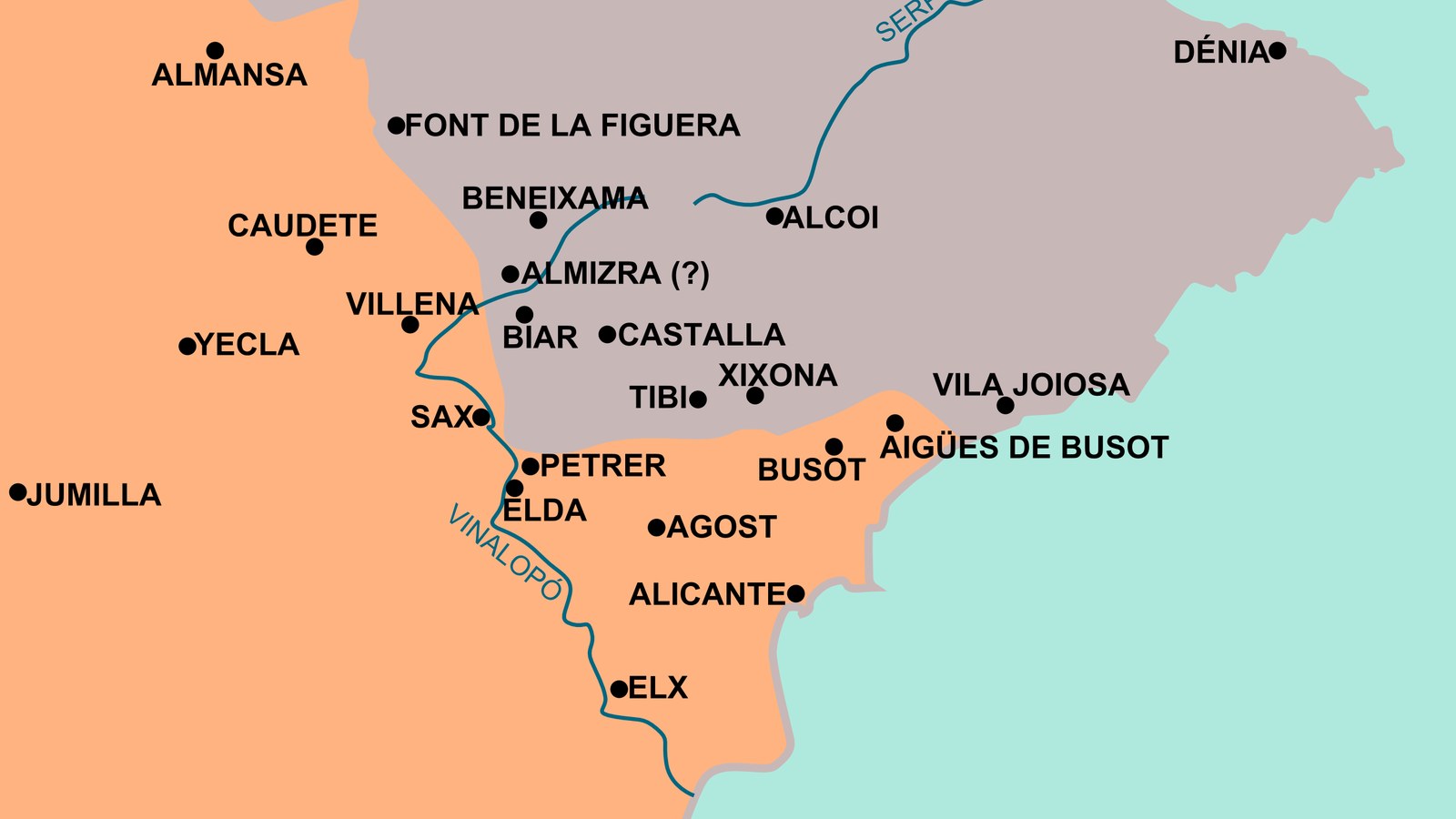
On 26 March 1244, at Almizra (today Camp de Mirra, Alicante), James I, king of Aragon, Mallorca and Valencia, count of Barcelona and of Urgell, lord of Montpellier, and the infante Alfonso, first-born of Ferdinand, king of Castile and Toledo, of León, Galicia, Córdoba and Murcia, hold a colloquium and seal the partition of the conquest. Alfonso is not yet the king’s son-in-law: the marriage to Violante comes later. The Latin text, preserved in copies of the Archive of the Crown of Aragon and published by Huici and Cabanes, opens: king James, for himself and his successors, praises, grants and assigns in perpetuity to the said infante and his successors the castle and town of Alicante with all its bounds, Aigües with all its bounds, Busot with all its bounds, as the land goes to the pass of Biar, and the castle and town of Villena (Millena) with all its bounds, and all else beyond the bound of Biar, between Biar and Villena, towards Murcia and Castile, each bound kept whole.
The line runs between the bound of Almizra and that of Bugarra, then towards the beginning of the sierra de la Rua, which stands above Ayora, as the waters fall from that sierra towards Castile, and as that sierra stands where the Cabriel falls into the Júcar (Xúcar). Likewise the infante Alfonso, for himself and all his successors, praises, grants and assigns in perpetuity to king James and his successors the castle of Castalla, the castle of Biar and the castle of Almizra, each with its bounds, and all that lies this side of the said castles of Alicante, Aigües and Busot, and all that lies below the pass of Biar towards Xàtiva, Dénia and the other land of the kingdom of Valencia, as the waters fall towards Valencia. This division proceeds as far as the Júcar, where the Cabriel enters the Júcar, and from the Júcar as far as Biar.
Each party declares himself fully content with the portion so assigned. They promise in good faith, without fraud, that neither will allow the other to be hindered in his share. For the perpetual firmness of the division, the king and the infante give it force with their seals. Given at Almizra, when they held colloquy there, era 1282. Witnesses, after Carreres Zacarés’s translation of the Latin published by Giménez Soler in 1905: Arnaldus, bishop of Valencia; brother Guillermus de Cardona, master of the Temple in Aragon; brother Hugo de Folalquer, castellan of Amposta; Guillermus de Moncada; Eximen de Foces; Eximen Pérez, the king’s lieutenant in Valencia; master Martinus, archdeacon of Valencia; Gundisalvus, bishop of Cuenca; Martinus Martini, master of the Temple in the three kingdoms of Spain; Pelagius Petri Corrigia, master of the knighthood of Santiago; Didacus Lupi de Faro; Alfonsus Tellez; and others. Guillermus, secretary, wrote it by command of the king and the infante.
The same day, a Castilian charter, transcribed in the Arxiu Virtual Jaume I from James I’s royal letters, makes a pleyto of friendship: that they love and help one another against all the men of the world, excepting the person of king Ferdinand of Castile; that a vassal who loses the love of one shall not be taken in by the other. Two charters divided by A B C, each like the other; James sets his lead seal on each, and the infante likewise. Facta carta ante Villenam et Almizra, when the king of Aragon and the infante Alfonso held their vistas, era 1282. The witnesses overlap in part with the Latin list: Moncada, Foces, Arnalt bishop of Valencia, Uco de Folalquer master of the Hospital, Cardona master of the Temple; from Castile Diego López de Haro, Alfonso Téllez, the bishop of Cuenca, Pelay Pérez master of Uclés, Martín Martínez master of the Temple.
The Llibre dels fets notes a partition of the lands then in hand: the infante to have Almansa, Xarafull and the river Cabriel; James, Castalla, Biar, Relleu, Xixona, Alarc, Finestrat, Torres, Polop, the Mola near Aigües, Altea and all enclosed in their bounds. The chronicle’s list does not replace the Latin clauses: Alicante, Aigües, Busot and Villena remain, in the act, on the Castilian side.
The treaty follows those of Tudilén (1151) and Cazorla (1179), both broken by the two crowns. James had taken Villena, Caudete and Sax, beyond the pass of Biar; the infante pressed a claim to Xàtiva, already in the Aragonese zone. This is not the Treaty of Alcaraz of 1243, by which Murcia became a Castilian vassal, and not the treaties of Torrellas (1304) and Elche (1305), which move Alicante and the Vinalopó into the kingdom of Valencia. Alfonso signs as infante, not as King Alfonso X.
Image: Enrique Íñiguez (Qoan), approximate limits of the Treaty of Almizra (1244), CC BY-SA 3.0, Wikimedia Commons. Cropped to 16:9.
Source consulted: Treaty of Almizra. Treaty text: Agustí Galiana, L'extrem sud de la Marina (Sarrià): Latin text of the Treaty of Almisra, after Huici and Cabanes.











0 Comments
No comments on this article yet. Be the first!