


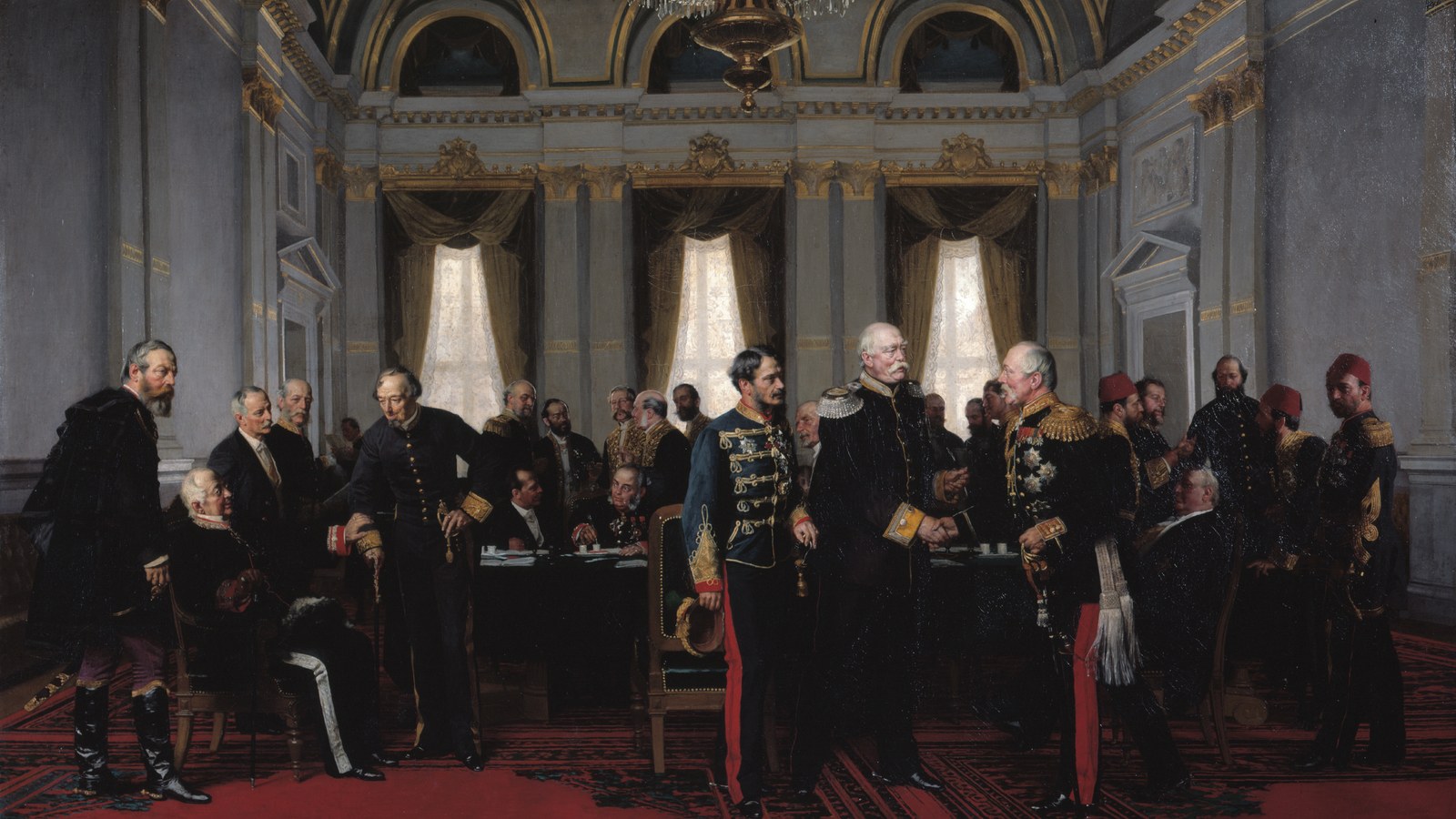
On 13 July 1878, in Berlin, the Treaty between Austria-Hungary, France, Germany, Great Britain and Ireland, Italy, Russia and the Ottoman Empire, for the Settlement of the Affairs of the East, was signed. It was the final act of the Congress of Berlin, opened on 13 June, with Otto von Bismarck in the chair.
The congress revised the Treaty of San Stefano, concluded after Russia’s victory in the Russo-Turkish War of 1877–1878. San Stefano had provided for a large, Russophile Bulgaria. London and Vienna refused it. Bulgaria itself was kept out of the room, at Russia’s insistence: it was not a sovereign state.
The treaty recognised the de facto independence of Romania, Serbia and Montenegro. Bulgaria was cut into three: the Principality of Bulgaria, the autonomous province of Eastern Rumelia, and Macedonia, returned to the Ottomans. Russia kept Batumi, Ardahan and Kars; the Alashkerd valley and Bayazid went back to the Porte.
The Romanian delegates could not stop the cession of southern Bessarabia to Russia. The compensation was Dobruja, including the Danube Delta. The Russian occupation of Bulgaria was limited to nine months, so that troops would not linger on Romanian territory. The treaty required Romania to recognise non-Christians — Jews and Muslims — as full citizens.
Austria-Hungary received the right to occupy the Vilayet of Bosnia and to station garrisons in the Sanjak of Novi Pazar. Bosnia remained formally Ottoman until the annexation of 1908. Kosovo stayed under the Porte. Greece received only a vague promise of a border rectification, realised in 1881 with Thessaly.
The plenipotentiaries included Benjamin Disraeli and the Marquess of Salisbury for the British, Count Andrássy for Austria-Hungary, Prince Gorchakov for Russia, William Henry Waddington for France, Luigi Corti for Italy and Alexander Karatheodori Pasha for the Ottomans. The 1918 U.S. State Department study “The Berlin congress,” by Henry F. Munro, describes the procedure of the room, not the articles: who spoke, in what order, how San Stefano became the final text.
A. J. P. Taylor later wrote that Russia’s defeat was not a full success for Vienna or London. Macedonia haunted diplomacy until the Balkan wars; Bosnia exploded in 1914. Bulgaria united with Eastern Rumelia in 1885 and declared full independence in 1908. Romania, Serbia and Montenegro proclaimed themselves kingdoms in the years that followed.
Image: Anton von Werner, Congress of Berlin, 13 July 1878, 1892 painting, public domain, Wikimedia Commons. Not a photograph of the congress. Cropped to 16:9.
Source consulted: Treaty of Berlin (1878). Treaty text: The Berlin congress — Henry F. Munro.











0 Comments
No comments on this article yet. Be the first!