


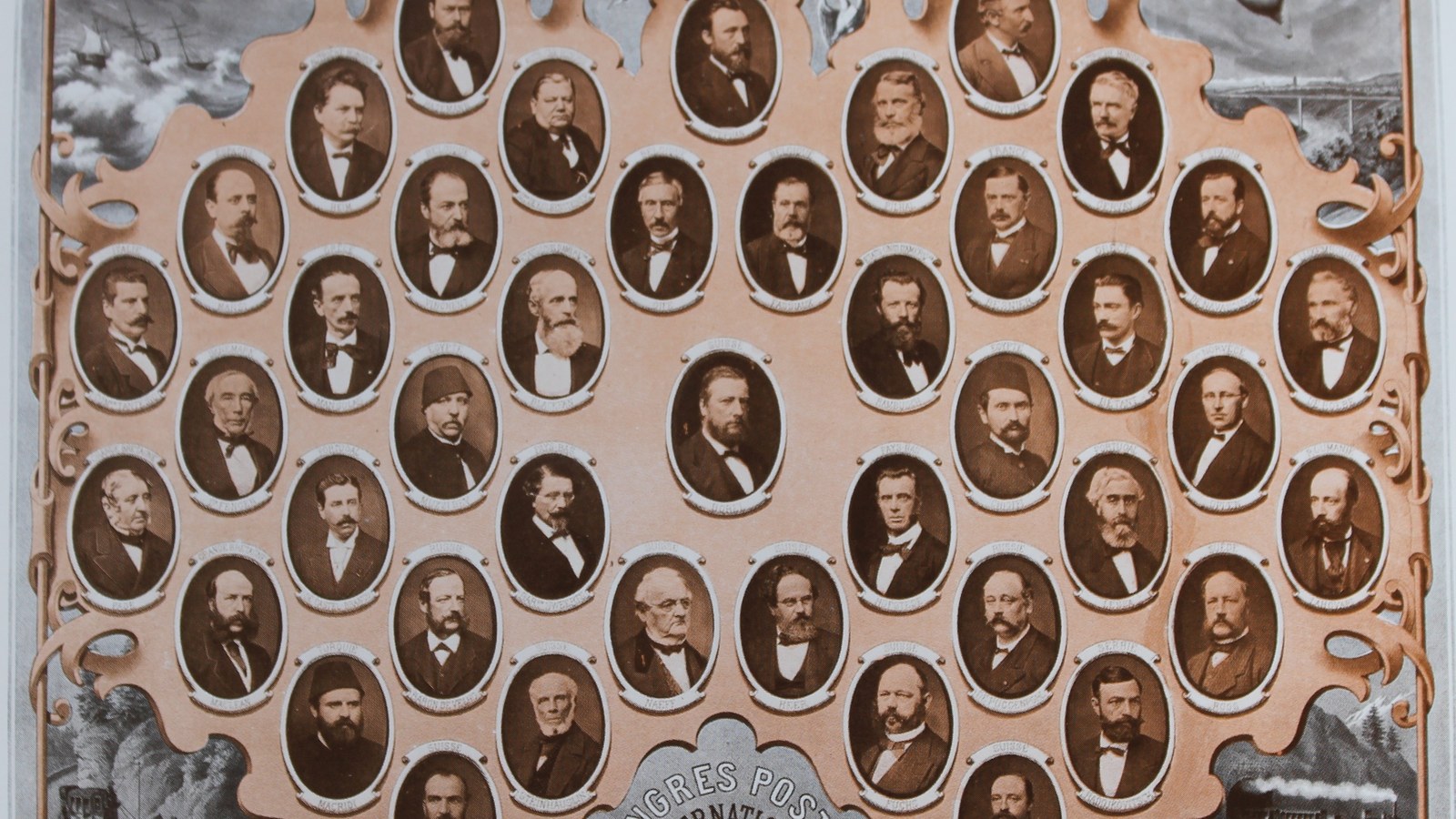
On 9 October 1874, at Bern, the plenipotentiaries of Germany, Austria-Hungary, Belgium, Denmark, Egypt, Spain, the United States, Great Britain, Greece, Italy, Luxemburg, Norway, the Netherlands, Portugal, Roumania, Russia, Servia, Sweden, Switzerland and Turkey signed the Treaty concerning the formation of a General Postal Union. It is not the Berne Convention of 1886 on copyright and not the UPU Constitution of 1964. France, keeping the protocol open, signs only on 3 May 1875, with reservations: it may enter into effect for her as late as 1 January 1876; territorial transit is paid on the route actually traversed; the October tariffs are not to be changed except by a unanimous vote.
The congress, demanded by Heinrich von Stephan after the war of 1870–1871 and convened by Switzerland on 15 September, sat in the Rathaus zum Äusseren Stand, under Eugène Borel. Article 1 makes the contracting countries, under the title of General Postal Union, a single postal territory for the reciprocal exchange of correspondence. Article 2 covers letters, post-cards, books, newspapers and other printed papers, patterns of merchandise, and legal and commercial documents, and also exchanges with countries outside the Union when they pass over the territory of at least two contracting parties.
Article 3 fixes the general Union rate at 25 centimes for a single prepaid letter, with a national band between 20 and 32; 15 grammes make a unit; unpaid letters pay double the destination rate; post-cards must be prepaid, at half. For sea conveyance of more than 300 nautical miles inside the Union an extra charge not exceeding half the general rate may be added. Article 4 sets 7 centimes on a single packet of prints, patterns and papers (5–11, 50 grammes), with a ceiling of 250 grammes for patterns and 1,000 for the rest. Article 5 allows registration, with an indemnity of 50 francs for loss, except vis major, if claimed within a year.
Article 9 lets each administration keep the sums it collects; no accounts are needed on that head. Article 10 guarantees the right of transit throughout the Union, by the most rapid routes: 2 francs a kilogramme for letters and 25 centimes for the articles of Article 4, doubled beyond 750 kilometres over one administration’s territory; by sea, over 300 miles, up to 6.50 francs and 50 centimes. The Indian mail and the mails across the United States by the railways between New York and San Francisco remain special arrangements. Article 15 sets up the International Office of the Union, under the surveillance of an administration chosen by the Congress, expenses shared. Article 16 sends disputes to arbitration. Article 18 requires a congress of plenipotentiaries at least every three years, one vote per country; the next meeting is at Paris, in 1877.
Article 19 brings the treaty into force on 1 July 1875, for three years, then indefinitely, with one year’s notice of withdrawal. Ratifications are exchanged at Bern at latest three months before; the procès-verbal of 3 May 1875 includes those of the United States. The convention of 1 June 1878, which changes the name to Universal Postal Union, terminates it. It is not the ITU of 1865 and not the Rhine Commission of 1815, though it is among the oldest organisations between states.
The international postal congress at Bern, period lithograph. Image: Wikimedia Commons, public domain.
For context: Treaty of Bern. The text: General Postal Union; October 9, 1874.











0 Comments
No comments on this article yet. Be the first!