


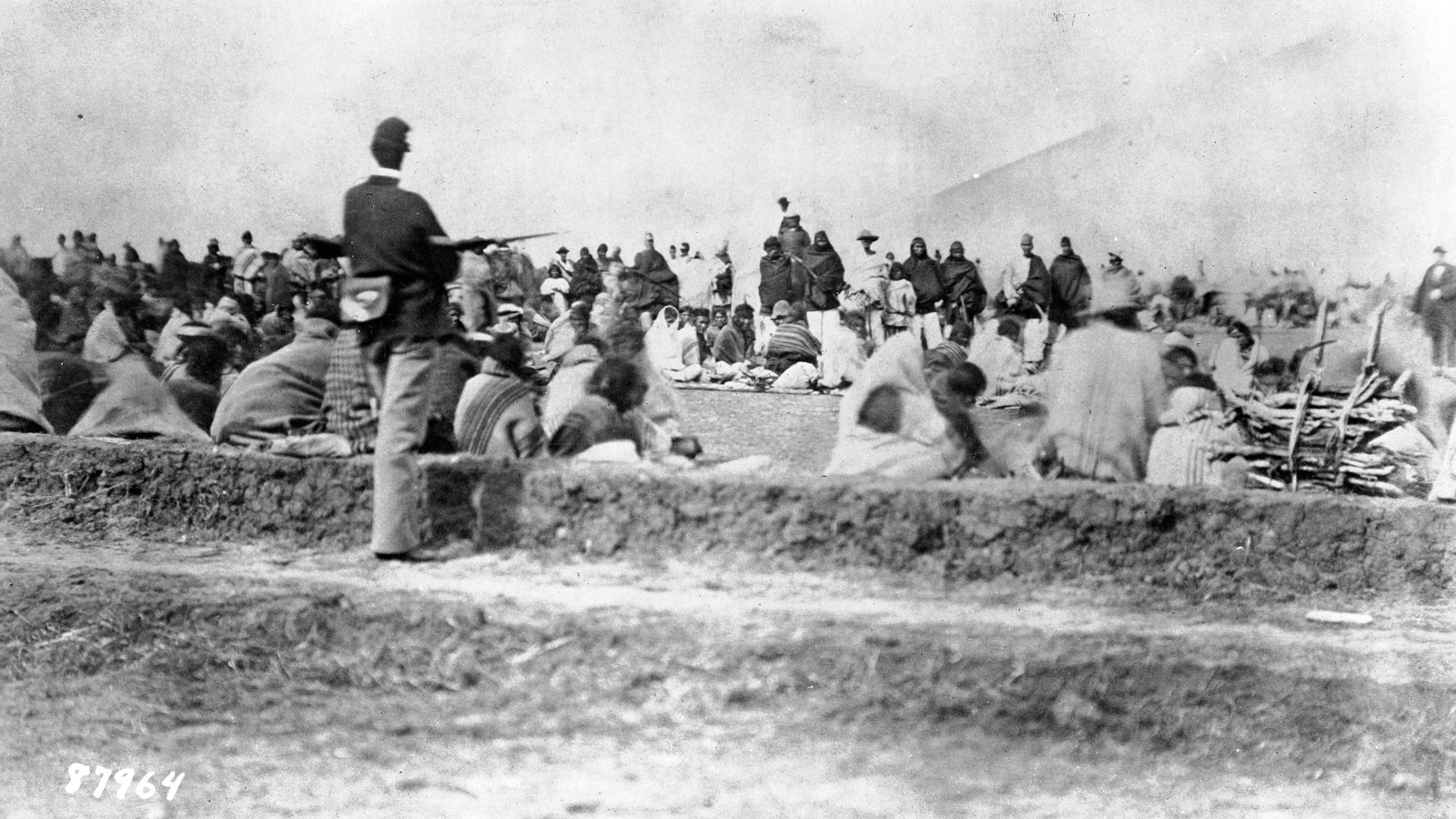
Kit Carson burned crops and herds. In 1862 James Henry Carleton ordered every Navajo to the Bosque Redondo reservation, near Fort Sumner, in New Mexico Territory. Refusal meant immediate military action. The Long Walk, 1864: some 8,000 to 10,000 people, more than 350 miles. Hweeldi, the land of suffering. Poor soil, weak irrigation, an unpredictable Pecos; worms and floods. One estimate: from March to December 1865 the population fell from about 9,000 to about 6,000. The cost of feeding and guarding them reached $1,250,000 in 1865. Sherman wrote to Carleton that the government would not maintain this extravagant system. Carleton was removed in 1867. The Indian Peace Commission reported in January 1868. The treaty was signed on 1 June 1868, at Fort Sumner.
Commissioners: Lieutenant-General William Tecumseh Sherman and Colonel Samuel F. Tappan, arrived 28 May, after the second Treaty of Fort Laramie. For the Navajo: Barboncito, Armijo, Manuelito and other headmen, 29 marks. Sherman proposed Indian Territory, the future Oklahoma. Barboncito refused. Tappan likened the camp to Andersonville. The Senate consented on 25 July; Andrew Johnson proclaimed on 12 August.
Article I: from this day forward all war between the parties shall forever cease. Article II: the reservation, from the 37th parallel to the line through old Fort Defiance in Canon Bonito, east by Ojo-de-oso, west about 109 degrees 30 minutes, with the whole of Canon-de-Chilly. Article III: warehouse, agency, carpenter shop, blacksmith shop, schoolhouse and chapel. Article V: a head of family, up to 160 acres; anyone over 18 not a head of family, 80. Article VI: children between six and sixteen years to school, for not less than ten years; one teacher for every thirty children. Some summaries say ages 6 to 13; the authentic text says 6 to 16.
Article VII: seeds and implements, one hundred dollars the first year, twenty-five for each of the next two. Article VIII: clothing or raw material, five dollars per Indian, for ten years; plus ten dollars a year for those in farming or mechanical pursuits. Article IX: relinquish the right to occupy land outside the reservation, retaining the hunt on unoccupied contiguous lands; no opposition to the railroad, no attacks on wagon trains. Article X: no future cession without three-fourths of the adult male Indians. Article XII: one hundred and fifty thousand dollars: removal about fifty thousand, fifteen thousand sheep and goats, five hundred beef cattle and a million pounds of corn. Article XIII: the reservation as a permanent home; anyone who leaves forfeits the annuities.
On 18 June some 8,000 set off, twelve miles a day, with about 2,000 sheep and 1,000 horses. They arrived too late to plant. The reservation was between 10 and 25 percent of the old country. This is not the April Fort Laramie treaty with the Sioux. The cover is the internment at Fort Sumner, U.S. Army Signal Corps; the treaty's first page is too narrow for the frame.
Sources: Treaty of Bosque Redondo; Treaty between the United States of America and the Navajo Tribe of Indians (15 Stat. 667).











0 Comments
No comments on this article yet. Be the first!