


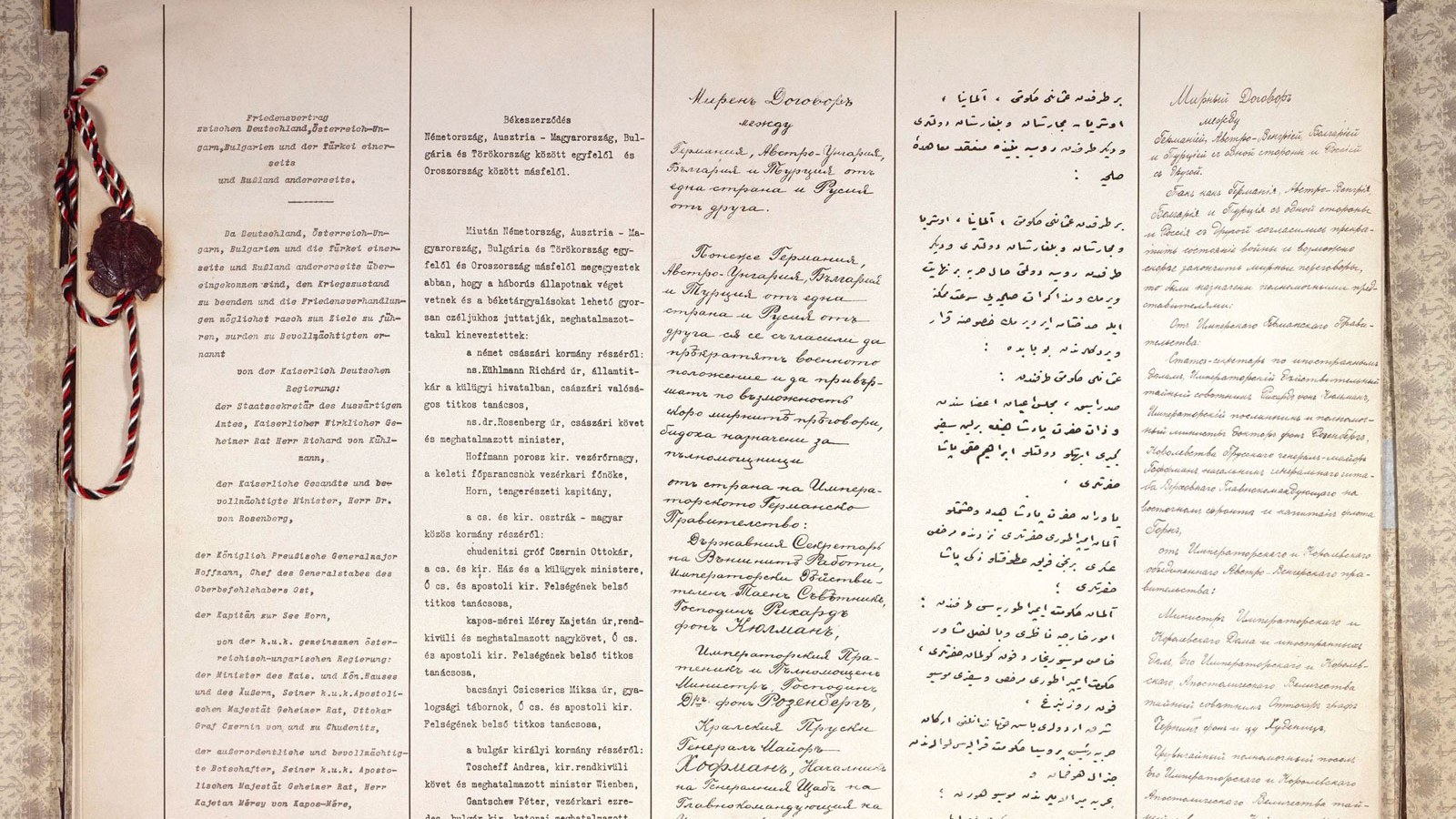
Talks at Brest-Litovsk opened on 22 December 1917, a week after the armistice on the Eastern Front. The Soviet delegation was led first by Adolph Joffe, then by Leon Trotsky. Opposite them sat Richard von Kühlmann and Max Hoffmann for Germany, Ottokar Czernin for Austria-Hungary, Talaat Pasha for the Ottoman Empire, and the Bulgarian representatives. The city, burned in 1915, hosted the conference in its fortress.
The Bolsheviks demanded “peace without annexations or indemnities”. The Central Powers accepted the principle only if all belligerents, including the Entente, bound themselves likewise. On 27 December Hoffmann made plain that Poland, Lithuania and Courland, already occupied, would leave Russia under the self-determination the Soviets themselves invoked. Trotsky then stretched the talks, hoping for revolution in Central Europe.
On the night of 8–9 February 1918 the Central Powers signed a separate peace with the Ukrainian People’s Republic. On 10 February Trotsky announced “neither war nor peace”: Russia left the table, declared hostilities over and refused to sign. Hoffmann resumed the offensive on 18 February. German troops took large parts of the Baltic lands, Belarus and Ukraine; a fleet approached the Gulf of Finland. Lenin forced the signature, threatening to resign. Trotsky left the Foreign Commissariat.
Grigori Sokolnikov arrived with orders to sign the ultimatum without discussing its terms. At 17:50 on 3 March 1918, Soviet Russia concluded a separate peace with Germany, Austria-Hungary, Bulgaria and the Ottoman Empire. Article 1 of the instrument, in the Avalon translation, declares that the state of war has ceased. Article 3 removes from Russian sovereignty the territories west of the line on the annexed map; Germany and Austria-Hungary would determine their future “with the consent of their inhabitants”.
Article 4 requires the evacuation of eastern Anatolia and of Ardahan, Kars and Batum. Article 5 orders the demobilisation of the Russian army, including units raised by the new government. Article 6 binds Russia to recognise the Ukrainian peace, to clear Estonia, Livonia, Finland and the Åland Islands, and to stop propaganda against those authorities. Article 9 mutually waives indemnities for war costs; a supplementary protocol signed in Berlin on 27 August 1918 nonetheless required Russia to pay six billion marks.
Russia lost control of Ukraine, Poland, Belarus, Lithuania, Latvia, Estonia and the Caucasian province of Kars–Batum. The lands held 34 percent of the former empire’s population, 54 percent of its industrial territory, 89 percent of its coalfields and 26 percent of its railways. Germany planned client states in the Baltics; Wilhelm Karl of Urach and Adolf Friedrich of Mecklenburg-Schwerin were named in title but never reigned.
The occupation kept more than a million German soldiers away from the Western Front. The 1918 Spring Offensive failed. The Armistice of Compiègne on 11 November 1918 annulled the treaty. At Rapallo in 1922, Soviet Russia and Germany waived territorial and financial claims against each other. The Caucasian border was largely confirmed by the Treaty of Kars in 1921.
Sources: Treaty of Brest-Litovsk; Avalon Project, Peace Treaty of Brest Litovsk.











0 Comments
No comments on this article yet. Be the first!