


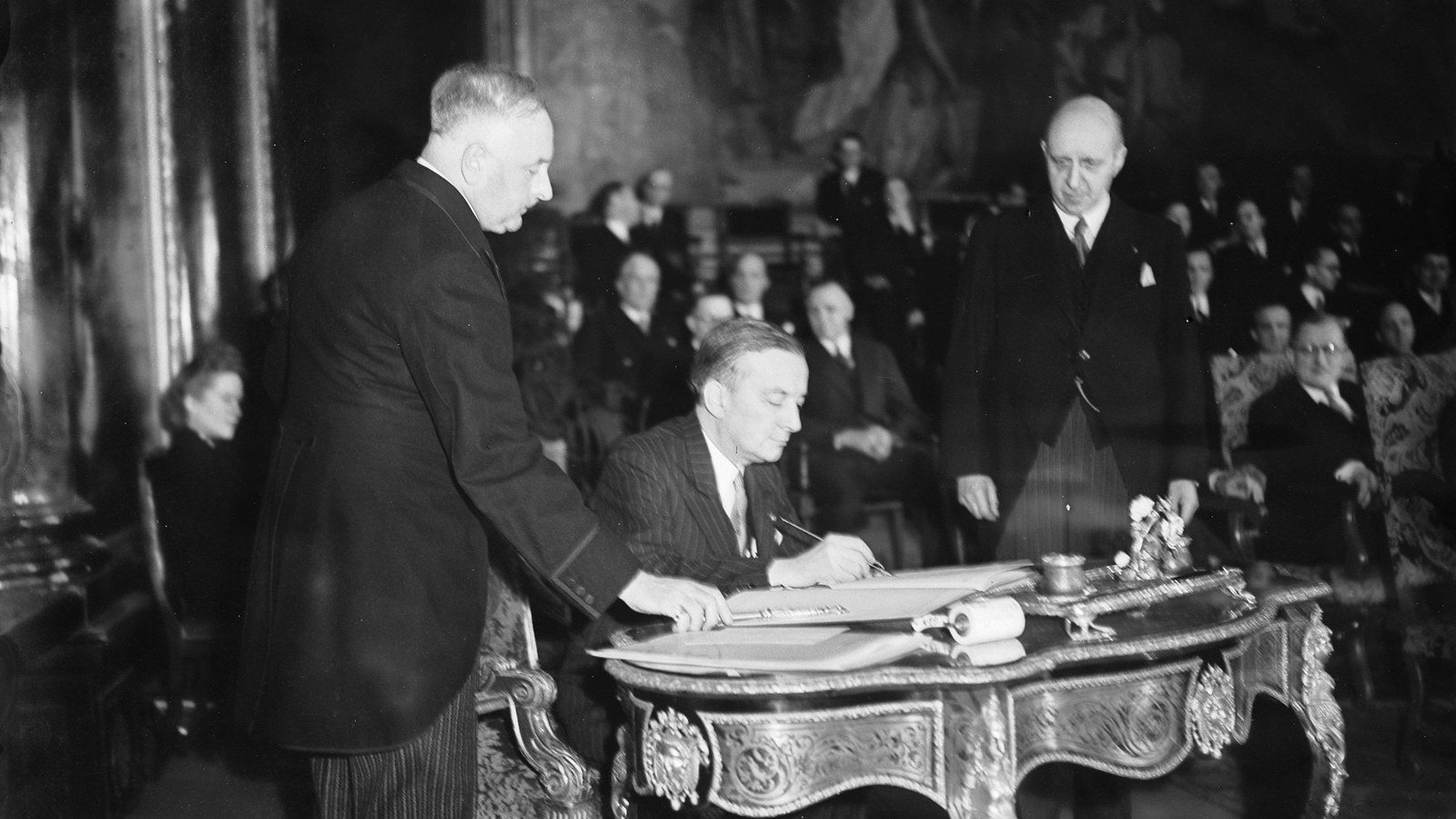
On 17 March 1948, at Brussels, Belgium, France, Luxembourg, the Netherlands and the United Kingdom sign the Treaty of Economic, Social and Cultural Collaboration and Collective Self-Defence, in English and French, each text equally authentic, in a single copy deposited in the archives of the Belgian Government. Plenipotentiaries: Paul-Henri Spaak and Gaston Eyskens; Georges Bidault and Jean de Hauteclocque; Joseph Bech and Robert Als; Baron C. G. W. H. van Boetzelaer van Oosterhout and Baron Binnert Philip van Harinxma thoe Slooten; Ernest Bevin and Sir George William Rendel. Preamble: fundamental human rights, the dignity and worth of the human person, the Charter of the United Nations; democracy, personal freedom, constitutional traditions, the rule of law; a firm basis for European economic recovery; assistance to each other, in accordance with the Charter, in maintaining international peace and security and in resisting any policy of aggression; such steps as may be necessary in the event of a renewal by Germany of a policy of aggression; progressive association of other States inspired by the same ideals.
Article I: the High Contracting Parties will so organise and co-ordinate their economic activities as to produce the best possible results, by the elimination of conflict in their economic policies, the co-ordination of production and the development of commercial exchanges; the co-operation, through the Consultative Council in Article VII and other bodies, shall not duplicate or prejudice the work of other economic organisations, but shall assist it. Article II: every effort in common for a higher standard of living and for social and related services; consultation on recommendations of immediate practical interest adopted with their approval in the specialised agencies; conventions with each other in the sphere of social security as soon as possible. Article III: every effort in common to lead their peoples towards a better understanding of the principles of their common civilisation and to promote cultural exchanges by conventions or by other means.
Article IV: if any of the High Contracting Parties should be the object of an armed attack in Europe, the other High Contracting Parties will, in accordance with Article 51 of the Charter of the United Nations, afford the Party so attacked all the military and other aid and assistance in their power. Article V: all measures taken as a result of the preceding Article shall be immediately reported to the Security Council. They shall be terminated as soon as the Security Council has taken the measures necessary to maintain or restore international peace and security. The Treaty does not prejudice obligations under the Charter, nor the authority and responsibility of the Security Council.
Article VI: none of the international engagements now in force between a Party and any other High Contracting Party or any third State is in conflict with the Treaty; none of the High Contracting Parties will conclude any alliance or participate in any coalition directed against any other. Article VII: a Consultative Council, so organised as to be able to exercise its functions continuously; it shall meet at such times as it shall deem fit. At the request of any Party, the Council shall be immediately convened with regard to any situation which may constitute a threat to peace, in whatever area this threat should arise; with regard to the attitude to be adopted and the steps to be taken in case of a renewal by Germany of an aggressive policy; or with regard to any situation constituting a danger to economic stability.
Article VIII: disputes only by peaceful means. Disputes falling within Article 36, paragraph 2, of the Statute of the International Court of Justice, referred to the Court, subject to any reservation already made when accepting compulsory jurisdiction. Other disputes, to conciliation. In a mixed dispute, any Party may insist that judicial settlement of the legal questions shall precede conciliation. Article IX: by agreement, any other State may be invited to accede on conditions to be agreed; accession by depositing an instrument with the Belgian Government, which informs the other Parties.
Article X: ratification; instruments deposited as soon as possible with the Belgian Government. The Treaty enters into force on the date of the deposit of the last instrument of ratification and thereafter remains in force for fifty years. After that period, each Party may cease to be a party provided that he has previously given one year’s notice of denunciation to the Belgian Government. Signed: Spaak, Eyskens; Bidault, de Hauteclocque; Bech, Als; van Boetzelaer, van Harinxma thoe Slooten; Bevin, Rendel.
According to the United Nations Treaty Series, ratifications: Belgium 30 April, United Kingdom 2 June, Luxembourg 10 June, the Netherlands 20 July, France 25 August 1948, the date the treaty takes effect. This is not the Dunkirk Treaty of 1947, between London and Paris, and not the North Atlantic Treaty of 1949. It is not the Protocol of Modification of 23 October 1954, which opens the Western European Union to West Germany and Italy.
Image: J. D. Noske / Anefo, Georges Bidault signing the Brussels Pact, 17 March 1948, CC0, Nationaal Archief / Wikimedia Commons. Cropped to 16:9.
Source consulted: Treaty of Brussels. Treaty text: UNTS vol. 19, no. 304: Treaty signed at Brussels, 17 March 1948.











0 Comments
No comments on this article yet. Be the first!