


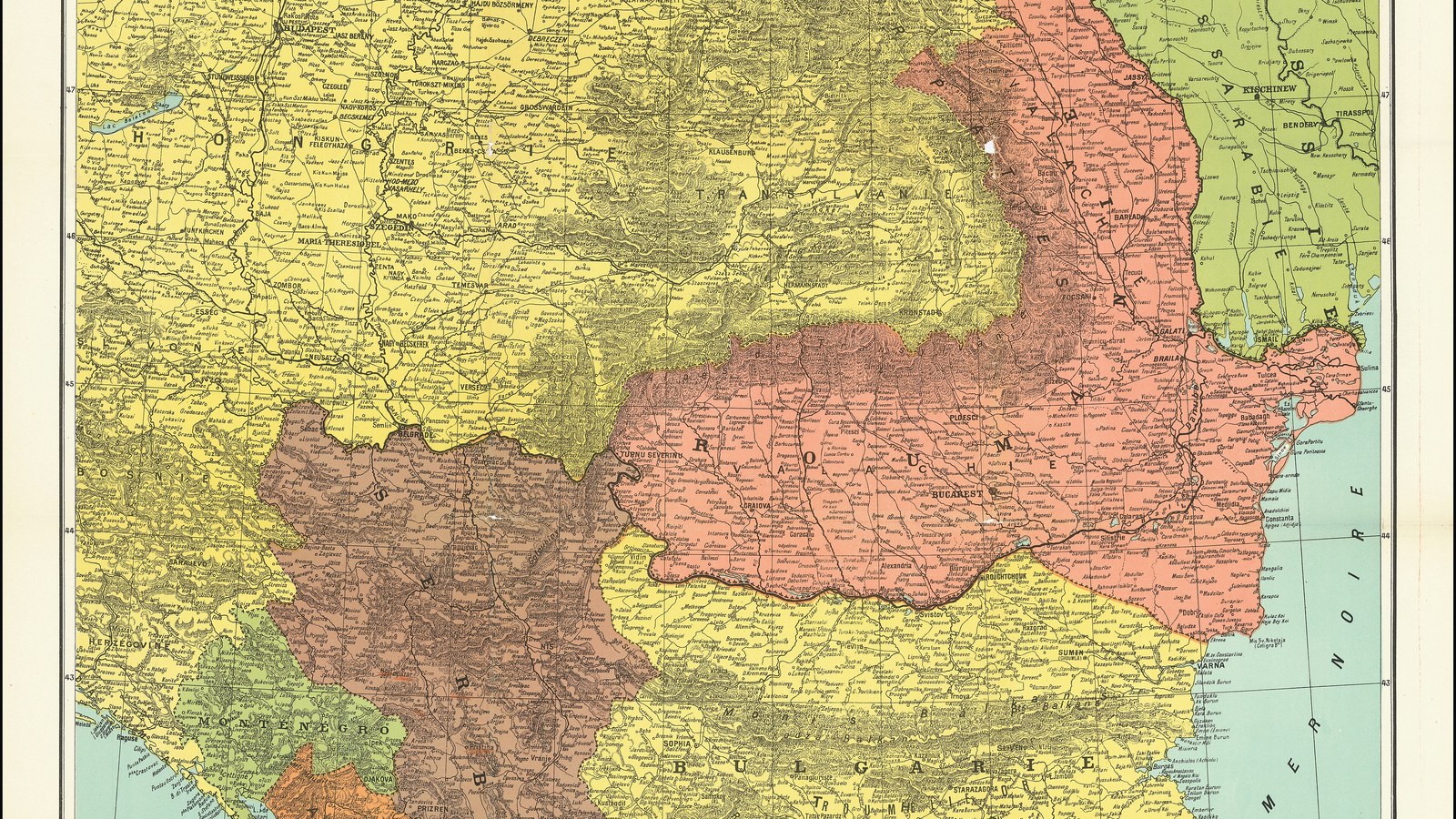
On 10 August 1913, in Bucharest, the delegates of Bulgaria, Romania, Serbia, Greece and Montenegro signed the Treaty of Bucharest. The act ended the Second Balkan War and amended the Treaty of London, which had closed the First. The Ottoman Empire was not at the table; with Sofia it signed later, separately, the Treaty of Constantinople.
Bulgaria, dissatisfied with the partition of Macedonia after the first war, had attacked its former allies in June. Serbian and Greek armies answered. The Ottomans retook Adrianople. Romania entered from the north and advanced, almost unopposed, toward Sofia. Surrounded, Bulgaria accepted an armistice and talks in the Romanian capital.
Titu Maiorescu presided. At the table were, among others, Eleftherios Venizelos, Nikola Pašić, Dimitar Tonchev, Take Ionescu, Alexandru Marghiloman and Janko Vukotić. The borders were drawn in committees, then ratified in plenary. The Great Powers did not revise the text.
Romania received the Cadrilater: Southern Dobruja, from a line on the Danube just above Tutrakan to the Black Sea shore south of Ekrene. About 6,960 square kilometres, with Silistra, Tutrakan and Balchik. Bulgaria undertook not to fortify Ruse, Shumen and the land between them, nor a 20-kilometre radius around Balchik.
Serbia took Vardar Macedonia, including Ohrid, Bitola, Štip and Kočani, and the eastern half of the Sanjak of Novi Pazar. Its territory grew from 48,300 to 87,780 square kilometres. Greece received Thessaloniki, much of Epirus and Macedonia as far as beyond Kavala; the border with Bulgaria was drawn from the crest of Belasica to the mouth of the Mesta. Crete was assigned to it definitively.
Bulgaria kept the Pirin, Strumica, Western Thrace and a 110-kilometre strip on the Aegean, with the port of Dedeagach. Montenegro received Berane, Peć and Gjakova. The 1914 Carnegie International Commission report, inquiring into the causes and conduct of the Balkan wars, records both the treaty and the atrocities of the campaigns.
For Sofia, Macedonia — the avowed purpose of the war — stayed outside the borders. For Bucharest, the northern intervention confirmed, for a few years, the position of the strongest army in the Balkans. The conference did not annex the Vlach districts of Macedonia; neighbouring states had nonetheless promised, in protocols before the signing, to protect their schools and churches.
Image: E. Patesson, map of the Balkan Peninsula with the borders after the Treaty of Bucharest, circa 1914, public domain, Wikimedia Commons. Not a photograph of the signing. Cropped to 16:9.
Source consulted: Treaty of Bucharest (1913). Treaty text: Report of the International Commission to Inquire into the Causes and Conduct of the Balkan Wars.











0 Comments
No comments on this article yet. Be the first!