


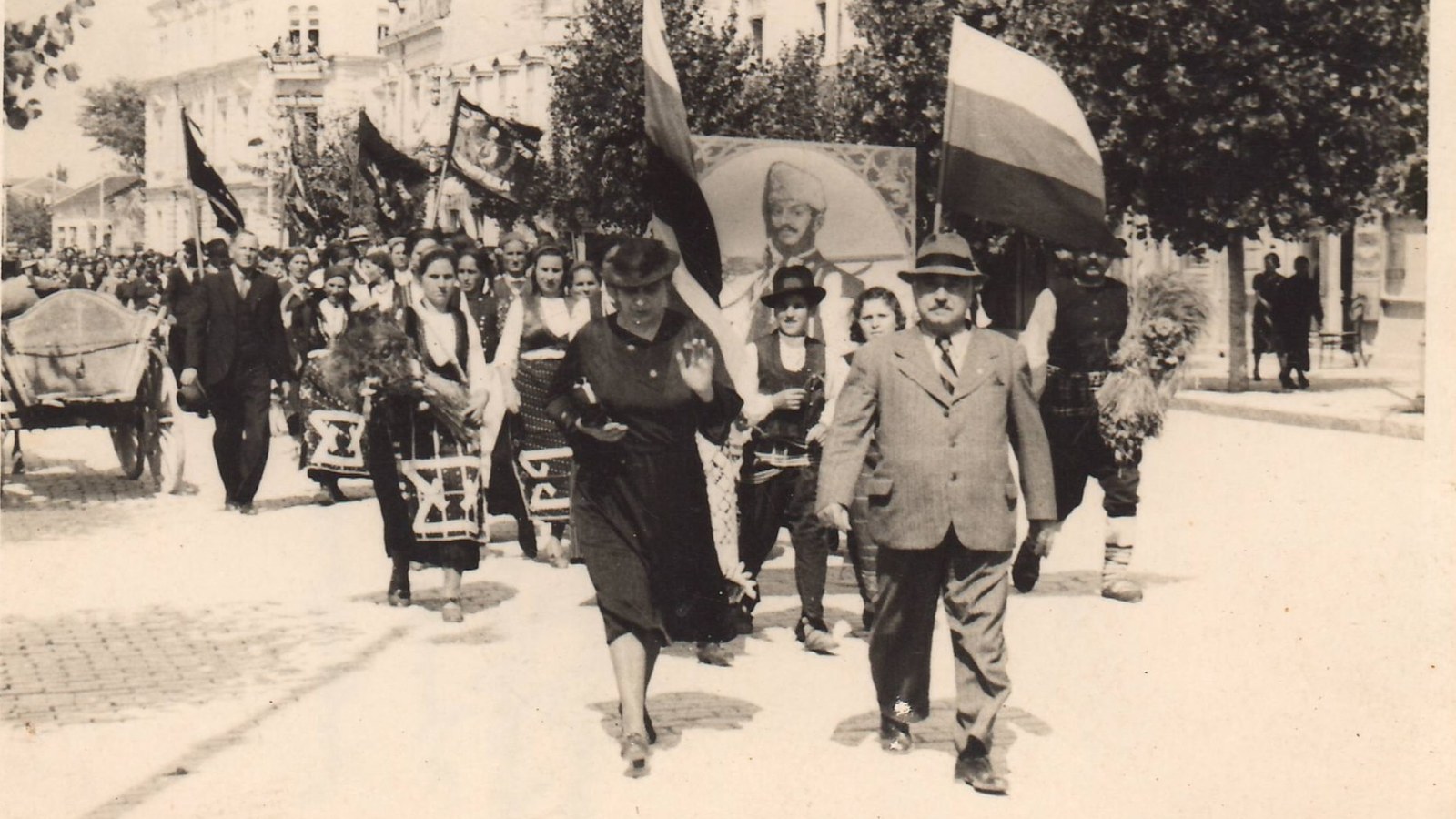
At Craiova, Romania and Bulgaria sign the treaty by which the Cadrilater passes to Sofia. The date of the instrument is 7 September 1940. It is not the Vienna Award of 30 August, which gave Hungary Northern Transylvania, and it is not the Treaty of Bucharest of 10 August 1913, by which Romania had taken Southern Dobruja.
For King Michael I, Alexandru Cretzianu, minister plenipotentiary, and Henri-Georges Meitani, legal counsellor at Foreign Affairs, sign. For Tsar Boris III, Svetoslav Pomenov and Theokhar Papazoff, ad-hoc judge at the Permanent Court of International Justice. Carol II had abdicated the day before. Prime Minister Ion Antonescu ratifies on 13 September; the king does not.
Article 1: between the Danube and the Black Sea, the frontier follows the line in the annexed Protocol. Article 2 declares it definitive and perpetual; each party undertakes never again to formulate a territorial claim against the other. Ratifications are exchanged in Bucharest by 15 September at the latest.
The Protocol: the new line starts from the Danube, immediately downstream of Silistra, and reaches the sea about eight kilometres south of Mangalia. A mixed commission traces it on the ground from the sketches signed at Mangalia on 5 September 1902. Evacuation, in four zones, runs from 20 September to 1 October: the Romanian army leaves, then the Bulgarian army enters, a day apart.
Article 3: within three months of ratification, a compulsory exchange between Romanian subjects of Bulgarian ethnic origin in the counties of Tulcea and Constanța and Romanian subjects of Romanian ethnic origin in Durostor and Caliacra. In the rest of the two countries, emigration remains optional for one year. Abandoned rural property passes to the state of departure; urban property remains with the owners.
Annex D: Bulgaria pays Romania one billion lei, a lump sum, in two equal instalments, on 15 January 1941 and 15 January 1942. With the sum, Bucharest waives claims from post-1913 investment; Sofia, those from the Treaty of Bucharest. The mixed commission of application sits at Giurgiu.
Later counts put some 103,711 Romanians, Aromanians and Megleno-Romanians moved north and 62,278 Bulgarians moved south. The Allies did not annul the instrument after the war: the Cadrilater remained Bulgarian, unlike Northern Transylvania.
It is not Vienna and it is not Bucharest 1913. The signatures at Craiova are Cretzianu’s and Pomenov’s, on a text that says, in so many words, that the frontier is perpetual.
Image: procession on the return of Southern Dobruja, 8 September 1940; unknown photographer; public domain, Wikimedia Commons. Cropped to 16:9.
Source consulted: Treaty of Craiova. Treaty text: Treaty of 7 September 1940 between Romania and Bulgaria (Official Gazette no. 212).











0 Comments
No comments on this article yet. Be the first!