


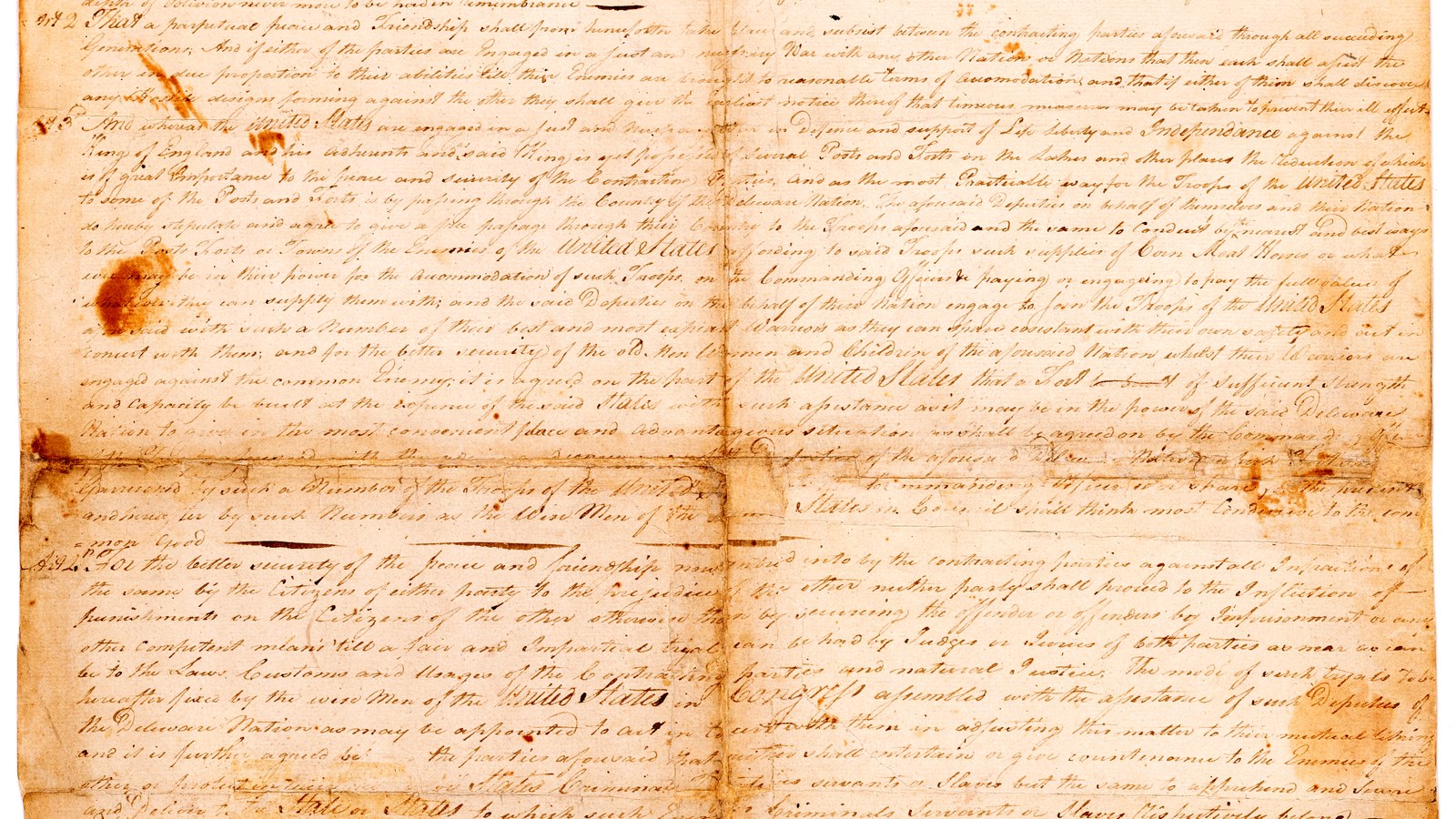
On 17 September 1778, at Fort Pitt, Andrew Lewis and Thomas Lewis, commissioners for the United States of North-America, concluded with White Eyes, John Kill Buck Junior and Captain Pipe, deputies of the Delaware Nation (Lenape), the Articles of agreement and confederation. It is the first formal treaty between the United States and any Native people. Witnesses included Brigadier General Lachlan McIntosh, Colonel Daniel Brodhead and Colonel William Crawford.
Article I buries prior hostilities. Article II proclaims perpetual peace and friendship; if either party is in a just and necessary war, the other shall assist in due proportion to its abilities, until a reasonable accommodation, and each shall give earliest notice of hostile designs.
Article III starts from the United States’ war against the King of England and from British posts on the lakes. The Delaware grant free passage, guides by the nearest ways, corn, meat and horses at full value, and warriors “consistent with their own safety.” The United States undertake, at their own expense, to build a fort for the old men, women and children, on a site agreed with the deputies, garrisoned by American troops.
Article IV forbids unilateral punishment: the offender is held until a trial by judges or juries of both parties, as near as may be to the laws and customs of the contracting parties; Congress, with Delaware deputies, is to fix the mode. Neither shall harbour the other’s enemies, fugitives, servants or slaves, but shall deliver them up. Article V ties the nation, for clothing, utensils and implements of war, to a regulated trade through an agent with an adequate salary, on such principles as Congress shall adopt.
Article VI guarantees the Delaware, and their heirs, all territorial rights “as it hath been bounded by former treaties,” so long as they hold fast the chain of friendship. If both parties later find it conducive, other tribes friendly to the United States may be invited to join the confederation and form a state headed by the Delaware Nation, with a representation in Congress; nothing in that clause is conclusive until it meets the approbation of Congress. The text does not create an Indian state and does not name Detroit.
This is not Penn’s treaty at Shackamaxon in 1682, not Fort Stanwix of 1784, not Greenville of 1795. White Eyes died in November; the Delaware delegation to Philadelphia in 1779 did not change the application. The Gnadenhütten massacre of 1782 is later. The 2013 Sacagawea dollar is a commemorative coin, not the instrument.
Scan of the ratified treaty, held by the U.S. National Archives. Image: Wikimedia Commons, public domain.
For context: Treaty of Fort Pitt. The official text: Treaty With the Delawares: 1778.











0 Comments
No comments on this article yet. Be the first!