


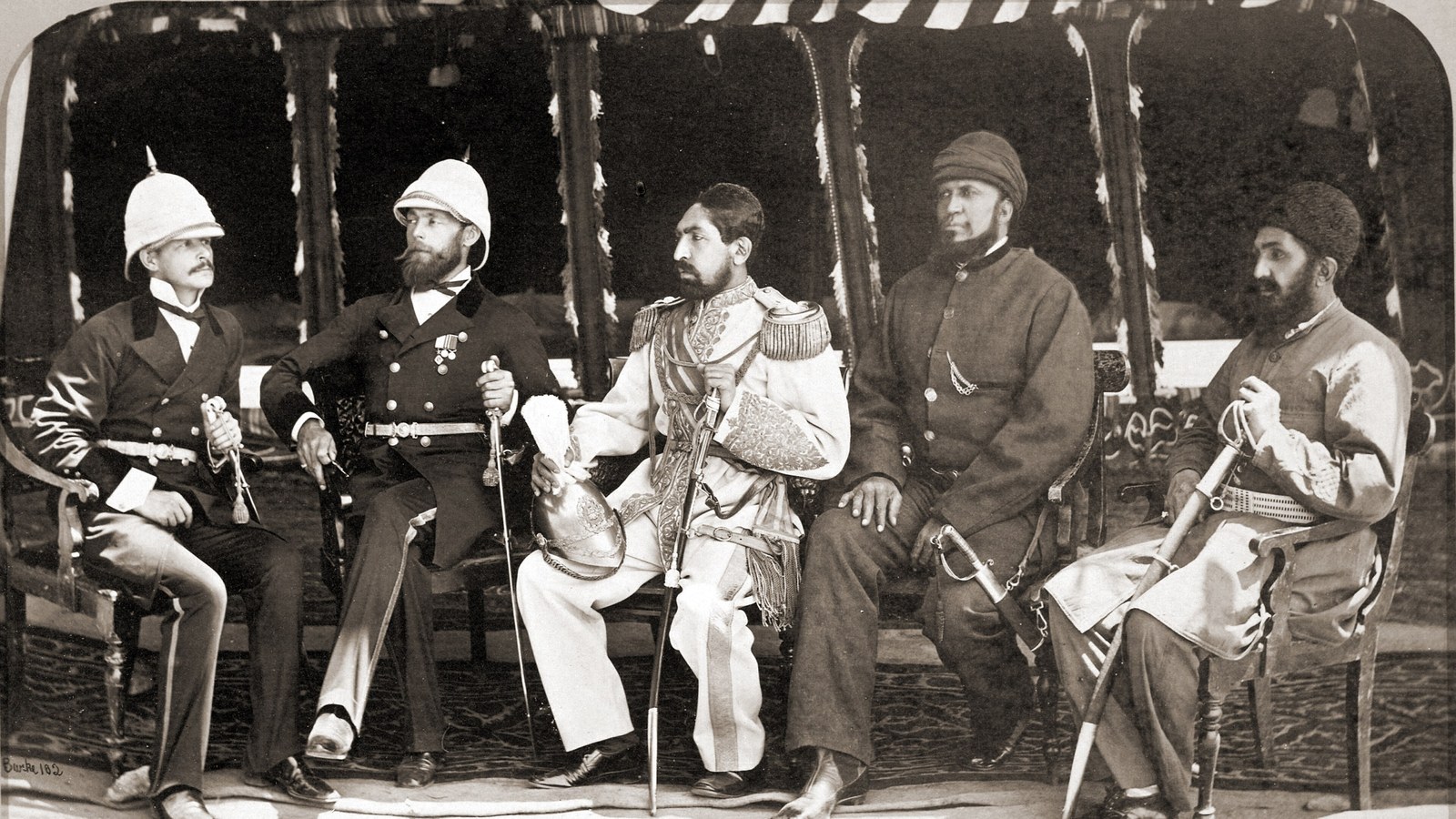
At Gandamak, on 26 May 1879 (4 Jumada II 1296), Emir Mohammad Yaqub Khan, on his own part, and Major Pierre Louis Napoleon Cavagnari, political officer on special duty, in virtue of full powers from Viceroy Edward Robert Lytton, signed the treaty of peace between the British Government and the Amir of Afghanistan and its dependencies. The instrument has ten articles. Lytton ratified it on 30 May.
The treaty is not the First Anglo-Afghan War of 1839–1842, nor the declaration of war of 21 November 1878 after the British mission was stopped at Ali Masjid, nor Sher Ali Khan’s death near Balkh on 21 February 1879, nor the massacre of Cavagnari’s mission in Kabul on 3 September 1879, nor the Durand Line of 1893.
Article 1 proclaims, from the day of the exchange of ratifications, perpetual peace and friendship between the British Government and the Amir and his successors. Article 2: the Amir publishes a full amnesty for all subjects who had intercourse with the British forces during the war. Article 3: relations with foreign states are conducted according to the advice and wishes of the British Government; the Amir enters into no engagements and takes up no arms against a foreign state except with British concurrence. In return the British support him against any foreign aggression with money, arms or troops, as they think best; British troops, if they enter, return to British territory as soon as the object is accomplished.
Article 4 places a British Representative at Kabul, with a suitable escort, and allows British Agents on the Afghan frontiers whenever the British Government thinks it necessary; the Amir may depute an Agent to the Viceroy’s court. Article 5 guarantees the personal safety and honourable treatment of British Agents; they, for their part, never interfere in the internal administration. Article 6 offers no impediment to British subjects trading peacefully, with the permission of the British Government.
Article 7 requires open roads for caravans and a separate Commercial Treaty within one year. Article 8: the British construct, at their cost, a telegraph from Kurram to Kabul; the Amir protects the line. Article 9 restores Kandahar and Jalalabad, with all territory then in British hands, except the districts of Kurram, Pishin and Sibi, which remain under British protection and administrative control as assigned districts, not permanently severed from the kingdom; the revenues, after civil charges, are paid to the Amir. Control of the Khyber and Michni Passes, and of relations with the tribes there, stays British.
Article 10 grants the Amir and his successors an annual subsidy of six lakhs of rupees, for the support of his legitimate authority and for the fulfilment of the whole engagement. Cavagnari’s mission reached Kabul on 24 July; on 3 September a regiment from Herat stormed the compound. Yaqub was removed. The Treaty of Gandamak is not that second phase of the war.
In 1880 the British appointed as Amir Abdur Rahman Khan, Yaqub’s cousin. He accepted the Gandamak provisions on condition that London abandon a British resident in Kabul. The May instrument remains the text by which the Amir ceded the conduct of foreign affairs and control of the frontier passes.
Image: Group. The Amir Yakub Khan, General Daod Shah, Habeebula Moustafi, with Major Cavagnari and Mr Jenkyns, Gandamak, 1879; John Burke, public domain, British Library / Wikimedia Commons. Cropped to 16:9.
Source consulted: Treaty of Gandamak. Treaty text: Wikisource: Treaty of Gandamak, 26 May 1879.











0 Comments
No comments on this article yet. Be the first!