


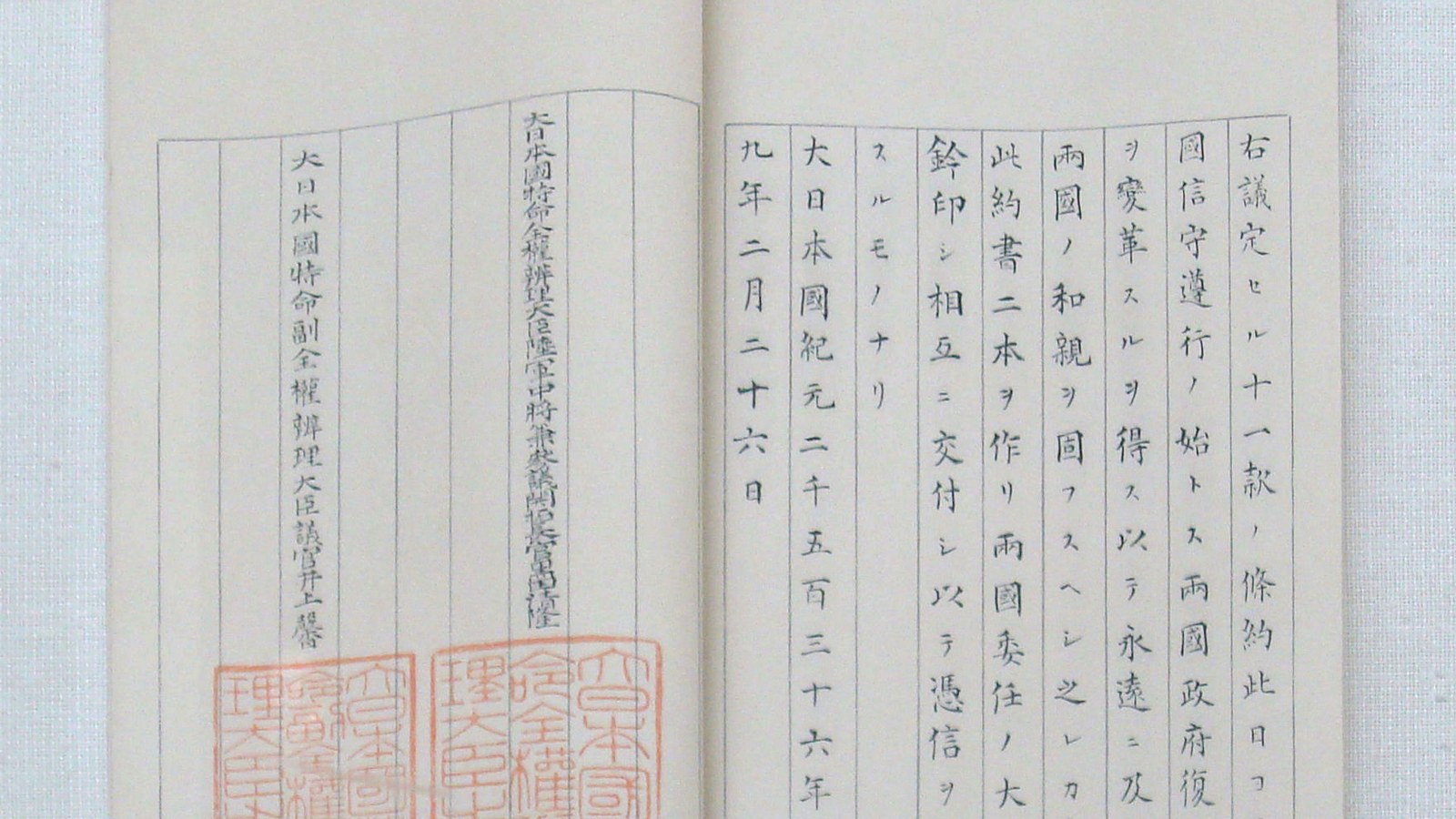
On 26 February 1876, at Ganghwa (Kokwa), the Empire of Japan and the Kingdom of Joseon sign the Treaty of Peace and Friendship, in Japanese and Chinese. Japanese plenipotentiaries: Kuroda Kiyotaka, High Commissioner Extraordinary, lieutenant-general, member of the Privy Council, Minister of the Colonization Department, and Inoue Kaoru, Associate High Commissioner Extraordinary, member of the Genroin. For Joseon: Shin Heon (Shin Ken) and Yun Ja-seung (In-Ji-Sho). Ninth year of Meiji, second month, twenty-sixth day; in the Joseon era, the second day of the second moon of the year Heishi, the four hundred and eighty-fifth year of the founding. Ratified and promulgated 22 March 1876.
Preamble: the two governments desire to resume the amicable relations that of yore existed between them. Article 1: Chosen being an independent state enjoys the same sovereign rights as does Japan. Intercourse shall henceforward be carried on in terms of equality and courtesy, each avoiding offence by arrogance or suspicion. Rules and precedents that obstruct friendly intercourse are totally abrogated; in their stead, liberal rules in general usage, fit to secure a firm and perpetual peace.
Article 2: Japan, at any time after fifteen months from signature, may send an envoy to the capital of Chosen, admitted to confer with the Rei-So-Han-Sho on diplomatic matters; he may reside there or return on completion of his mission. Chosen, in like manner, may send an envoy to Tokyo, admitted to confer with the Minister for Foreign Affairs. Article 3: official communications from Japan are written in Japanese and, for ten years, accompanied by a Chinese translation. The Government of Chosen will use the Chinese language.
Article 4: Sorio in Fusan (Busan), where a Japanese official establishment already stands, remains open for trade; all former usages are abolished, including Sai-ken-sen, the junks annually sent by the late Prince of Tsushima. In addition, Chosen agrees to open two ports, as in Article 5. In those places Japanese subjects may lease land, erect buildings and rent buildings belonging to subjects of Chosen. Article 5: on the coast of five provinces — Keikin, Chiusei, Zenra, Keisho and Kankio — two ports suitable for commerce shall be selected; they open in the twentieth month from the second month of the ninth year of Meiji.
Article 6: Japanese vessels, by stress of weather or want of fuel and provisions, may enter any port in Chosen for refuge, wood, coal or repairs; the expenses fall on the ship’s master. If a vessel of either country is wrecked, the people of the vicinity rescue the crew and inform the local authorities. Article 7: the coast of Chosen having been left unsurveyed, any Japanese mariner may freely survey it, to prepare charts of islands, rocks, reefs and depths. Article 8: Japan may appoint an officer at each open port for the protection of Japanese merchants; questions interesting both nations, settled with the local authorities of Chosen.
Article 9: subjects of both parties may freely carry on business without interference from either government; neither restriction nor prohibition shall be made on trade. Fraud or refusal of payment is pursued by the authorities; neither government is responsible for such debt. Article 10: a Japanese subject at an open port who offends against a subject of Chosen is tried by the Japanese authorities; a subject of Chosen who offends against a Japanese subject is tried by the authorities of Chosen. Offenders are punished according to the laws of their respective countries.
Article 11: trade regulations and detailed provisions shall be agreed at the capital of Chosen or at Kokwa Fu within six months, by special commissioners. Article 12: the foregoing eleven articles are binding from the date of signing and shall be observed faithfully. The treaty is executed in duplicate. Signed: Kuroda Kiyotaka, Inoue Kaoru, Shin Ken, In-Ji-Sho. The Un'yō incident of 20 September 1875 at Ganghwa precedes the treaty; the text does not name it. Incheon and Wonsan are not named here.
Image: World Imaging, the treaty copy at the Japan Diplomatic Archives, 2009, CC BY-SA 3.0, Wikimedia Commons. Cropped to 16:9. A photograph of the document on display, not the signing.
Source consulted: Japan–Korea Treaty of 1876. Treaty text: Treaty of Peace and Friendship, Kokwa, 26 February 1876 (Kyujoyakuisan).











0 Comments
No comments on this article yet. Be the first!