


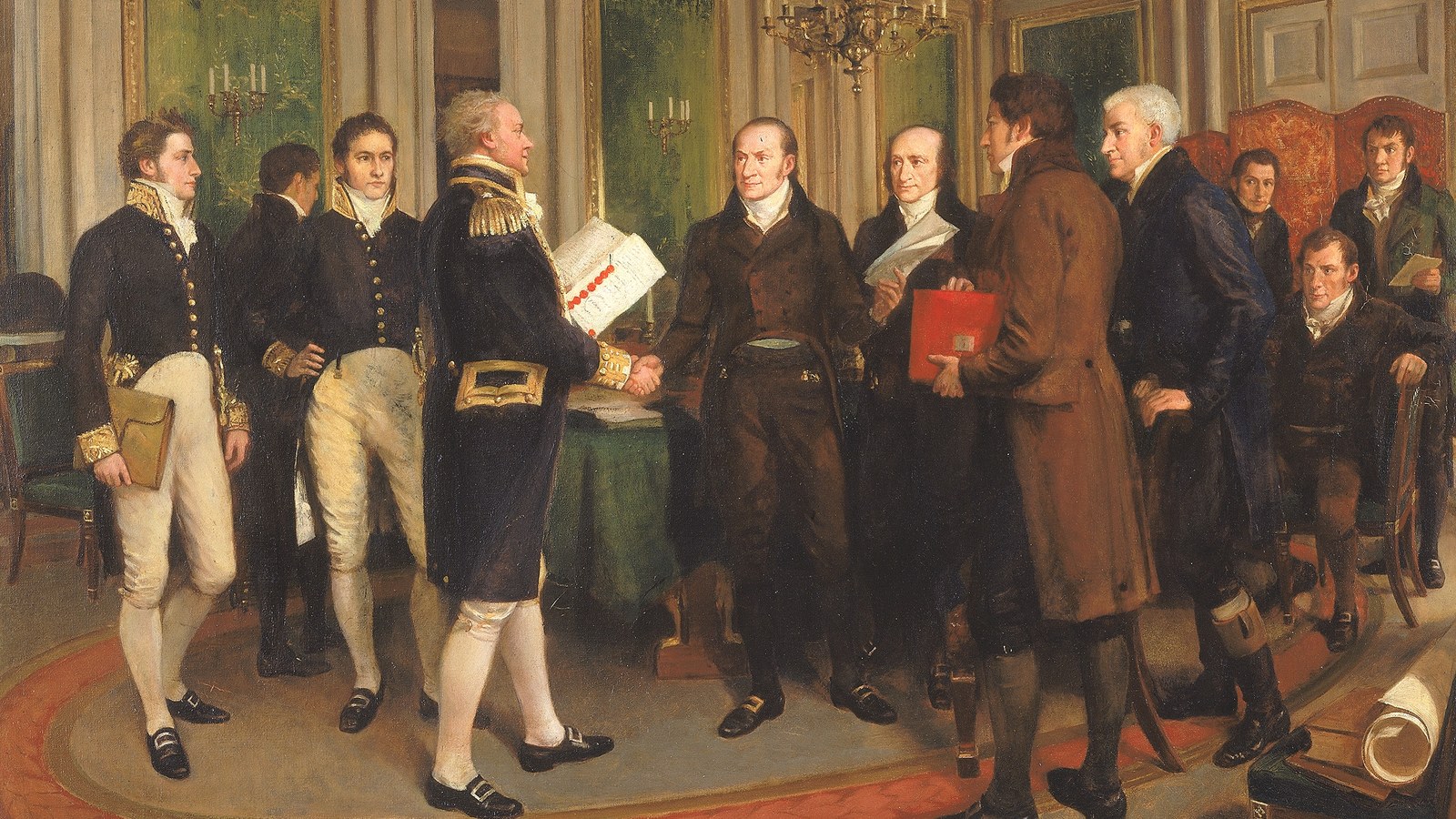
On 24 December 1814, in Ghent, in the Sovereign Principality of the United Netherlands, British and American plenipotentiaries signed the Treaty of Ghent. The act ended the War of 1812. It did not stop the fighting that day: ratifications were exchanged in Washington only in February 1815.
The United States sent John Quincy Adams, Henry Clay, James A. Bayard, Jonathan Russell and Albert Gallatin. Britain sent Admiral Lord Gambier, Henry Goulburn and the civilian lawyer William Adams. They signed in the mirror room of the former Carthusian monastery in Ghent, where the British delegates were lodging.
The text kept by the Avalon Project, a “Treaty of Peace and Amity,” opens with a “firm and universal Peace” and with hostilities ending only after ratification. Territory taken in the war was to be restored, with the exceptions set out. Prisoners, on land and at sea, were to be released.
The borders returned, in principle, to the line of June 1812. Joint commissions were to settle the islands in Passamaquoddy Bay and the line from the St. Croix to the Great Lakes. Impressment of sailors, the immediate cause of the war, does not appear in the articles.
Article IX required both parties to end hostilities with Indigenous nations and to restore the possessions, rights and privileges of 1811. Article X bound London and Washington to continue efforts to abolish the Atlantic slave trade.
News crossed the Atlantic slowly. On 8 January 1815 Andrew Jackson’s troops won the Battle of New Orleans, after the signing and before the United States had ratified. The Senate approved the treaty unanimously; the ratified copies were exchanged on 17 February 1815.
The war did not move the Canadian border. It left American expansion westward open, after the defeat of Britain’s Indigenous allies, and it left British maritime rights unchanged. The peace that followed 1815 held, with crises, for more than a century.
Image: Amédée Forestier, The Signing of the Treaty of Ghent, Christmas Eve, 1814, Smithsonian American Art Museum, CC0, Wikimedia Commons. A 1914 painting, not a photograph of the signing. Cropped to 16:9.
Source consulted: Treaty of Ghent. Treaty text: Treaty of Ghent; 1814 — The Avalon Project.











0 Comments
No comments on this article yet. Be the first!