


The Third Javanese War of Succession began in a weakened court. After the Chinese rebellion, Pakubuwana II had ceded Java’s north coast and Madura to the Dutch East India Company; before he died in 1749 he surrendered the remainder of the Mataram Sultanate. The company installed Pakubuwana III. The late king’s brother, Prince Mangkubumi, dissatisfied with a lesser place, joined Raden Mas Said, who held Sukowati. Dutch troops did not stop the war.
Nicolaas Hartingh, the company’s governor for North Java, left Semarang on 10 September 1754 and met Mangkubumi on the 22nd. The next day the closed table included Prince Natakusuma, Tumenggung Ronggo, Hendrik Breton, Captain C. Donkel, secretary Willem Fockens and the interpreter Bastani. Hartingh doubted that one empire could have two rulers. Mangkubumi pointed to the sultans of Cirebon. The company asked him not to take the title of Sunan; the prince held to it, because the people had recognised him as Sunan for five years.
The 23 September 1754 memorandum cut the knot: Mangkubumi would take the title of sultan and half the realm. The north coast stayed with the company; half the compensation and half the palace heirlooms would go to the new sultan. On 4 November Pakubuwana III wrote to Governor-General Jacob Mossel that he accepted the bargain.
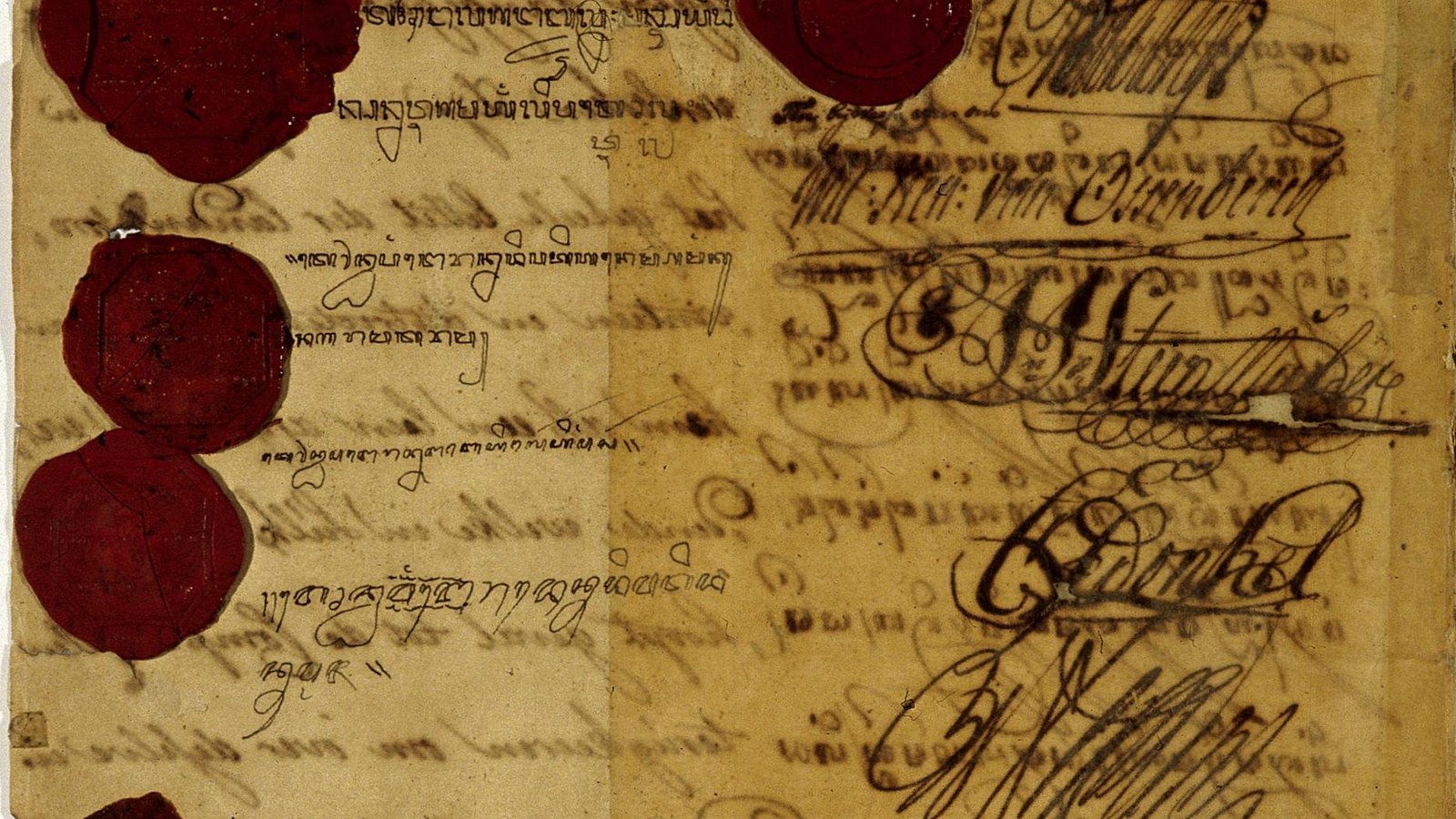
The treaty was signed on 13 February 1755, in the hamlet of Giyanti — now Dusun Kerten, Jantiharjo, southeast of Karanganyar in Central Java — in Javanese and Dutch. For the company the signatories were N. Hartingh, W. van Ossenberch, J.J. Steenmulder, C. Donkel and W. Fockens. The eastern half, with its capital at Surakarta, remained with Pakubuwana III. The western half, with its capital at Yogyakarta, went to Mangkubumi, who became Sultan Hamengkubuwono I, Senapati Ingalaga Abdurrahman Sayyidin Panatagama Khalifatullah, with heir adipati Anom Bendoro Raden Mas Sundoro.
The articles bind the sultan to the company: cooperation between their peoples, an oath by the dalem and the regents before they take office, appointments and dismissals only with Dutch consent. The sultan will not claim Madura or the coast ceded on 18 May 1746; he receives an annual compensation of ten thousand. He promises aid to Pakubuwana III, the sale of produce at fixed prices, and observance of the treaties of 1705, 1733, 1743, 1746 and 1749.
The new sultan set his court at Yogyakarta, near Kotagede, where the tomb of Senopati, founder of Mataram, stands. The peace did not end the fighting: Raden Mas Said, called Sambernyawa, fought until 1757, when he received a share of eastern Mataram and the title Mangkunegara I. The Library of Congress country study calls Giyanti the end of the succession war and the start of the split into Surakarta and Yogyakarta, with Mangkunegaran carved from Solo’s territory two years later.
The division was recorded in Javanese chronicles, the Babad Giyanti or Babad Mangkubumen; the best-known Babad Giyanti is attributed, in the early nineteenth century, to Yasadipura the Elder of Surakarta. The sealed manuscript, held at the National Library of Indonesia, shows the stamped text of the accord, not a modern map of Java.
Sources: Treaty of Giyanti; Library of Congress Country Study, The Dutch on Java, 1619-1755.











0 Comments
No comments on this article yet. Be the first!