


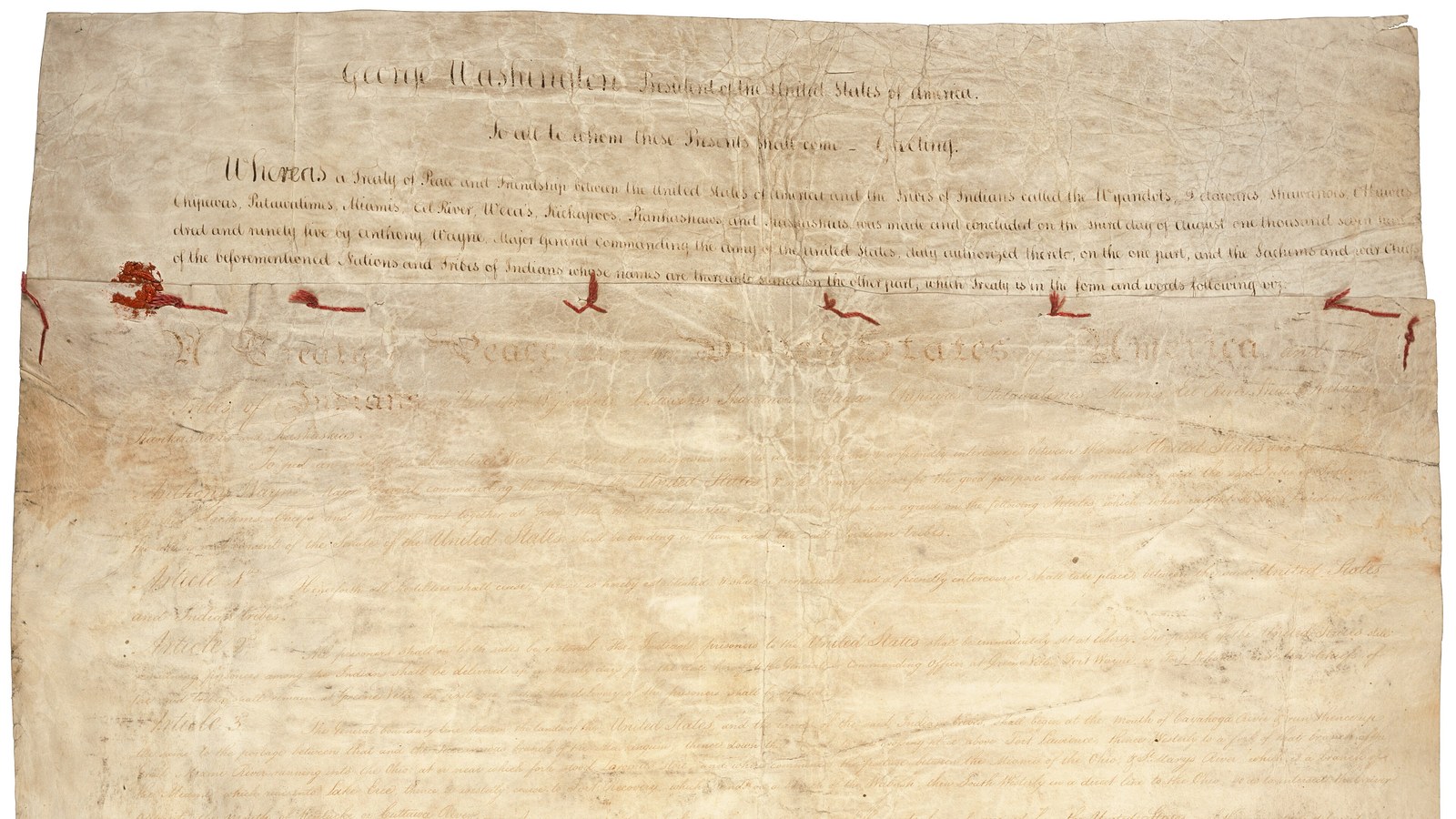
On 3 August 1795, at Greenville, headquarters of the army in the territory of the United States northwest of the Ohio, Major General Anthony Wayne, sole commissioner, signed a treaty of peace with the Wyandots, Delawares, Shawanees, Ottawas, Chippewas, Pattawatimas, Miamis, Eel Rivers, Weas, Kickapoos, Piankeshaws and Kaskaskias.
Among the chiefs who set their marks were Tarhe (the Crane) and Leather Lips for the Wyandots, Bukongehelas for the Delawares, Blue Jacket and Black Hoof for the Shawanees, Little Turtle (Meshekunnoghquoh) and Le Gris for the Miamis. Among the witnesses were William Henry Harrison, aide-de-camp to Wayne, Caleb Swan and William Wells.
Article I: all hostilities shall cease; peace is perpetual. Article II: prisoners on both sides; ten chiefs remain hostages at Greenville until American prisoners are delivered, within ninety days, at Greenville, Fort Wayne or Fort Defiance.
Article III traces the line from the mouth of the Cuyahoga, through the portage with the Tuscarawas, the crossing above Fort Lawrence, Loromie’s store, Fort Recovery, then south-westerly to the Ohio opposite the mouth of the Kentucky. The tribes cede claims east and south of the line, plus parcels at Fort Wayne, Detroit, Michilimackinac and six miles square at the mouth of the Chicago River.
Article IV: the United States relinquish other Indian lands north of the Ohio and east of the Mississippi, excepting Clark’s grant, the post of Vincennes, the French settlements and Fort Massac. At the signing, goods to the value of 20,000 dollars are delivered; thereafter, every year, goods of 9,500 dollars, reckoned at first cost.
Article V: the tribes quietly enjoy the remaining lands; sale, if they so dispose, only to the United States; they acknowledge the protection of the United States and no other power. Article VII leaves them free to hunt on the ceded lands so long as they demean themselves peaceably.
Article X: all other treaties between the United States and these tribes since 1783 that come within the purview of this treaty cease. The text binds when ratified by the President, with the advice and consent of the Senate. The Senate ratified on 22 December 1795.
This is distinct from the Battle of Fallen Timbers in August 1794, from the treaties of Fort McIntosh (1785) and Fort Harmar (1789), and from the second Treaty of Greenville of 1814. It is not Tippecanoe.
Image: first page of the Treaty of Greenville, 3 August 1795; public domain, National Archives / Wikimedia Commons. Cropped to 16:9.
Source consulted: Treaty of Greenville. Treaty text: A treaty of peace, Greenville, 3 August 1795.











0 Comments
No comments on this article yet. Be the first!